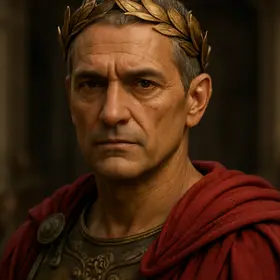
Julius Caesar in Julius Caesar
Protagonist
Rome’s celebrated general and ruler, proud, publicly adored, whose elevation provokes conspiracy and ends in assassination.
Who is Julius Caesar?
Julius Caesar appears as Rome’s most celebrated general returning in triumph, commanding public adoration and effortless authority. He expects obedience and treats omens and private warnings with calm certainty or dismissal. When his wife Calpurnia begs him to stay home after terrifying portents, he first yields to her fear but is persuaded by Decius Brutus’s flattering reinterpretation of the dream and by concern for public honor, and so goes to the Senate. There, despite an intercepted warning from Artemidorus and a final reminder from the Soothsayer, he is surrounded by fellow senators and stabbed by conspirators led by Cassius and Brutus; his last words mark personal betrayal. His assassination immediately unleashes political chaos: Antony mourns him publicly, predicts civil strife, and moves to bring Octavius to Rome, while the conspirators try to justify their act. Caesar’s death becomes the catalyst for the power struggles and civil war that follow, shifting Rome from one strong ruler to open conflict among rivals.
In the book: We first meet Julius Caesar as Rome’s most celebrated general, fresh from victory and adored by the crowds as he moves through the city with effortless authority. He speaks with calm certainty, expects obedience, and his growing prestige makes some powerful men around him quietly uneasy.
Personality
- Commanding
- He moves through the city in a public procession with Antony and others, inspiring crowd adoration and expecting obedience.
- Proud
- He dismisses the Soothsayer’s warning and Blames any fainting or odd behavior on infirmity rather than weakness.
- Dismissive of omens
- He initially treats Calpurnia’s terrifying dream and the Soothsayer’s warning as the talk of dreamers and signs not to be feared.
- Susceptible to flattery
- Decius Brutus reinterprets Calpurnia’s dream to flatter and shame him into attending the Senate and accepting honors.
Character arc
Caesar opens as Rome’s dominant, publicly adored leader: confident, accustomed to honors, and quick to assert that destiny and public standing outweigh private fear. When Calpurnia’s dream and other portents alarm those close to him, he briefly yields to domestic pressure and plans to remain home, showing a momentary willingness to defer to loved ones and religious rites. This hesitation is reversed when Decius Brutus flatters and reframes the omens as signs of glory for Rome; Caesar, ashamed at the thought of being thought cowardly and concerned about the Senate’s honors, changes his mind and goes to the Capitol. That decision leads directly to his assassination: he ignores Artemidorus’s warning and the Soothsayer’s cry, is surrounded by conspirators, and is stabbed to death—his arc ending not with triumph but with betrayal and mortality. Though he does not live to see the consequences, his death propels Rome into civil conflict and reshapes the political landscape he once dominated.
Relationships
- Mark Antony Close ally and attendant; Antony accompanies Caesar in public and mourns him passionately after his assassination, promising to fetch Octavius.
- Calpurnia His wife, who pleads with him to heed terrifying dreams and stay home from the Senate to avoid danger.
- Brutus A respected friend and senator whose final stab marks personal betrayal and whose participation in the conspiracy brings Caesar’s death.
- Cassius A conspirator who resents Caesar’s rise and helps to organize the plot that leads to Caesar’s assassination.
- Decius Brutus A senator who flatters and persuades Caesar to dismiss Calpurnia’s fears and to go to the Senate, sealing his fate.
- Artemidorus Would-be warn-er who tries to hand Caesar a written warning about the conspiracy, but Caesar brushes him aside.
Quotes by Julius Caesar
“The things that threaten’d me Ne’er look’d but on my back; when they shall see The face of Caesar, they are vanished.”
Act 2, Scene 2Caesar asserts his belief that danger retreats when faced directly, using pride to reject Calpurnia’s warnings.
“Cowards die many times before their deaths; The valiant never taste of death but once.”
Act 2, Scene 2Caesar explains his philosophy on fear and death, arguing that cowardice brings repeated defeat and so refuses to stay home.
Why Julius Caesar matters
Caesar personifies the play’s central tensions: the lure and danger of concentrated power, the clash between public image and private vulnerability, and the fraught relationship between fate and choice. His refusal to take or his inability to act on warnings highlights human overconfidence and the limits of control; his assassination raises questions about legitimacy, liberty, and the morality of political violence. The murder that ends his life sparks the cycle of revenge and civil war that explores how individual ambition and collective action reshape Rome’s fate.
Chapters with Julius Caesar
More Julius Caesar characters
 BrutusProtagonist
 CassiusAntagonist
 Mark AntonyAntagonist
 CascaMajor character
 LuciliusMajor character
 TitiniusMajor character
 Decius BrutusMajor character
 Octavius CaesarMajor character
All chapter summaries ›Characters ›
Read Julius Caesar illustrated
Every scene in these notes comes from the Book2Life reader, where the full public-domain text is illustrated as you read, with character portraits and narration. Free in your browser, on iPhone and on Android.