Alice's Adventures in Wonderland Chapter 10 Summary
The Lobster Quadrille
The Mock Turtle and the Gryphon describe and perform the Lobster Quadrille, sing nonsense songs, then rush off to a trial.

Summary
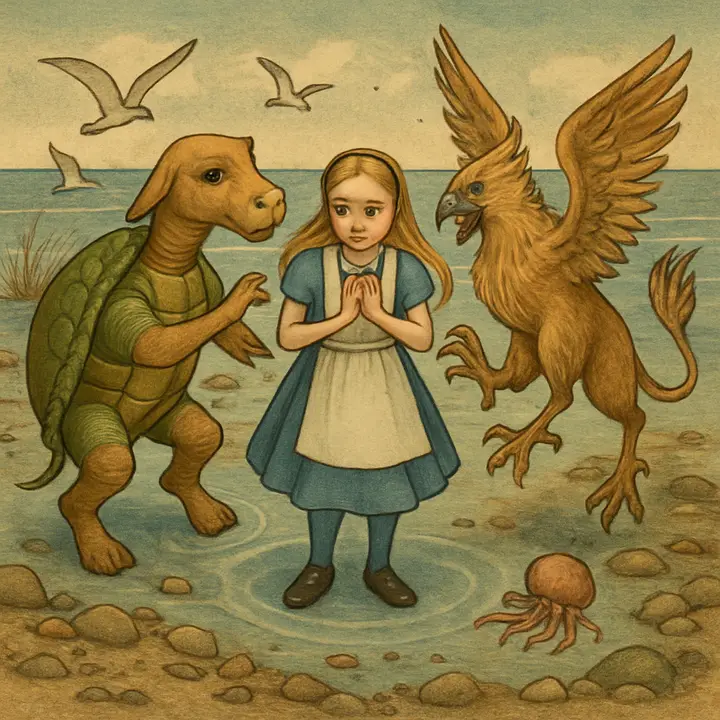
Alice listens as the Mock Turtle, overcome with emotion, tries to describe the Lobster Quadrille to her while the Gryphon punctuates the story with energetic interjections and demonstrations. The Mock Turtle explains the fanciful steps—lining up along the sea-shore, partnering with lobsters, clearing jellyfish, throwing lobsters out to sea and swimming after them—and both creatures act out parts of the dance, occasionally treading on Alice’s toes. They sing a long whimsical dance-song about a whiting and a snail, full of puns and absurd “reasons” for fishy behavior.
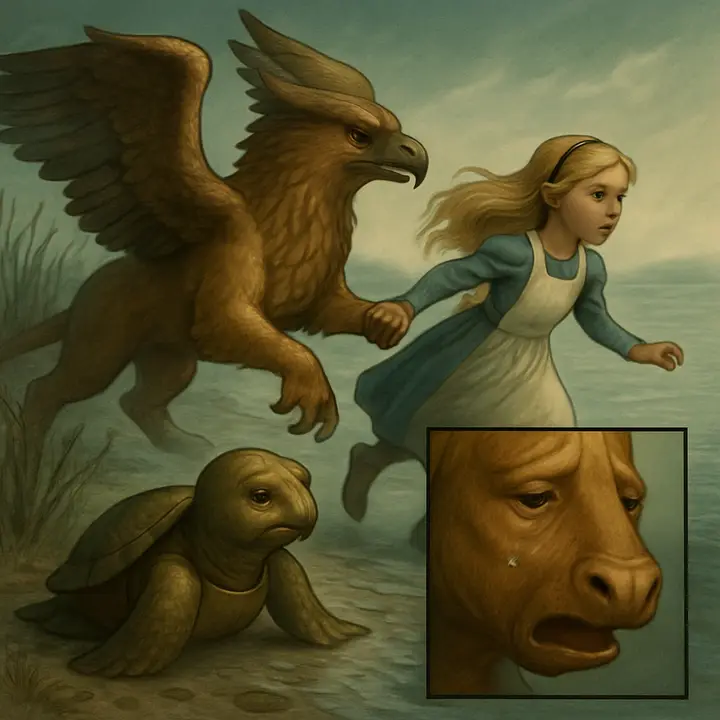
Conversation drifts into more nonsense: the Gryphon and Mock Turtle offer mock-etymologies (a whiting “does the boots and shoes”), trade puns about porpoises/purposes, and ask Alice to tell her recent adventures. Alice reluctantly recites poetic fragments she remembers, which come out mangled and humorous; the Mock Turtle and Gryphon critique and demand explanations. The Mock Turtle then sings “Beautiful Soup,” a sentimental, extravagant ode to soup. Their performance is abruptly cut short when the Gryphon hears that the trial is beginning; it seizes Alice’s hand and hurries away, leaving the Mock Turtle’s song trailing on the breeze.
Key events
- Mock Turtle, sobbing, describes the Lobster Quadrille while Gryphon demonstrates
- They act out the dance around Alice and sing the Lobster Quadrille song
- Mock Turtle and Gryphon exchange absurd explanations and puns about sea creatures
- Alice recounts her recent adventures and recites altered verses
- Mock Turtle sings the song 'Beautiful Soup'
- Gryphon hears that the trial is beginning and rushes off with Alice
Chapter 10 in pictures
Analysis
This chapter deepens the novel’s commitment to verbal play, parody, and the inversion of sensible discourse. The Lobster Quadrille materializes Carroll’s pattern of combining childlike performance with grown-up parody: a formal dance described in ludicrous, aquatic terms, performed by two quasi-mythical creatures who both instruct and bewilder Alice. The chapter foregrounds language games—punning (porpoise/purpose), mock-etymology, and transformed nursery verses—which unsettle the boundary between sense and nonsense and test Alice’s adaptive, literal-minded intelligence.
Structurally, the chapter functions as a comic digression that both entertains and characterizes the Mock Turtle and the Gryphon: the Mock Turtle is plaintive, nostalgic and sentimental (his frequent sighs, tears, and the “Beautiful Soup” song), while the Gryphon is brisk, bossy, and impatient. Alice’s role is largely receptive; she watches, asks questions, and performs memory exercises under pressure, underscoring her schooling motif—she is repeatedly placed in a didactic setting where lessons are arbitrary. The Lobster Quadrille and the songs also foreshadow the courtroom chaos to come by emphasizing ritual without reason and authority without coherence. Imagery of sea, dance, and food threads playfully with Victorian social rituals (dancing, meals, schooling), turning them into absurd spectacles that challenge adult rationales through childlike literalness and nonsense rhetoric.
Important quotes
““You may not have lived much under the sea—” (“I haven’t,” said Alice)—“and perhaps you were never even introduced to a lobster—””
Mock TurtleOpening line of the Mock Turtle's description of the Lobster Quadrille, establishing the fanciful lesson and Alice's tentative participation.
““Beautiful Soup, so rich and green, Waiting in a hot tureen! Who for such dainties would not stoop? Soup of the evening, beautiful Soup!””
Mock TurtleThe Mock Turtle's sentimental song that parodies grand melodrama and highlights his melancholy, theatrical character.
““Come on!” cried the Gryphon, and, taking Alice by the hand, it hurried off, without waiting for the end of the song.”
NarratorAbrupt transition: the Gryphon interrupts and rushes Alice away to the trial, ending the chapter in motion and suspense.
Characters in Chapter 10
All chapter summaries ›Characters ›
Read Alice's Adventures in Wonderland illustrated
Every scene in these notes comes from the Book2Life reader, where the full public-domain text is illustrated as you read, with character portraits and narration. Free in your browser and on iPhone.
Read Alice's Adventures in Wonderland free
