
The King in Grimms' Fairy Tales
Major character
An archetypal sovereign who issues decrees, sets tests or rewards, and whose commands propel quests and moral reckonings.
Who is The King?
Across the tales in which he appears, the King functions as the story’s legal and moral anchor: he issues proclamations (prizes, marriages, punishments), demands impossible tasks, and stands as the figure whose favor or displeasure shapes heroes’ fates. He wants stability, heirs, treasure, or justice—often expressed through public contests (finding the dancers’ secret, fitting a slipper, producing gold) or by ordering protection for family (destroying spindles, safeguarding a princess). He enforces bargains (threatening death for failure in the Twelve Dancing Princesses; ordering the miller’s daughter to spin) and can be greedy or credulous (seizing spun gold, trusting boastful sons). He also acts as a father whose illness or dying wish launches quests (searching for the Water of Life) and as a judge whose rewards restore social order (marriage, land, title). While he rarely undertakes the adventure himself, his edicts create the narrative stakes and test characters’ virtue, cunning, or loyalty; his decisions resolve plots by granting marriage, revealing truth, or meting out punishment.
In the book: “The King” is an archetypal sovereign who sets laws, offers decrees or rewards, and often serves as the catalyst for the hero’s or heroine’s journey. He may be a protective father, a stern judge, or a ruler in need of help, and his promises, tests, or mistakes frequently launch the central conflict and guide the moral stakes of the tale—without being the principal protagonist.
Personality
- Authoritative
- He proclaims life-or-death conditions and marriage rewards—e.g., the heirship promise for whoever discovers where the twelve daughters dance.
- Protective
- He orders every spindle in the kingdom destroyed to guard his daughter after the fairy’s curse in Briar Rose.
- Greedy
- He imprisons the miller’s daughter and demands ever more gold after hearing the miller’s boast in Rumpelstiltskin.
- Judicial
- He sets trials and enforces consequences—promising marriage to the man who reveals the dancing princesses’ secret and threatening death for failure.
- Credulous
- He accepts his elder sons’ substituted Water of Life and is healed, initially deceived by their lie in The Water of Life.
Character arc
The King does not follow a single linear personal development; instead, his role shifts to meet each tale’s moral need. Early appearances cast him as an initiator: his garden’s stolen golden apples and his demand for the Golden Bird set a quest in motion. In protective mode he reacts urgently to supernatural threats—ordering spindles destroyed in Briar Rose—yet those measures sometimes prove insufficient. As a contest-giver (Twelve Dancing Princesses, Ashputtel, The Golden Slipper), he functions as arbiter: his decrees create trials that expose truth, reward virtue, or punish deception. At times he is victim of greed or gullibility—demanding impossible wealth or accepting false claims—prompting the younger, cleverer protagonists to vindicate justice. In narratives centered on succession or cure (The Water of Life, The Turnip), his vulnerability (age or sickness) motivates sons’ quests and reveals family loyalties and betrayals. By story end he commonly restores social order—bestowing marriage, titles, or reparations—or is forced to confront the consequences of earlier trust; occasionally he learns and changes (e.g., recognizing the true hero or restoring a humbled princess), but often he primarily remains the institutional force whose judgments produce narrative closure.
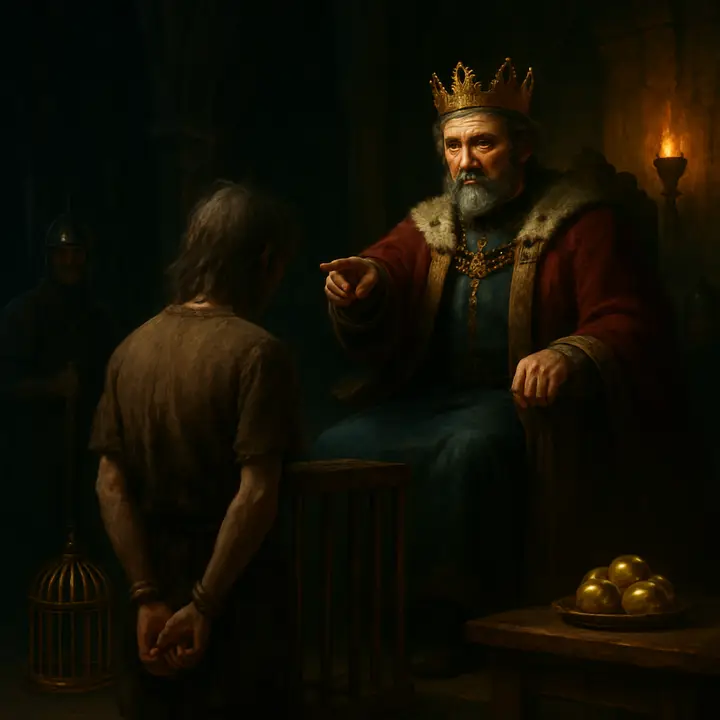
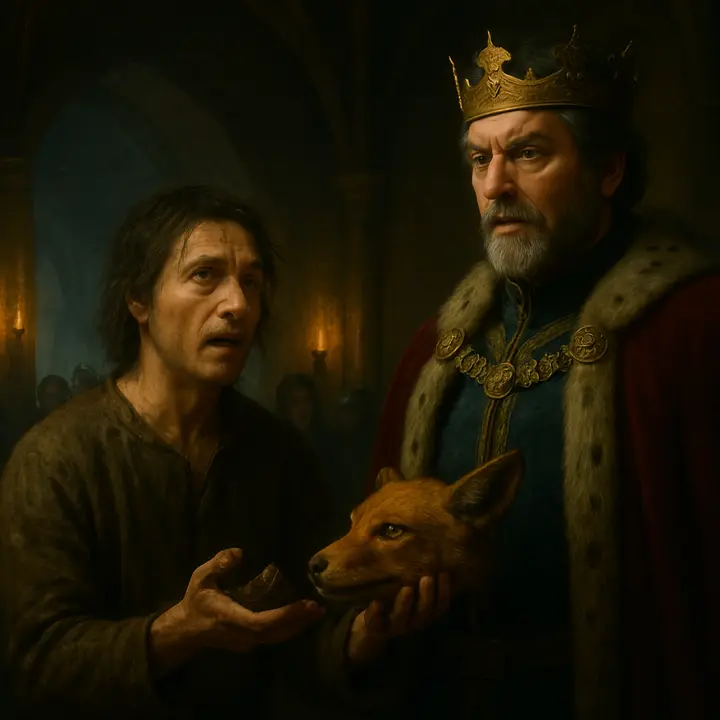
The King in pictures
Relationships
- the princess Often his daughter or the object of his protective decrees; he issues commands to keep her safe or arranges her marriage.
- the king's daughter He is her father and judge in contests (e.g., demanding the truth about the dancing nights and assigning marriage to the victor).
- Rumpelstiltskin As sovereign confronted with the miller’s boast, he pressures the miller’s daughter into impossible service that brings Rumpelstiltskin into the court’s drama.
- The Valiant Little Tailor He tests and exploits the tailor’s reputed prowess by sending him on deadly missions, then honors his success with marriage into the royal family.
- The Fisherman's Wife As a counterpart in stories of desire and reward, he occupies the courtly position whose favors and titles protagonists seek (the Fisherman's Wife aims at similar social climb).
- the queen He shares rulership and paternal concerns with his queen; her presence frames courtly ceremonies and domestic decisions that affect the plots.
Quotes by The King
“One feather is of no use to me, I must have the whole bird.”
THE GOLDEN BIRDThe king refuses to be satisfied with the single golden feather and orders the capture of the entire golden bird, setting the quest in motion.
“Do not shoot me, for I will give you good counsel; I know what your business is, and that you want to find the golden bird.”
THE GOLDEN BIRDThe fox first appears offering guidance; this marks the start of the magical helper relationship that directs the hero’s choices.
“Pray kill me, and cut off my head and my feet.”
THE GOLDEN BIRDThe fox’s shocking final request foreshadows the revelation of his true human identity and closes the story’s supernatural loop.
“‘I know what your wish is, and it shall be fulfilled, in return for your kindness to me—you will soon have a daughter.’”
BRIAR ROSEThe supernatural repayment that initiates the princess’s birth and the tale’s chain of events.
“‘The king’s daughter shall, in her fifteenth year, be wounded by a spindle, and fall down dead.’”
BRIAR ROSEThe curse that provides the central conflict and shapes the royal family's reactions.
“only take care not to drink any of the wine which one of the princesses will bring to you in the evening; and as soon as she leaves you pretend to be fast asleep.”
The Twelve Dancing PrincessesGives the soldier the crucial practical advice that allows him to follow the princesses undetected.
Why The King matters
The King embodies institutional authority and the social stakes against which individual virtues and vices are measured. His proclamations create tests that reveal characters’ truthfulness, courage, or cunning; his fears and desires (for heirs, riches, or order) catalyze quests and expose family dynamics. Thematically, he represents law, reward, and punishment—showing how public power can protect or be misled, how status is granted or reclaimed, and how justice is restored when heroes confront deceit. Through his inconsistent wisdom—sometimes protective, sometimes gullible—the tales probe the limits of authority and insist that moral worth, not rank alone, earns a rightful place in the kingdom.
Chapters with The King
- THE GOLDEN BIRD
- BRIAR ROSE
- The Twelve Dancing Princesses
- The Willow-Wren and the Bear
- The Frog-Prince
- The Valiant Little Tailor
- RUMPELSTILTSKIN
- Snowdrop
- The Pink
- ASHPUTTEL
- The White Snake
- The Queen Bee
- The Turnip
- The Four Clever Brothers
- The Blue Light
- The Water of Life
- THE TWELVE HUNTSMEN
- The Story of the Youth Who Went Forth to Learn What Fear Was
- KING GRISLY-BEARD
- Iron Hans
- Cat-skin
More Grimms' Fairy Tales characters
- TThe QueenMajor character
- tthe king's daughterMajor character
 The WolfAntagonist
- mmotherMajor character
- tthe cookMinor character
- tthe foxMajor character
 The HuntsmanMajor character
- tthe princessMajor character
All chapter summaries ›Characters ›
Read Grimms' Fairy Tales illustrated
Every scene in these notes comes from the Book2Life reader, where the full public-domain text is illustrated as you read, with character portraits and narration. Free in your browser and on iPhone.
