A Tale of Two Cities Chapter 1 Summary
Tellson's and Jerry Cruncher
An old-fashioned Tellson’s Bank is described, then we follow Jerry Cruncher’s household routines and his hostile reaction to his wife's prayers.
Summary
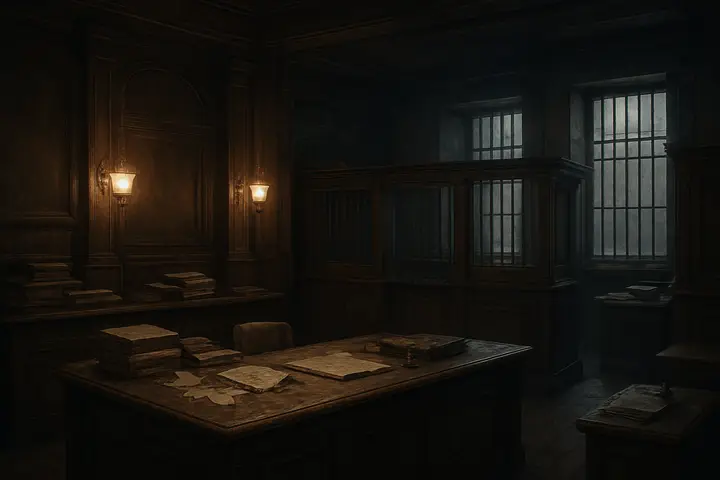
The chapter opens with a long, satirical description of Tellson’s Bank by Temple Bar in 1780: small, dark, ugly, and proudly so, its partners valuing inconvenience as a badge of respectability. Dickens sketches the bank’s cramped rooms, dingy windows, wormy drawers, and the grim utilitarian ways in which family papers and valuables are stored. The narration notes the severe punishments common in the age—capital penalties for many petty crimes—and implies that Tellson’s history and atmosphere are in keeping with the harshness and conservatism of the period.
The scene then shifts to Mr. Cruncher, the odd-job man who serves as Tellson’s live sign, in his lodging on a windy March morning. Cruncher, called Jerry, wakes angrily to find his wife kneeling in prayer; he accuses her of praying against his prosperity and of causing his bad luck. Their son, young Jerry (Master Cruncher), watches and teases his mother while his father rants about being “counter-prayed.” Mrs. Cruncher insists she prays for him, but Jerry resents any perceived threat to the family’s food and income. After breakfast he presents a respectable face and takes up his station as the bank’s outdoor odd-job man, sitting on a stool with straw near the Tellson’s window while young Jerry keeps watch and ponders the rust on his father’s fingers.
Key events
- Tellson’s Bank is described as old-fashioned, dark, and proud of its inconveniences.
- The bank’s cramped, grim storage and routine are detailed, with moral satire on punishment.
- Introduction of Jerry Cruncher as Tellson’s odd-job-man and his lodging in Hanging-sword-alley.
- Domestic scene: Jerry angrily confronts his wife for praying and claims her prayers harm his luck.
- Young Jerry teases his mother and assists his father; Jerry takes his place outside Tellson’s.
Analysis
This chapter functions as both world-building and character introduction. The lengthy depiction of Tellson’s establishes a tone of irony and social criticism: the bank’s pride in squalor satirizes institutions that equate tradition and respectability with resistance to reform. The catalogue of drab details—wormy drawers, dingy windows, and headless trophies on Temple Bar—creates a physical and moral atmosphere of decay and brutality that frames the society the novel will examine.
The shift to Jerry Cruncher provides a comic but morally telling contrast. His coarse superstition and hostility toward his wife's prayers reveal personal pettiness and a pragmatic, self-centered worldview. The domestic quarrel also illustrates gender and generational relations: Mrs. Cruncher’s quiet piety meets Jerry’s crude materialism, while young Jerry mirrors his father’s habits and gestures, hinting at inherited traits. Dickens uses free indirect narration and precise, humorous dialogue to sketch character quickly. Symbolically, the references to rust on Cruncher’s fingers and his furtive, grimy occupation foreshadow ambiguous moral themes—decay, clandestine labor, and the murky boundary between respectable business and unsavory work. Structurally, the chapter moves from broad institutional portrait to intimate domestic scene, preparing readers to see private lives as embedded within and shaped by larger social institutions.
Important quotes
“Tellson’s (they said) wanted no elbow-room, Tellson’s wanted no light, Tellson’s wanted no embellishment.”
NarratorEstablishes the partners' pride in the bank's dark, inconvenient conditions and satirizes conservative respectability.
“Bust me, if she ain’t at it agin!”
Jerry CruncherJerry’s first outburst on seeing his wife praying, showing his hostility to her piety and his superstition about being 'counter-prayed.'
“I ain’t a going to be blest out of house and home.”
Jerry CruncherJerry exaggerates fear that his wife's prayers will deprive the family of their food, revealing his materialism and paranoia.
Characters in Chapter 1
- Jerry Cruncher
- Mrs. Cruncher
- Master Cruncher
- young Jerry
- the oldest of men
- the House (Tellson’s partners)
All chapter summaries ›Characters ›
Read A Tale of Two Cities illustrated
Every scene in these notes comes from the Book2Life reader, where the full public-domain text is illustrated as you read, with character portraits and narration. Free in your browser and on iPhone.
Read A Tale of Two Cities free
