Alice's Adventures in Wonderland Chapter 7 Summary

A Mad Tea-Party

Alice stumbles on a perpetual tea-party with the Mad Hatter, March Hare and a sleepy Dormouse, then escapes to the garden.
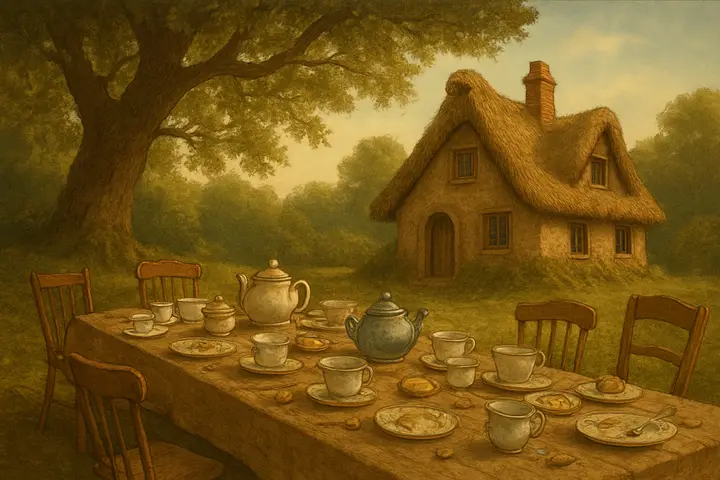
A long, cluttered tea-table stretches under a gnarled tree before a crooked house, carpeted with mismatched teapots, chipped cups and saucers, crumbs and spilled tea darkening the grass. Scattered pocket‑watches and a single peculiar day‑only watch lie among buttered plates and a crooked sugar bowl, while empty chairs sit pushed back at odd angles. The scene feels paused, the clutter and overturned utensils suggesting a quarrel frozen in time.

Summary

Alice finds a tea-table set under a tree where the Mad Hatter and the March Hare are talking over a Dormouse who is asleep between them and being used as a cushion. The three crowd one corner of a large table and protest there is "No room!" when Alice approaches; she sits in an arm-chair and is immediately drawn into a series of illogical exchanges. The Hatter asks a riddle — "Why is a raven like a writing-desk?" — that has no answer, and the party proceeds with punning, contradictions and circular arguments that confuse and frustrate Alice.

The Hatter repeatedly examines a watch that tells the day but not the hour, revealing the group's strange relationship with Time: an anecdote explains that Time and the Hatter quarrelled, so it is always six o'clock and always tea-time. They continually move places and pass cups and dishes because the tea-things are never washed. The Dormouse, periodically woken and pinched, tells a nonsensical story about three sisters who live at the bottom of a "treacle-well" and draw things that begin with M, producing more wordplay and absurd logic. Alice grows increasingly impatient with their rudeness and nonsense; when she finally gets up in disgust and leaves, the others ignore her and stuff the Dormouse into a teapot. As she walks away, she notices a tree with a door leading into it, returns to the hall, retrieves the little golden key and a kept piece of mushroom, adjusts her height to about a foot, and at last slips into the beautiful garden she has been trying to reach.

Key events

  1. Alice joins the tea-table despite their complaint of 'No room!'
  2. The Hatter poses the riddle: 'Why is a raven like a writing-desk?'
  3. Hatter and March Hare reveal their frozen six-o'clock tea-time because of Time
  4. Dormouse tells a sleepy, absurd story about treacle-well and sisters
  5. Alice, disgusted, leaves the tea-party while they ignore her
  6. Alice finds a tree-door, returns to the hall, uses key and mushroom, and enters the garden

Chapter 7 in pictures
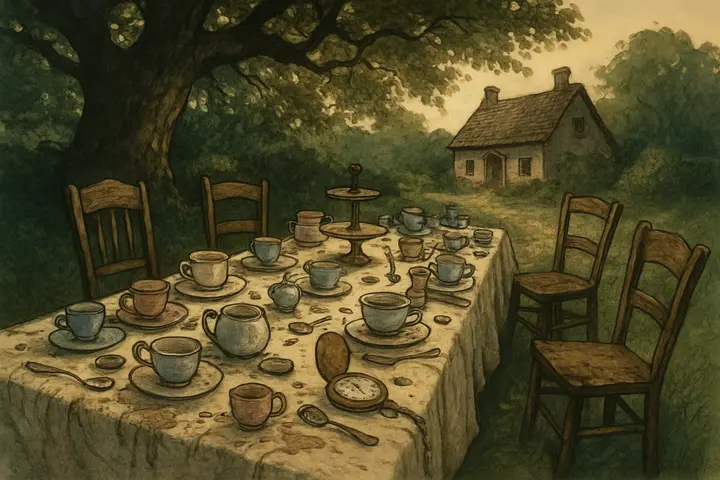
A long, ramshackle table sits beneath a broad, leafed tree in front of a small country house; mismatched teacups, saucers and bent spoons crowd a stained cloth while a battered pocket‑watch lies open and still among overturned plates. Chairs are crooked and the grass around the table is trodden into irregular paths, the whole spread frozen in a stubborn, perpetual tea‑time.
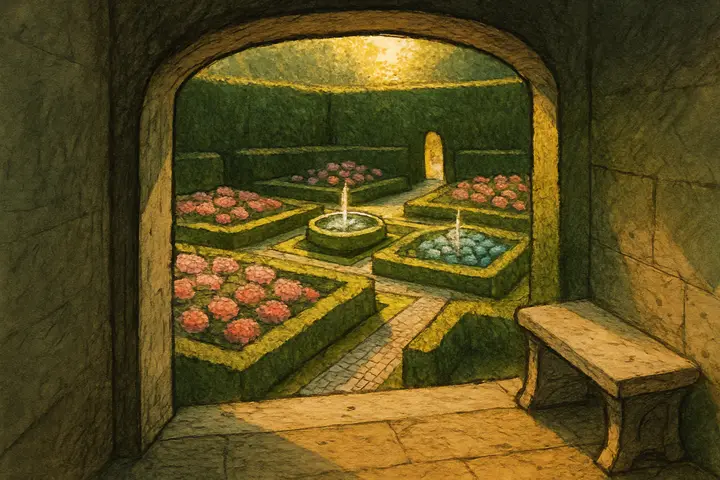
A compact formal garden enclosed by clipped hedges, its beds planted in tight geometric patterns of brilliant blooms and polished gravel walks. Cool, circular fountains throw fine sprays that catch the sun, marble benches and a small mosaic path leading inward give the space a hushed, secret order.
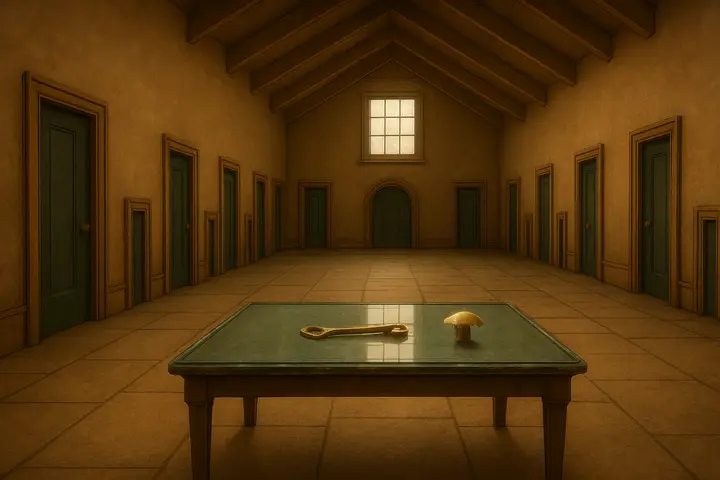
A long, low stone hall lined with dozens of tiny doors at varying heights recedes into shadow; brass knobs catch thin shafts of cool light from a distant opening. In the foreground a minute glass table sits on the polished floor, bearing a tarnished golden key and a single pale mushroom cap, their reflections doubled in the sheen. The scale is intimate and expectant, the architecture whispering of hidden passages beyond the little doors.
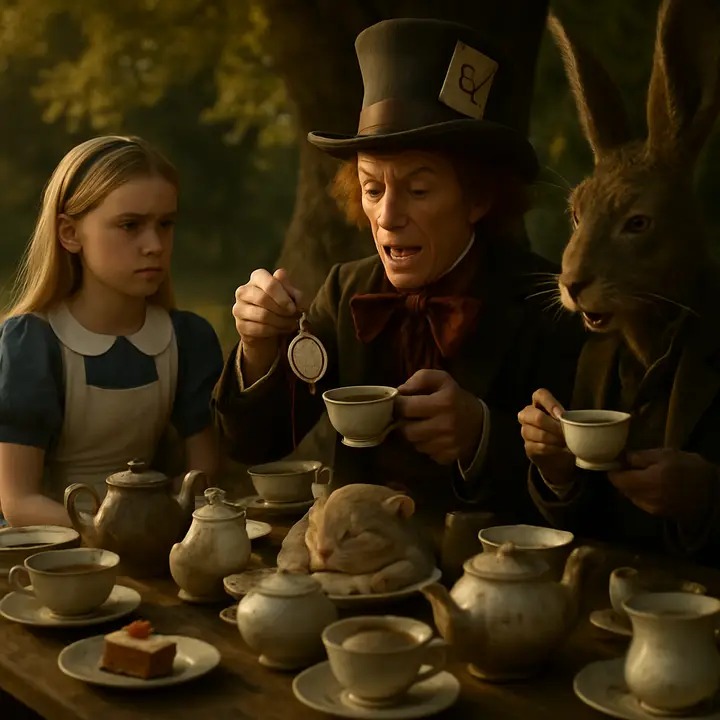
At a long outdoor table under a tree the Mad Hatter and March Hare bicker endlessly over teacups while a dozing Dormouse is smothered between saucers; Alice sits opposite, exasperated, as time-stained teapots and tilted cups create a tableau of perpetual tea-time. The Hatter tosses riddles, dips a battered watch in tea, and the trio trade places in chaotic, comic motions while the Dormouse mumbles a nonsensical tale in its sleep.
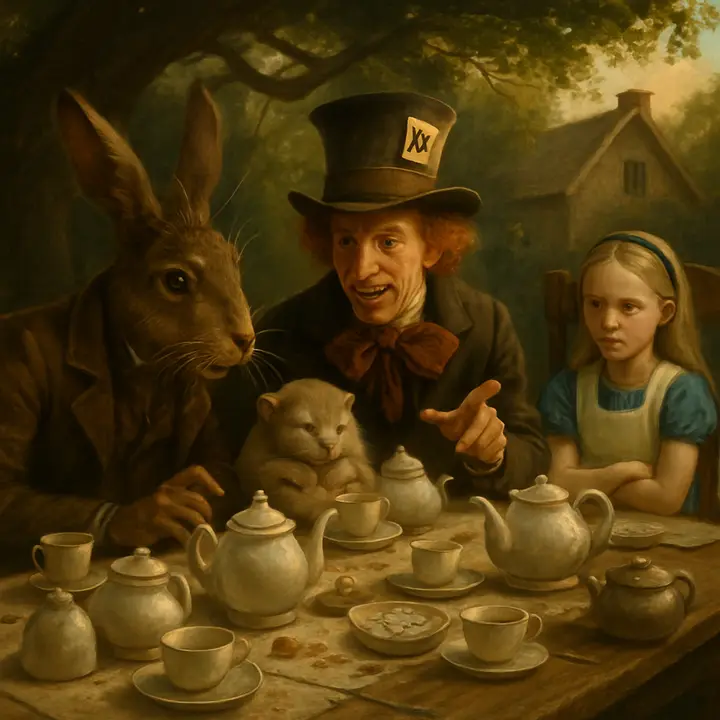
A long, cluttered tea-table under a gnarled tree before a cottage; the March Hare and Mad Hatter sit elbow-to-elbow with the Dormouse slumped between them like a cushion, while Alice indignantly takes a large armchair at the table's end as they cry “No room!” Teapots, tilted cups, crumbs and a battered pocket-watch scatter the tabletop; the Hatter leans forward, mid-riddle, eyes bright with mischief.

Analysis

This chapter intensifies the novel's sustained exploration of logic, language and time by staging a scene where conversation collapses into puns, non sequiturs and circularity. The tea-party dramatizes Carroll's satire of Victorian social rituals: the outward formality of tea is preserved while its substance — manners, attentiveness, coherent discourse — is thoroughly subverted. The Hatter's riddle without an answer and the Dormouse's dreamlike tale invert the expectation that riddles and stories should instruct or amuse logically; instead they reveal language as playful and destabilizing. Time is personified and punished, producing the perpetual six-o'clock that fixes the characters in ritual and stasis; this literalization of temporal idioms critiques human attempts to measure and master time.

Structurally, the chapter provides a comic interlude that also advances Alice's arc: her patience and insistence on common-sense replies mark her as the 'normal' observer confronted with Wonderland's anti-reason. The constant moving-around of seats and the pinching of the Dormouse create a physical comedy underlining social discomfort and the characters' indifference to Alice's feelings. Symbolically, the tea-party functions as an inverted domestic space — a scene of hospitality that is inhospitable — foreshadowing later encounters with arbitrary authority. Narratively, the chapter pivots from chaotic dialogue back to Alice's agency as she uses the key and mushroom to finally reach the garden, moving the plot toward the controlled, picturesque space she desires.

Important quotes

“Why is a raven like a writing-desk?”

Mad HatterThis famously unanswered riddle encapsulates the chapter's playful undermining of logical question-and-answer patterns.

“It’s always six o’clock now.”

Mad HatterA concise statement of the party's frozen relation to Time and the cause of their perpetual tea ritual.

Characters in Chapter 7

Read Alice's Adventures in Wonderland illustrated

Every scene in these notes comes from the Book2Life reader, where the full public-domain text is illustrated as you read, with character portraits and narration. Free in your browser and on iPhone.

Read Alice's Adventures in Wonderland free

Download Book2Life on the App Store