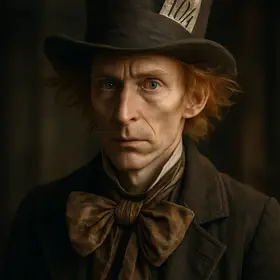
Mad Hatter in Alice's Adventures in Wonderland
Major character
Eccentric tea‑party host whose riddles and time‑obsessed behaviour embody Wonderland’s playful nonsense.
Who is Mad Hatter?
The Mad Hatter is an eccentric resident of Wonderland who presides over a perpetual tea‑party with the March Hare and the sleepy Dormouse. He wants to preserve the ritual of tea-time and to unsettle ordinary logic, using riddles, wordplay, and absurd anecdotes to confound guests. In the story he greets Alice at a chaotic outdoor tea-table, poses the famous riddle “Why is a raven like a writing-desk?,” explains his quarrel with Time that fixes the hour as tea-time, and performs a stream of contradictory, teasing remarks. Later he appears as the first witness at the Queen’s trial, giving rambling, irrelevant testimony about dates and lost hats that adds to the courtroom’s farce. Across these scenes he functions as both comic provocateur and living example of Wonderland’s refusal of conventional sense, repeatedly disrupting Alice’s attempts at rational conversation and contributing to the book’s tone of cheerful absurdity.
In the book: An eccentric tea‑party host in Wonderland, the Mad Hatter embodies playful illogic and riddling wordplay. He helps define the book’s tone of cheerful absurdity, constantly challenging Alice’s assumptions about time, manners, and meaning, and becoming one of the story’s most memorable symbols of nonsense and caprice.
Personality
- Absurd
- He asks a riddle with no answer—“Why is a raven like a writing-desk?”—and delights in circular arguments at the tea-party.
- Time‑obsessed
- He repeatedly examines a watch that shows only the day and explains that Time and he quarrelled, so it’s always six o’clock.
- Provocative
- He deliberately gives rambling, contradictory testimony as the first witness at the Knave’s trial, increasing the court’s confusion.
- Playful
- He and the March Hare continually move places and pass cups at the tea-table, turning manners into a game of nonsense.
- Unconcerned
- During the trial he offers irrelevant details about lost hats and twinkling tea rather than a straightforward answer.
Character arc
When Alice first meets him at the tea-party he is a riotous, rule‑bending host devoted to keeping tea-time eternal; his behaviour is performative, full of riddles, puns, and a personal grudge against Time that explains the party’s stuck hour. He functions as a living example of Wonderland’s anti‑logic, actively challenging Alice’s patience and conventions of polite conversation. By the time he appears in the courtroom he retains those same qualities—rambling, evasive, and disruptive—but they now play a legally absurd role: his testimony as a witness contributes to the trial’s mockery of justice rather than merely amusing a small circle. He does not undergo a moral or psychological transformation; instead his role shifts from private comedic instigator to public participant in Wonderland’s institutional nonsense. The Hatter remains consistently committed to caprice and misrule from first to last appearance, maintaining the book’s steady insistence that conventional meaning and procedure can be upended at any moment.
Mad Hatter in pictures


Relationships
- March Hare Constant companion and co‑host at the perpetual tea-party; they act as a pair of chaotic interlocutors.
- Dormouse Third member of the tea-party, often used as a sleeping cushion and contributor of nonsensical stories.
- Alice Visitor and foil whose attempts at sense and manners are repeatedly challenged and confounded by the Hatter’s riddles and behaviour.
- Cheshire Cat Indirect influencer: the Cat points Alice toward the Hatter and March Hare, noting their madness before she meets them.
- White Rabbit Court official who summons the Hatter to testify as the first witness in the trial of the Knave of Hearts.
- Knave of Hearts Defendant at the trial where the Hatter’s rambling testimony is presented as evidence against him.
Quotes by Mad Hatter
“Why is a raven like a writing-desk?”
Chapter 7This famously unanswered riddle encapsulates the chapter's playful undermining of logical question-and-answer patterns.
“It’s always six o’clock now.”
Chapter 7A concise statement of the party's frozen relation to Time and the cause of their perpetual tea ritual.
Why Mad Hatter matters
The Mad Hatter embodies the book’s central themes of illogic, satire of social ritual, and the instability of meaning. His fixation on tea-time and quarrel with Time literalises Carroll’s play with temporal rules, while his riddles and evasions expose how language can be used to frustrate understanding. In both the intimate setting of the tea-table and the public farce of the court, the Hatter shows how social conventions and institutions can be reduced to performative nonsense, deepening the novel’s critique of order and authority through comic disruption.
Chapters with Mad Hatter
More Alice's Adventures in Wonderland characters
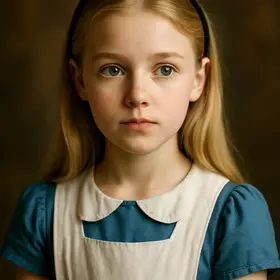 AliceProtagonist
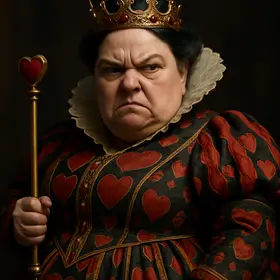 Queen of HeartsAntagonist
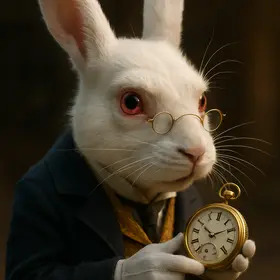 White RabbitMajor character
- DDinahMinor character
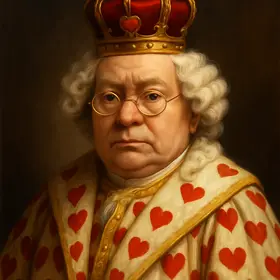 King of HeartsMajor character
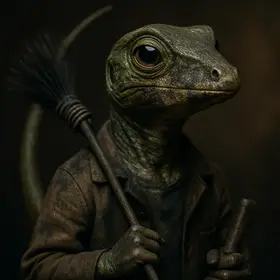 Bill the LizardMinor character
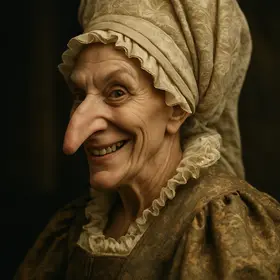 DuchessMinor character
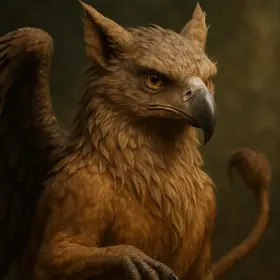 GryphonMinor character
All chapter summaries ›Characters ›
Read Alice's Adventures in Wonderland illustrated
Every scene in these notes comes from the Book2Life reader, where the full public-domain text is illustrated as you read, with character portraits and narration. Free in your browser and on iPhone.
Read Alice's Adventures in Wonderland free
