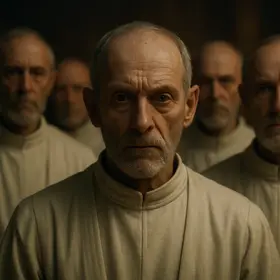
World Council of Scholars in Anthem
Antagonist
The World Council of Scholars: the solemn ruling body that defines sanctioned knowledge and enforces collective orthodoxy.
Who is World Council of Scholars?
The World Council of Scholars are the highest scientific authority in the City, taught to be infallible arbiters of truth. They determine what counts as legitimate knowledge and what must be forbidden, and their decrees shape every institution—Homes, Vocations, and education. When Equality 7-2521 secretly invents a new form of electricity and a glowing light, he brings it to the Scholars expecting recognition; instead, they react as custodians of the social order. The Council regards his solitary experiments as a crime against the collective and a threat to established Plans (such as the Department of Candles). In the Hall of the World Council of Scholars they debate and reject his gift, pronounce the invention to be destroyed, and set in motion the effort to punish and contain him. Their response directly precipitates Equality’s flight and final break with the City, demonstrating their role as the institutional antagonist who places dogma and social control above discovery and individual initiative.
In the book: They’re the top scientific authority everyone is taught to revere—the guardians who decide what counts as knowledge and what must not be questioned. When the story finally brings us to them, they appear as solemn arbiters presiding over discovery, and their word is treated like law.
Personality
- Dogmatic
- They denounce Equality’s solitary work and refuse the light because it violates the rule that truth must be held by all, not discovered by one.
- Authoritative
- Their pronouncement in the Hall that the invention must be destroyed and that Equality be delivered to higher judgment is treated as decisive law.
- Conservative
- Council members argue that the new device would threaten established Plans and the Department of Candles, prioritizing existing systems over innovation.
- Fearful
- When the glowing wire fills the hall, the Scholars recoil in terror, revealing an instinct to reject what they cannot immediately control.
- Institutional
- Throughout their meeting the Council speaks in terms of collective policy and social order rather than engagement with the invention’s scientific implications.
Character arc
From their appearance in the Hall of the World Council of Scholars to their final judgment on Equality’s invention, the Council remains steadfastly institutional and unyielding. They first appear as the conceptual enforcers of the City’s orthodoxy—the ultimate referees over what knowledge may exist. When Equality presents the light, the Council’s internal process unfolds: initial amazement gives way to recoil and then to a deliberation centered on social consequence rather than scientific assessment. They weigh Plans, departments, and precedent, and conclude that permitting a lone man’s discovery would undermine the collective. Their decision to command destruction and hand Equality over for higher judgment shows no development toward openness; instead they act to preserve the status quo. In short, the Council’s arc is one of confirmation rather than change: they reveal the practical operation of their doctrine when tested, and by rejecting the light they catalyze the protagonist’s final separation from the City. Their constancy in dogma transforms them from abstract authority into active antagonist.
Relationships
- Equality 7-2521 They are the institutional antagonists to Equality, rejecting his invention and ordering his condemnation.
- Council of Vocations They share the City’s bureaucratic structure; the Council’s decisions reinforce and are reinforced by vocational assignments.
- Collective 0-0009 Collective 0-0009 participates in the Council’s meeting and helps articulate the collective stance against the invention.
- International 4-8818 International is allied socially with Equality and would be affected by the Council’s condemnation of those who transgress norms.
- Solidarity 9-6347 As a named member of the society, Solidarity represents the class of citizens whose beliefs the Scholars defend.
- Fraternity 2-5503 Fraternity’s position in the social hierarchy is upheld by the Council’s rulings, which maintain the communal order that protects Fraternity’s place.
Why World Council of Scholars matters
The World Council of Scholars embodies the book’s critique of collectivist stifling of inquiry: they transform knowledge into dogma and privilege consensus over discovery. Their refusal to evaluate a novel empirical result on its merits exposes how institutions can sacrifice progress to preserve social plans and authority. By acting as the formal antagonist who condemns individual initiative, the Council sharpens the novel’s central theme—the moral and practical necessity of the individual mind against enforced conformity.
Chapters with World Council of Scholars
More Anthem characters
 Equality 7-2521Protagonist
 International 4-8818Major character
 Liberty 5-3000Major character
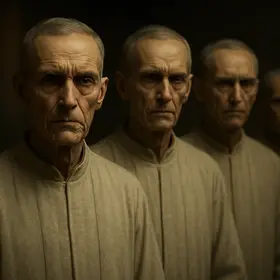 Council of VocationsAntagonist
 Fraternity 2-5503Minor character
 Solidarity 9-6347Minor character
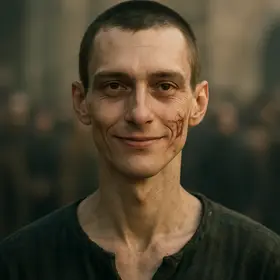 The Transgressor of the Unspeakable WordMinor character
All chapter summaries ›Characters ›
Read Anthem illustrated
Every scene in these notes comes from the Book2Life reader, where the full public-domain text is illustrated as you read, with character portraits and narration. Free in your browser and on iPhone.
