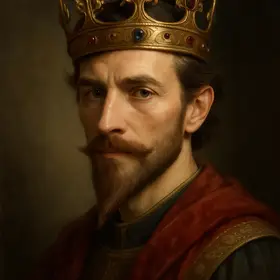
King Thrushbeard in Grimms' Fairy Tales
Major character
A disguised suitor who engineers humiliations to teach a proud princess humility and wins her love through patient, staged trials.
Who is King Thrushbeard?
King Thrushbeard appears as a suitor mocked by a proud princess. Humiliated by her scorn, he withdraws and later returns incognito to correct her arrogance. Adopting the identities of a fiddler, a soldier, and other lowly figures, he orchestrates the princess’s enforced fall from privilege: arranging her marriage to a wandering musician, guiding her into poverty, and placing her in menial labor where she repeatedly fails and is humiliated. Through these trials he watches how she reacts, allowing her to learn the consequences of vanity and cruelty without direct punishment. At the end, when the princess has been humbled and shown compassion, he reveals his true identity, restores her status, and transforms the chastening into a joyful marriage that confirms her moral growth. He acts less as a conqueror than as a teacher-architect of reformation, manipulating circumstances so the princess can confront and change her prideful ways.
In the book: A suitor to a proud princess, King Thrushbeard is central to the tale’s lesson about humility and compassion. Through patience and carefully arranged trials, he becomes the catalyst for the princess’s transformation, guiding the story toward reconciliation and moral growth without overshadowing her arc.
Personality
- patient
- He waits after the princess’s insult and spends time in disguise to see whether she will learn rather than forcing immediate retribution.
- cunning
- He assumes multiple disguises—the fiddler and the soldier—and arranges complex deceptions to engineer the princess’s fall.
- didactic
- He deliberately stages humiliations and poverty to teach the princess humility and empathy rather than simply punishing her.
- compassionate
- After her transformation he restores her to finery and celebrates a joyful marriage instead of abandoning her to disgrace.
Character arc
King Thrushbeard’s outward behavior remains steady in purpose, but his role shifts from rejected suitor to covert instructor and finally to revealed partner. Initially he is the object of the princess’s scorn; his reaction is not immediate anger but a decision to withdraw and enact a long lesson. As the fiddler/soldier figure, he becomes the architect of her humiliation, orchestrating events that force her into menial work and poverty. During this middle phase he is remote and observational, testing the princess’s character through contrived hardships. By the time she demonstrates humility and contrition, he moves from invisible manipulator to generous reconciler: he discloses his true identity, restores her social position, and converts the punishment into a reconciliatory celebration. Thus his arc is less about personal change and more about the shift in his relation to the princess—from scorned suitor to corrective guardian to loving husband—culminating in a moral repair that affirms his original aim to reform rather than to dominate.
Relationships
- the princess He is her rejected suitor who later disguises himself to humble and ultimately marry her after she learns humility.
- The King He is the suitor whom the king’s household must accept when the king insists the princess marry the first comer, and he manipulates events under the king’s edict.
- the king's daughter He is the man whose rejection by the king's daughter spurs him to set the moral trials that reform her behavior.
Quotes by King Thrushbeard
“‘Fear me not! I am the fiddler who has lived with you in the hut. I brought you there because I really loved you. I am also the soldier that overset your stall. I have done all this only to cure you of your silly pride, and to show you the folly of your ill-treatment of me.'”
KING GRISLY-BEARDThe revelation where the husband unmasks his role in her humiliation and explains the didactic purpose of his deceptions.
Why King Thrushbeard matters
King Thrushbeard embodies the story’s moral engine: he transforms scorn into instruction, showing that pride can be remedied through experience and empathy. His calculated humility-teaching underscores themes of repentance, social responsibility, and the ethical use of power—he wields disguise and deprivation not to crush but to educate. By restoring the princess when she changes, he reinforces the tale’s optimistic belief in moral reform and in marriage as a union justified by character rather than status.
Chapters with King Thrushbeard
More Grimms' Fairy Tales characters
 The KingMajor character
- TThe QueenMajor character
- tthe king's daughterMajor character
 The WolfAntagonist
- mmotherMajor character
- tthe cookMinor character
- tthe foxMajor character
 The HuntsmanMajor character
All chapter summaries ›Characters ›
Read Grimms' Fairy Tales illustrated
Every scene in these notes comes from the Book2Life reader, where the full public-domain text is illustrated as you read, with character portraits and narration. Free in your browser and on iPhone.
