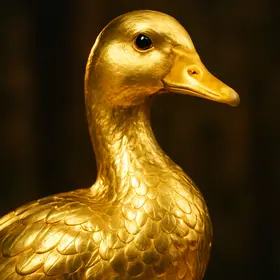
The Golden Goose in Grimms' Fairy Tales
Minor character
A magical goose with gleaming golden feathers whose enchantment causes people to stick together and triggers Dummling’s rise in fortune.
Who is The Golden Goose?
The Golden Goose is a found object of supernatural origin discovered by the Simpleton beneath a marked tree after the Simpleton shows kindness to a strange old man. It appears inert but carries an enchantment: anyone who tries to pluck a feather becomes magically bound to the goose or to the already-stuck chain of people. When the Simpleton brings the goose to an inn, the host’s three daughters attempt to pull a feather and become glued together; subsequent passersby who try to separate them join the chain, creating a ludicrous procession. This absurd parade attracts attention all the way to the king’s court, where the king’s daughter—unable to laugh—breaks into laughter at the sight. The goose thus functions as the plot catalyst: its enchantment produces the comic chain of events that allows the Simpleton to win the princess’s favor and ultimately the throne. The Golden Goose does not speak or act with human motives; instead its agency is purely magical, enabling social change around it.
In the book: The Golden Goose is a magical creature whose irresistible, gleaming feathers and peculiar enchantment set the story’s comic chain of events in motion, drawing people together—quite literally—and propelling a humble protagonist toward unexpected good fortune. It serves as the catalyst that changes social fortunes and opens doors otherwise closed.
Personality
- Enchanting
- Its golden feathers cause the host’s daughters to become stuck when they try to pull a feather at the inn.
- Catalytic
- The successive people who try to free the daughters are bound to the goose, forming the procession that makes the princess laugh.
- Silent
- The goose never speaks or explains itself; it functions through its magical effect on others.
- Radiant
- Its feathers are described as pure gold, an irresistible gleam that draws attention and provokes action.
Character arc
The Golden Goose itself undergoes no psychological change; its role in the tale is static but dynamically transformative for others. From the moment the Simpleton uncovers it beneath the marked tree it remains a silent, gleaming presence whose magic operates without alteration. Its first active consequence appears at the inn, where a simple attempt to pluck a feather triggers the sticking enchantment; thereafter the goose’s effect spreads outward as more characters become attached and join the procession. The goose does not grow, speak, or seek anything—its arc is a steady function: to provoke social disruption and laughter. By the story’s end the goose has fulfilled its narrative purpose—enabling the Simpleton’s recognition, the princess’s laughter, and the fulfilment of the king’s marriage condition—then it recedes back into the background as the Simpleton moves into his new life. In short, the Golden Goose remains constant while the world around it is altered.
Relationships
- Simpleton Found and carries the goose; his stewardship of it sets the story’s events in motion.
- the king's daughter Her laughter at the procession the goose creates is the pivotal outcome the goose indirectly secures.
- the parson One of the figures who tries to free the stuck women and becomes bound into the procession by the goose’s enchantment.
- the King Sets the marriage challenge that the goose’s effects ultimately help the Simpleton meet and thereby changes the king’s household.
Quotes by The Golden Goose
“‘For shame, you good-for-nothing girls, why are you running across the fields after this young man? Is that seemly?’”
The Golden GooseThe parson scolds the girls but becomes stuck when he touches one, adding to the absurd parade that will make the princess laugh.
“‘Since you have a good heart, and are willing to divide what you have, I will give you good luck.'”
The Golden GooseThe little grey man rewards Dummling’s generosity with advice that leads to the discovery of the golden goose.
Why The Golden Goose matters
The Golden Goose embodies the tale’s theme that wonder and reward often arrive through unexpected, unassuming channels. As a magical object that produces comic, involuntary community, it exposes social pretensions (the king’s household, the townspeople) and upends ordinary means of advancement. The goose also underlines moral contrasts: the Simpleton’s kindness leads to an extraordinary gift, while others’ curiosity and greed leave them literally stuck. Ultimately, the goose symbolizes the disruptive power of enchantment to reveal true worth and to reshape social hierarchies without moralizing exposition.
Chapters with The Golden Goose
More Grimms' Fairy Tales characters
 The KingMajor character
- TThe QueenMajor character
- tthe king's daughterMajor character
 The WolfAntagonist
- mmotherMajor character
- tthe cookMinor character
- tthe foxMajor character
 The HuntsmanMajor character
All chapter summaries ›Characters ›
Read Grimms' Fairy Tales illustrated
Every scene in these notes comes from the Book2Life reader, where the full public-domain text is illustrated as you read, with character portraits and narration. Free in your browser and on iPhone.
