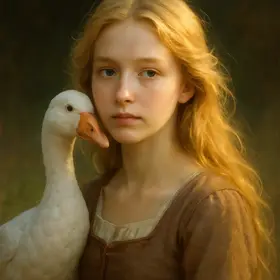
The Goose Girl in Grimms' Fairy Tales
Protagonist
A betrothed princess betrayed into servitude as a goose-tender, patient and quietly resilient until her true identity is restored.
Who is The Goose Girl?
The Goose Girl is a royal daughter set to marry a distant prince under the protection of a good fairy. While traveling with a magical lock of hair and her speaking horse Falada, she is robbed of her status by a treacherous waiting-maid at two rivers who forces the princess to swap clothes and take on the humiliating role of goose-keeper. Reduced to tending geese for Curdken at the prince’s court, she endures hardship with patience and kindness, confiding each morning to Falada’s severed head after the false bride orders the horse killed. Her quiet song and routine draw the old king’s attention; he discovers her tale, exposes the impostor by asking the court to pronounce punishment, and restores the true bride to her place. The Goose Girl marries the prince, receives justice for the deceit, and—through the good fairy’s aid—witnesses Falada brought back to life, completing her restoration to dignity.
In the book: The Goose Girl is a princess who, through misfortune and deceit, lives incognito tending geese, displaying patience, kindness, and quiet resilience. Her story centers on hidden identity, loyalty, and the eventual restoration of truth and justice, making her a symbol of virtue tested by hardship.
Personality
- Patient
- After being forced into servitude, she quietly tends the geese each day and endures humiliation rather than lash out.
- Kind
- She sings softly and cares for the flock and speaks gently to Falada’s head, showing compassion despite her plight.
- Resilient
- Though robbed of her rank and separated from Falada, she maintains her composure until the truth can be revealed.
- Loyal
- She remains true to her identity and keeps faith that justice will prevail, even when the false bride lives as the accepted bride.
Character arc
At the story’s opening the Goose Girl is a beloved king’s daughter, traveling to wed a prince with the protection of a good fairy, a magic lock of hair, and her speaking horse, Falada. Her apparent security collapses when a treacherous waiting-maid seizes the chance at two rivers to force her to dismount, steal her clothes and horse, and present herself as bride. Stripped of title and forced into menial labor as the court’s goose-keeper, the princess moves from privileged confidence to humbled endurance. Daily she confides in Falada, even after the false bride has the horse killed and the head hung on the gate; her song and routine draw attention but she does not attempt violent revenge. The hidden truth is uncovered when the old king witnesses the strange incidents and learns her story; he restores her to royal apparel and exposes the impostor. By the end she has been vindicated and returned to her rightful role, marries the prince, and sees Falada restored—her inner constancy rewarded by external restoration of status and justice.
Relationships
- The King The ruler who discovers her secret, pronounces justice, and restores her to royal status.
- the princess The title and identity that the Goose Girl ultimately regains when the truth of her birth and betrothal is revealed.
Quotes by The Goose Girl
“Blow, breezes, blow! Let Curdken’s hat go! Blow, breezes, blow! Let him after it go! O’er hills, dales, and rocks, Away be it whirl’d Till the silvery locks Are all comb’d and curl’d!”
The Goose-GirlA playful incantation the goose-girl sings while combing her silver hair; it causes the wind to carry Curdken’s hat away so she can keep her secret and delays him from watching the geese.
Why The Goose Girl matters
The Goose Girl embodies tested virtue: patience, humility, and quiet moral steadfastness under injustice. Her endurance contrasts with the false bride’s treachery and highlights themes of identity, truth, and poetic justice; the story affirms that true nobility is moral rather than merely performative, and that honesty and constancy are ultimately recognized and rewarded by the community and authority.
Chapters with The Goose Girl
More Grimms' Fairy Tales characters
 The KingMajor character
- TThe QueenMajor character
- tthe king's daughterMajor character
 The WolfAntagonist
- mmotherMajor character
- tthe cookMinor character
- tthe foxMajor character
 The HuntsmanMajor character
All chapter summaries ›Characters ›
Read Grimms' Fairy Tales illustrated
Every scene in these notes comes from the Book2Life reader, where the full public-domain text is illustrated as you read, with character portraits and narration. Free in your browser and on iPhone.
