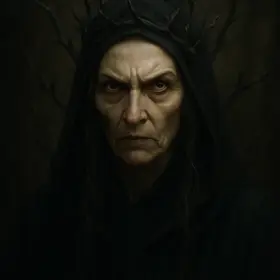
The Wicked Fairy in Grimms' Fairy Tales
Antagonist
A slighted supernatural guest who curses the newborn princess, triggering the story’s century-long sleep.
Who is The Wicked Fairy?
The Wicked Fairy is the uninvited, furious supernatural guest at the christening of the king's daughter. Angry at being excluded because there are only twelve golden dishes, she pronounces a lethal fate: the princess will be wounded by a spindle and die on her fifteenth birthday. Her curse is the story’s inciting action—what follows is the court’s frantic effort to avert the prophecy, the king’s order to destroy every spindle in the kingdom, and ultimately the unavoidable fulfillment when the princess pricks her finger in an old tower. The Wicked Fairy does not appear again as an active agent after delivering the curse, but her declaration shapes every major event that follows: the defensive measures of the royal couple, the isolation of the palace, the growth of the thorn hedge, and the century-long sleep that defines the tale’s stakes and resolution.
In the book: A slighted supernatural guest at a royal celebration, she delivers a fateful pronouncement that sets the entire tale in motion and defines the stakes for the royal family. Her role embodies wounded pride and implacable retribution, serving as the catalyst that propels the heroine’s destiny without occupying much narrative space herself.
Personality
- Vindictive
- She curses the newborn because she was left uninvited to the christening, pronouncing death on the princess.
- Authoritative
- Her single pronouncement immediately becomes the central law-like fact that the kingdom must reckon with.
- Catalytic
- Her curse directly propels the king to destroy all spindles and sets the narrative of protection and eventual fulfillment in motion.
- Implacable
- Despite the benevolent fairy’s mitigation, the Wicked Fairy’s original intent still produces a grave, unavoidable consequence.
Character arc
The Wicked Fairy’s role is static but story-defining: she appears once as the resentful, uninvited guest and issues a powerful curse, then withdraws from the action while the kingdom reacts. Her initial cruelty prompts the king and queen to take extreme protective measures—destroying spindles and attempting to deny the curse any avenue of fulfillment. Those measures prove insufficient when the princess later finds an old woman spinning in a tower and pricks her finger. The Wicked Fairy does not change, apologize, or relent; instead, the narrative shows the consequences of her deed unfolding to their completion—the palace falling into sleep, the hedge growing up, and a century passing. Her lack of transformation underscores the story’s sense of inexorable fate: the curse functions like a force of nature rather than a character who learns or repents. By the tale’s end, her action has been enacted and the curse is lifted only through the prince’s arrival, not through any change in her motives or behavior.
Relationships
- The King She is the antagonist to his household, whose attempts to protect his daughter respond directly to her curse.
- The Queen Her malediction targets the queen's newborn and upends the family the queen seeks to safeguard.
- Briar Rose She curses Briar Rose with a spindle wound that determines the princess’s fate.
- the king's daughter Her pronouncement seals a perilous destiny for the king's daughter, the central victim of the curse.
- the court Her curse causes the entire court to fall into the same enchanted sleep as part of its consequence.
Quotes by The Wicked Fairy
“‘I know what your wish is, and it shall be fulfilled, in return for your kindness to me—you will soon have a daughter.’”
BRIAR ROSEThe supernatural repayment that initiates the princess’s birth and the tale’s chain of events.
“‘The king’s daughter shall, in her fifteenth year, be wounded by a spindle, and fall down dead.’”
BRIAR ROSEThe curse that provides the central conflict and shapes the royal family's reactions.
Why The Wicked Fairy matters
The Wicked Fairy embodies themes of pride, social exclusion, and the moral consequences of wounded honor. Her single act demonstrates how a moment of slight can produce catastrophic, long-lasting effects that no amount of prevention can fully erase. The tale uses her implacable curse to explore fate versus human agency: the royal couple exercises control and protection, yet they cannot finally avert the outcome set in motion. Her presence as a catalyst rather than a developed character keeps the narrative focused on how people and institutions respond to an external, punitive force and on the eventual restorative power that undoes the curse without changing its originator.
Chapters with The Wicked Fairy
More Grimms' Fairy Tales characters
 The KingMajor character
- TThe QueenMajor character
- tthe king's daughterMajor character
 The WolfAntagonist
- mmotherMajor character
- tthe cookMinor character
- tthe foxMajor character
 The HuntsmanMajor character
All chapter summaries ›Characters ›
Read Grimms' Fairy Tales illustrated
Every scene in these notes comes from the Book2Life reader, where the full public-domain text is illustrated as you read, with character portraits and narration. Free in your browser and on iPhone.
