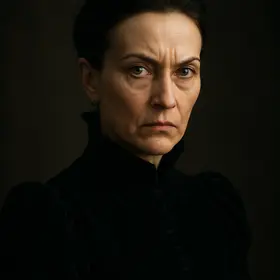
The Wicked Stepmother in Grimms' Fairy Tales
Antagonist
A cruel stepmother whose jealousy and self-interest drive her to persecute her stepchildren and create the central trials they must survive.
Who is The Wicked Stepmother?
The Wicked Stepmother appears in multiple tales as the primary source of suffering for young heroines and children. Motivated by jealousy, greed, or a desire to secure advantage for her own biological daughters, she strips stepchildren of comforts, forces them into menial or dangerous tasks, or persuades others to abandon them. In Hansel and Gretel she convinces her husband to abandon the children in the forest during famine, setting the siblings on the path that leads to the witch’s house. In the Cinderella (Ashputtel) cycle she arrives as a new wife who humiliates and exploits the heroine, consigning her to ashes and impossible chores so the stepmother’s daughters may prosper. Her actions create the moral tests and physical dangers that the protagonists must meet, and her downfall (explicit or implied in different tales) serves to restore justice and reward innocence.
In the book: Across multiple Grimm tales (such as those centered on persecuted stepdaughters), the Wicked Stepmother functions as the primary antagonist, driven by jealousy, vanity, or greed. Her schemes set the trials that the young protagonist must endure, highlighting themes of innocence under threat, moral testing, and eventual justice without revealing specific plot turns.
Personality
- Jealous
- She targets the stepchildren’s welfare and status, ensuring her own daughters gain the household’s advantages at the cost of the girl’s comfort and honor.
- Manipulative
- She persuades the woodcutter to abandon Hansel and Gretel in the forest during famine, converting a household decision into a betrayal of the children.
- Cruel
- She forces Ashputtel to live among the ashes and to perform impossible tasks while favoring her own daughters and mocking the girl.
- Self‑interested
- Her schemes consistently aim to protect or advance her own daughters’ prospects, even when that requires harming the stepchild.
Character arc
Across the tales in which she appears, the Wicked Stepmother largely functions as a constant rather than a character who experiences internal change. She enters each story as an agent of harm—bringing poverty or domestic demotion to the stepchild—and maintains that posture through the central conflict, provoking tests of resilience, cleverness, or virtue in the protagonists. Her schemes directly precipitate the children’s trials: in Hansel and Gretel, her insistence on abandoning the children creates the circumstances that lead them to the witch; in Ashputtel/Cinderella, her systematic oppression forces the heroine to find supernatural or moral aid. By the end of these narratives she loses her power: the children are rescued or elevated, and justice is meted out (her death in Hansel and Gretel, disgrace and exposure in Cinderella variants). Thus her arc is one of static malice followed by narrative retribution—she refuses moral improvement but is removed or punished as the story restores moral order and rewards the innocent.
Relationships
- Hansel She is the stepmother whose decision leads to Hansel’s abandonment in the forest and the trials he must face.
- Gretel As Gretel’s stepmother she instigates the choice to leave the children in the woods, setting Gretel on the path to confront the witch and survive.
- Cinderella She is the cruel stepmother who humiliates Cinderella (Ashputtel), forces her into servitude, and elevates her own daughters by denying Cinderella’s rightful place.
- The King Her mistreatment of Cinderella indirectly affects the social contest (the king’s feast) through which Cinderella’s fate is decided, as the girl must overcome the stepmother’s obstacles to be seen.
Quotes by The Wicked Stepmother
“‘I’ll tell you what, husband,’ answered the woman, ‘early tomorrow morning we will take the children out into the forest to where it is the thickest; there we will light a fire for them, and give each of them one more piece of bread, and then we will go to our work and leave them alone. They will not find the way home again, and we shall be rid of them.’”
HANSEL AND GRETELThe stepmother proposes abandoning the children to solve the family's hunger, revealing her cruel pragmatism that sets the plot in motion.
“‘Nibble, nibble, gnaw, Who is nibbling at my little house?’”
HANSEL AND GRETELThe witch’s chant from inside the sugar-and-bread house signals the children’s danger and the moment their innocent consumption invites peril.
“‘Always be a good girl, and I will look down from heaven and watch over you.’”
ASHPUTTELA dying mother’s charge sets Ashputtel’s moral compass and frames her steadfast goodness throughout the tale.
“‘Back again! back again! look to the shoe! The shoe is too small, and not made for you! Prince! prince! look again for thy bride, For she’s not the true one that sits by thy side.’”
ASHPUTTELThe bird’s song publicly exposes the stepsisters’ fraud and guides the prince back to the true bride, sealing the story’s moral justice.
Why The Wicked Stepmother matters
The Wicked Stepmother embodies the tale‑type’s moral and social antagonism: she personifies envy, the misuse of parental authority, and the domestic dangers that threaten childlike innocence. By opposing the virtuous protagonist, she creates the moral tests that allow themes of resilience, divine or supernatural aid, and ultimate justice to play out. Her eventual punishment or removal reinforces the stories’ didactic message that cruelty and selfishness are defeated and virtue, humility, and perseverance are rewarded.
Chapters with The Wicked Stepmother
More Grimms' Fairy Tales characters
 The KingMajor character
- TThe QueenMajor character
- tthe king's daughterMajor character
 The WolfAntagonist
- mmotherMajor character
- tthe cookMinor character
- tthe foxMajor character
 The HuntsmanMajor character
All chapter summaries ›Characters ›
Read Grimms' Fairy Tales illustrated
Every scene in these notes comes from the Book2Life reader, where the full public-domain text is illustrated as you read, with character portraits and narration. Free in your browser and on iPhone.
