Grimms' Fairy Tales RAPUNZEL Summary
Girl in the Tower
A girl stolen at birth is raised in a tower; a prince finds her, they fall in love, she is banished, and they are reunited years later.
Summary
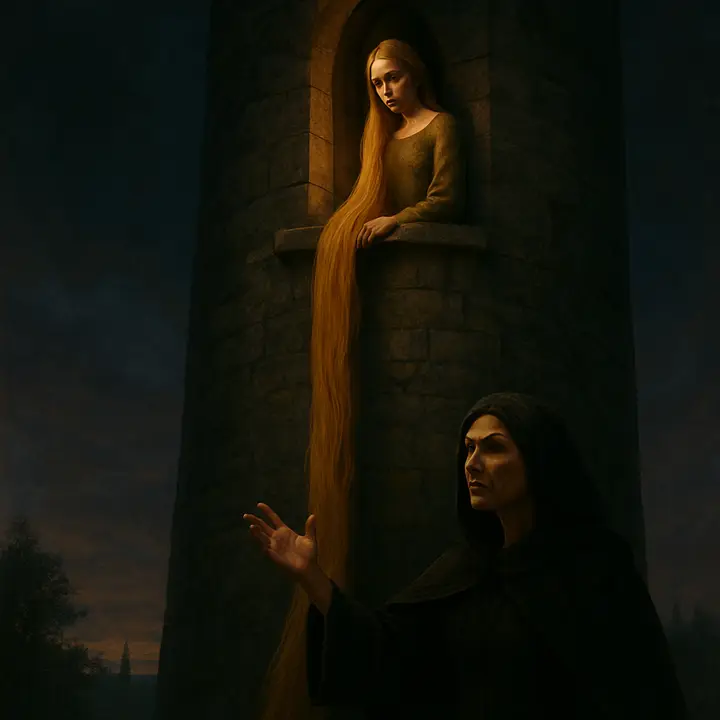
A childless couple live beside an enchantress's walled garden; when the wife longs for the rampion she sees there, her husband steals some and is caught by the enchantress, who demands the unborn child in payment. The couple surrender the infant, whom the enchantress names Rapunzel and raises. When Rapunzel is twelve the enchantress locks her in a high tower without stairs or doors, entering only by calling to her and having Rapunzel lower her long braided hair as a ladder.
Years later a king’s son passing through the forest hears Rapunzel singing, learns how the enchantress is let into the tower by calling, and imitates the call himself to climb up. He and Rapunzel fall in love and plan escape: he will bring silk so she can weave a ladder. Their meetings continue until Rapunzel inadvertently reveals the visits to the enchantress, who cuts off Rapunzel’s hair and casts her into a desert. The enchantress deceives the prince with the cut hair, he jumps from the tower, and the thorns blind him. Blind and bereft, the prince wanders eating roots and berries until he finds Rapunzel, who has borne twins in exile. Her tears restore his sight; they return to his kingdom and live together happily thereafter.
Key events
- A husband plucks rampion from the enchantress's garden to satisfy his wife's craving.
- The enchantress claims the couple's newborn as payment and names her Rapunzel.
- Rapunzel is confined to a windowed tower and lowers her hair to admit the enchantress.
- A king’s son hears Rapunzel sing, learns the calling phrase, and secretly visits her.
- Rapunzel and the prince plan escape with silk; the enchantress discovers them, cuts Rapunzel's hair and banishes her.
- The prince leaps, is blinded by thorns and wanders until he finds Rapunzel in the desert with her twins; her tears heal him.
Analysis
This tale compresses classic fairy-tale motifs—demanded birthright, confinement, forbidden contact, transformation through suffering, and restoration—into a compact narrative that explores control, innocence, and redemption. The enchantress functions as both captor and jealous guardian, embodying arbitrary power; her bargain with the desperate parents sets up a theme of cost and exchange that drives the plot. Rapunzel's tower isolates her physically and socially, turning her voice and hair into her only instruments of connection: her singing attracts the prince, and her hair literally becomes the means of ascent. Hair thus acts as a symbol of beauty, vulnerability, and agency—the same attribute that enables both rescue and exploitation.
Narratively the story alternates quiet domestic detail (the parents' longing, Rapunzel's daily singing) with sudden, violent turns (the cutting of the hair, the prince's blinding), which intensify emotional stakes and underline moral consequences. The prince's blindness and Rapunzel's exile enact a moral and bodily fall followed by a miraculous reunion, suggesting themes of suffering as purification and tears as restorative. The tale's sparse point of view—third-person, with occasional direct speech—keeps focus on actions and archetypes rather than interior psychology, which suits its role as a moral and cautionary fable rather than a realist study of character.
Important quotes
“‘Rapunzel, Rapunzel, Let down your hair to me.’”
Narrator (words spoken by the enchantress and later repeated by the prince)The phrase is the ritual call used to enter the tower; it links the enchantress, Rapunzel, and the prince and enables the crucial meetings.
“‘Ah! you wicked child,’ cried the enchantress.”
Narrator (the enchantress)The enchantress's outcry follows Rapunzel's casual comparison of how quickly she pulls up visitors, precipitating Rapunzel's punishment and exile.
Characters in RAPUNZEL
- the man
- the woman
- Rapunzel
- the enchantress
- Dame Gothel
- The king’s son
- Rapunzel's twins
All chapter summaries ›Characters ›
Read Grimms' Fairy Tales illustrated
Every scene in these notes comes from the Book2Life reader, where the full public-domain text is illustrated as you read, with character portraits and narration. Free in your browser and on iPhone.
