
Bishop Myriel in Les Misérables
Major character
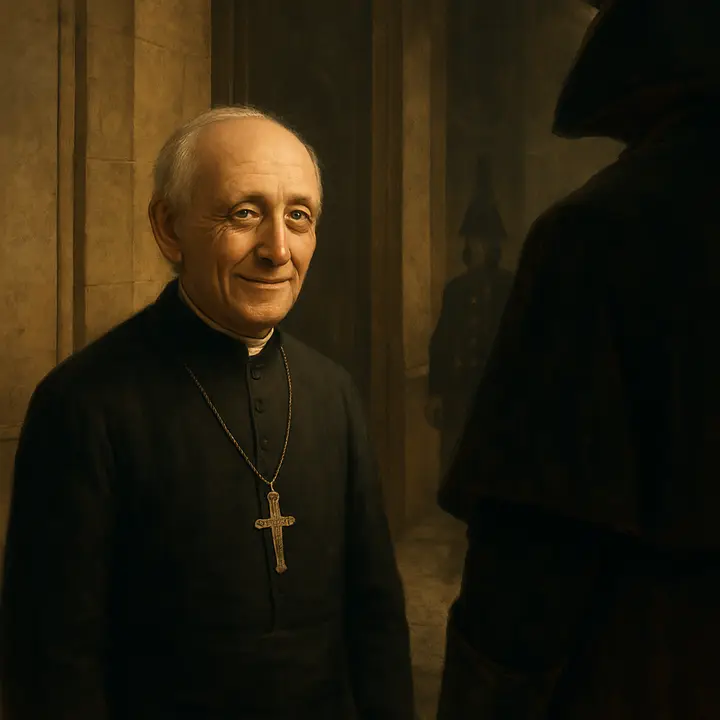
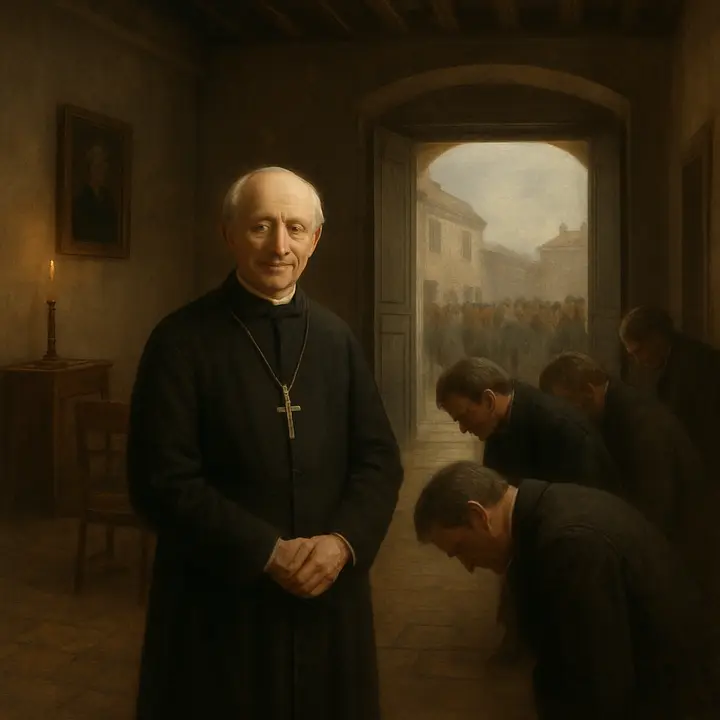
The humble, compassionate Bishop of D—— (Monseigneur Bienvenu) whose radical charity sets Valjean on a path to redemption.
Who is Bishop Myriel?
Charles-François-Bienvenu Myriel, Bishop of D——, is an elderly priest whose daily life is devoted to practical compassion and humble service. He trades the episcopal palace for the town hospital, gives away his official income to the poor, and opens his door to anyone in need. He insists on concrete acts of charity—redistributing donations, visiting distant curacies on foot or donkey, rehabilitating a destitute veteran—and treats even marginalized figures with dignity. His most consequential action is welcoming Jean Valjean, offering him food, shelter, and respect, then later claiming Valjean as his guest and giving him the two silver candlesticks when Valjean is arrested. Through a lifetime of modest ritual, pastoral visits, and teaching by example, Myriel embodies the novel’s moral language of mercy, humility, and social conscience, shaping community expectations in D—— and initiating the chain of events that compels Valjean toward repentance and a lifelong commitment to goodness.
In the book: The Bishop of Digne, also known as Monseigneur Bienvenu, serves as the novel’s moral compass—an embodiment of humility and compassion whose extraordinary kindness profoundly influences the protagonist and sets the story’s central themes of grace, redemption, and social conscience into motion.
Personality
- Radically charitable
- He devotes his entire official salary and later additional allowances to charities, seminaries, aid for prisoners, foundlings, and the poor (Volume 1, Chapter 2).
- Humble
- He exchanges the palace with the overcrowded hospital, moving patients into the palace while he takes the small hospital lodging (Volume 1, Chapter 2).
- Fearless
- He insists on traveling alone through dangerous territory to reach a mountain community controlled by the brigand Cravatte, refusing an escort (Volume 1, Chapter 7).
- Pastoral teacher
- On his circuits he gives concrete moral instruction using local examples—Briançon, Embrun, Devolny—favoring practical charity over abstract preaching (Volume 1, Chapter 3).
- Forbearing wisdom
- When a materialist senator ridicules religion, the Bishop listens with good humor and responds by explaining the social and consoling functions of faith (Volume 1, Chapter 8).
Character arc
From his first appearance, Myriel is presented as a settled model of lived piety: a learned, elderly bishop whose vocation is daily, visible charity rather than ceremonial pomp. He consistently acts on this program—inspecting the hospital, redistributing funds, visiting remote parishes on foot or donkey, and rehabilitating the needy—so his outward conduct remains remarkably steady through the chapters in which he appears. The most dramatic moment in his narrative function is his encounter with Jean Valjean: rather than condemn or expose the exhausted ex-convict who arrives at night, he offers hospitality, treats him with dignity, refuses to allow the gendarmes to lock Valjean up, and gives him the silver candlesticks, charging him to become honest. That single episode produces a moral conversion in Valjean and becomes the origin for much of the later plot. After this, Myriel’s life continues in the same gentle program—prayer, pastoral work, and modest domesticity—until his death is announced years later, at which point society memorializes his saintliness and his example continues to shape others’ behavior (Volume 1, Chapter 4). His personal interior does not undergo a dramatic change; rather, his constancy is the causal seed for transformation in others.
Bishop Myriel in pictures
Relationships
- Jean Valjean He gives Valjean shelter, dignity, and the two silver candlesticks and tells him to 'go in peace,' an act that triggers Valjean's moral conversion.
- Mademoiselle Baptistine She is his devoted sister who shares his household and narrates domestic details of his humility and routine (Volume 1, Chapter 9).
- Madame Magloire His housekeeper and attendant who manages the household and reacts anxiously when the silver is stolen, while he remains calm (Volume 1, Chapter 12).
- Cravatte A brigand whose return of stolen cathedral vestments to Myriel is received by the Bishop as providential, used to teach humility (Volume 1, Chapter 7).
- G—— (the dying conventionary) Myriel visits the dying conventionary out of duty and holds a long moral conversation that ends with the man blessing him before death (Volume 1, Chapter 10).
- The Senator (unnamed speaker) They exchange views at a dinner where the senator asserts a materialist creed and the Bishop replies with tolerant, ironic moral reflection (Volume 1, Chapter 8).
Quotes by Bishop Myriel
“you have my house, and I have yours. Give me back my house; you are at home here.”
Volume 1, Chapter 2Myriel tells the hospital director to use the episcopal palace for the patients and moves himself into the small hospital building, reversing expected roles.
“I like that name," said he. "Bienvenu makes up for the Monseigneur.”
Volume 1, Chapter 2Myriel accepts and appreciates the affectionate nickname 'Bienvenu' given to him by the countryside people.
““Monsieur the Mayor,” said the Bishop, “and Messieurs Citizens, I perceive that I shock you. You think it very arrogant in a poor priest to ride an animal which was used by Jesus Christ. I have done so from necessity, I assure you, and not from vanity.””
Volume 1, Chapter 3The Bishop responds calmly to the scandalized mayor and laughing citizens upon arriving in Senez on a donkey, explaining his humility.
“Place your hopes in the man from whom you do not inherit.”
Volume 1, Chapter 4The Bishop replies to Madame de Lô’s boasts about family inheritances with this remark attributed to St. Augustine, undercutting worldly expectation with spiritual counsel.
“There is M. Géborand purchasing paradise for a sou.”
Volume 1, Chapter 4On seeing a formerly miserly man give a sou to beggar-women after a sermon on charity, the Bishop wryly judges the apparent purchase of salvation by a token alms.
“Give them to me,”
Volume 1, Chapter 4When the stingy Marquis claims he already has poor people, the Bishop replies bluntly and morally subversive: 'Give them to me,' demanding practical care rather than excuses.
Why Bishop Myriel matters
Bishop Myriel functions as the novel’s moral exemplar: his habitual humility, concrete charity, and refusal to conflate religion with social power embody Hugo’s arguments about grace, social responsibility, and the moral economy of compassion. He demonstrates that mercy is practical—redistributing funds, opening his home, rehabilitating the poor—and that such acts can disrupt cycles of punishment and exclusion. Most importantly, his merciful treatment of Jean Valjean reframes justice as the possibility of redemption rather than only retribution; that single gesture supplies the ethical axis for Valjean’s life and the novel’s broader inquiry into law, conscience, and social reform.
Chapters with Bishop Myriel
- Volume 1, Chapter 1
- Volume 1, Chapter 2
- Volume 1, Chapter 3
- Volume 1, Chapter 4
- Volume 1, Chapter 5
- Volume 1, Chapter 6
- Volume 1, Chapter 7
- Volume 1, Chapter 8
- Volume 1, Chapter 9
- Volume 1, Chapter 10
- Volume 1, Chapter 11
- Volume 1, Chapter 12
- Volume 1, Chapter 13
- Volume 1, Chapter 14
- Volume 1, Chapter 2
- Volume 1, Chapter 3
- Volume 1, Chapter 4
- Volume 1, Chapter 5
- Volume 1, Chapter 10
- Volume 1, Chapter 11
- Volume 1, Chapter 12
- Volume 1, Chapter 13
- Volume 1, Chapter 4
- Volume 1, Chapter 3
- Volume 1, Chapter 4
- Volume 2, Chapter 3
- Volume 2, Chapter 4
- Volume 3, Chapter 8
- Volume 3, Chapter 7
- Volume 5, Chapter 11
- Volume 5, Chapter 5
- Volume 5, Chapter 4
- Chapter 3
- Volume 5, Chapter 5
More Les Misérables characters
 Jean ValjeanProtagonist
 CosetteMajor character
 Marius PontmercyMajor character
 CourfeyracMajor character
 JavertAntagonist
 ThénardierAntagonist
 EnjolrasMajor character
- MMariusMajor character
All chapter summaries ›Characters ›
Read Les Misérables illustrated
Every scene in these notes comes from the Book2Life reader, where the full public-domain text is illustrated as you read, with character portraits and narration. Free in your browser and on iPhone.
