Les Misérables Volume 1, Chapter 1 Summary
M. Myriel introduced
In 1815 the elderly Bishop Myriel arrives in D——, his background and household are described, and a defining encounter with Napoleon leads to his appointment.

Summary
The chapter opens in 1815 by naming M. Charles-François-Bienvenu Myriel as Bishop of D—— and briefly sketches his origins, youth, and the rumors that follow him. Born to a councillor of the Parliament of Aix, Myriel is said to have led a worldly, gallant early life and to have emigrated to Italy during the Revolution, where his wife dies and he later returns as a priest. The narrator emphasizes how talk and rumor shape a man’s public fate even when they may not reflect truth.
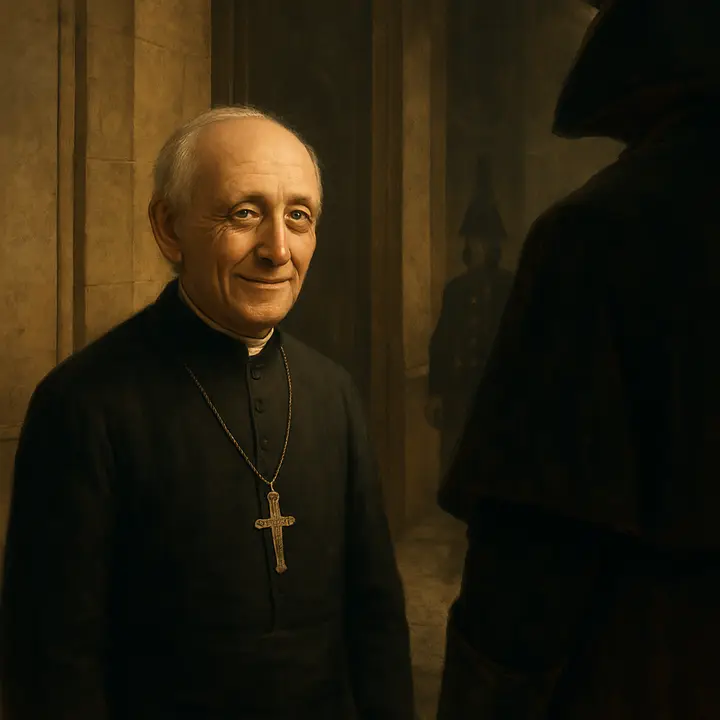
We learn that by 1804 Myriel serves as Curé of B—— and that an encounter in Paris—when Napoleon notices the old priest in an anteroom and asks who he is—results unexpectedly in Myriel’s appointment as Bishop of D——. The chapter then describes his settled life in the diocese: his sister Mademoiselle Baptistine and their servant Madame Magloire live with him in the episcopal palace, and local gossip about his past gradually dies away. Physical and moral portraits are sketched: Baptistine is thin, modest, and saintlike in presence; Madame Magloire is busy, plump, and asthmatic. The chapter closes with Myriel installed with formal honors, the town watching to see how its new bishop will act.
Key events
- Introduction of M. Charles-François-Bienvenu Myriel as Bishop of D—— in 1815
- Brief account of his noble origins, youthful gallantry, emigration, and widowhood in Italy
- His transition from lay life to priesthood and role as Curé of B—— by 1804
- The Paris anecdote: Napoleon notices him and later Myriel is appointed bishop
- Description of Myriel's household: Mademoiselle Baptistine and Madame Magloire
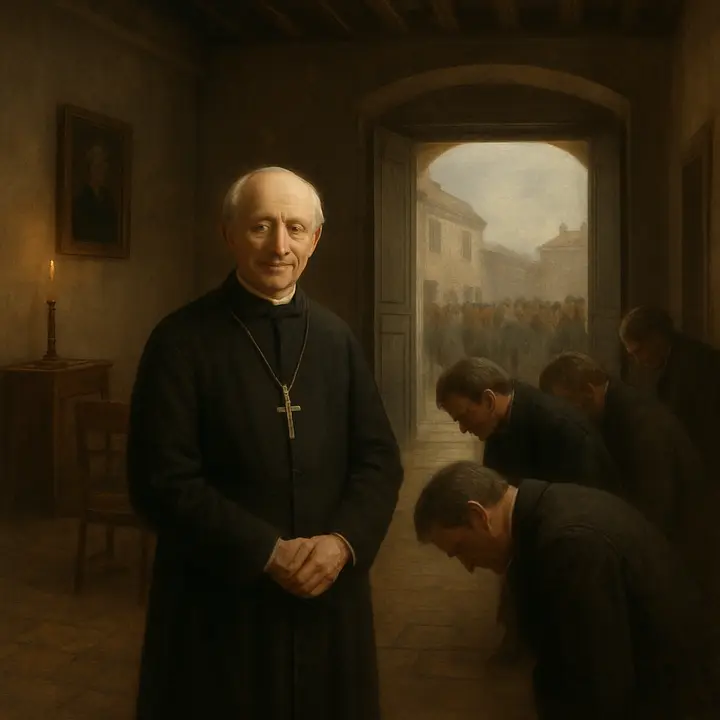
- Myriel’s formal installation in the episcopal palace and the town's curiosity
Volume 1, Chapter 1 in pictures

Analysis
This chapter establishes M. Myriel as a central moral figure and frames the importance of reputation versus reality. By opening with biographical detail and circulating rumors, the narrator shows how small-town talk constructs social identity; yet the text immediately complicates gossip by giving a measured, sympathetic portrait that privileges interior truth over scandal. The anecdote with Napoleon functions narratively as the pivot that converts Myriel’s private history into his official public role, underscoring chance and the odd routes by which authority is conferred.
The physical descriptions of Mademoiselle Baptistine and Madame Magloire contrast two forms of devotional service—gentle, almost ethereal piety versus energetic, practical care—prefiguring different models of Christian charity that Myriel will embody. The narrator’s reflective voice, frequent parenthetical remarks, and occasional ironic distance create a tone that is both moralizing and humanizing: readers are invited to look beyond hearsay to observed actions. Structurally, the chapter functions as a prologue to Myriel’s moral presence in the novel: it situates him in time (post-1815), place (the diocese of D——), and social network (family and servants), preparing the reader to judge his conduct by character rather than rumor. Symbols are subtle—the palace, installation, and formal honors hint at institutional religion, while the intimate domestic portraits signal lived compassion; together they set up a tension between public office and private virtue.
Important quotes
“In 1815, M. Charles-François-Bienvenu Myriel was Bishop of D——”
NarratorOpens the chapter by situating Myriel in time and establishing him as the focal figure.
““Who is this good man who is staring at me?””
NapoleonNapoleon’s sudden question in the anteroom initiates the anecdote that leads to Myriel’s episcopal appointment.
““Sire,” said M. Myriel, “you are looking at a good man, and I at a great man. Each of us can profit by it.””
M. MyrielMyriel’s modest, witty reply impresses Napoleon and precipitates his later promotion to bishop.
“She was a soul rather than a virgin.”
NarratorA condensed, evocative portrait of Mademoiselle Baptistine that emphasizes spiritual identity over physical presence.
Characters in Volume 1, Chapter 1
- Bishop Myriel
- M. Charles-François-Bienvenu Myriel
- Mademoiselle Baptistine
- Madame Magloire
- Napoleon
- M. le Cardinal Fesch
- the Emperor
All chapter summaries ›Characters ›
Read Les Misérables illustrated
Every scene in these notes comes from the Book2Life reader, where the full public-domain text is illustrated as you read, with character portraits and narration. Free in your browser and on iPhone.
