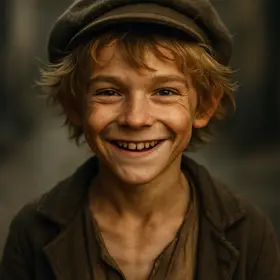
Gavroche in Les Misérables
Major character
A streetwise Paris urchin: witty, generous, and fearless, who feeds, scouts for, and inspires the insurgents at the barricades.
Who is Gavroche?
Gavroche is a scrappy, charismatic street-boy of Paris who survives by his wits and charms. He moves freely between the city’s alleys, the ruined Bastille elephant, and the revolutionary barricades, acting as helper, messenger, and comic provocateur. He steals opportunely to aid the destitute (slipping Montparnasse’s purse to Mabeuf), shelters younger children inside his makeshift lair beneath the elephant, and supplies ammunition and intelligence to the insurgents. During the June 1832 uprising he constantly reconnoiters, taunts the enemy with songs, rallies defenders, helps fetch cartridges from fallen National Guardsmen, and carries an urgent letter from Marius to Cosette. Gavroche’s small size and boldness let him perform tasks adults refuse or cannot do; his gaiety and irreverent verse sustain morale even as he courts danger. Ultimately his daring leads him to move among exposed corpses collecting cartridges and to die in the street, a dramatic, public casualty of the barricade fighting.
In the book: Gavroche is a Paris street urchin whose wit, generosity, and daring make him a lifeline and messenger for others throughout the story. He embodies the resilient spirit of the city’s poor, offering comic relief, sharp social commentary, and unexpected acts of kindness and bravery, especially during the turmoil surrounding the June Rebellion of 1832.
Personality
- Bold
- He darts into the open street under musket fire to collect cartridge-boxes from twenty corpses (Volume 5, Chapter 15).
- Generous
- He lifts Montparnasse’s purse and flings it over the hedge so Father Mabeuf finds several napoleons (Volume 4, Chapter 2: Mother Plutarque Explains).
- Playful
- He smashes lanterns, tears down theatre posters, and sings mock couplets while brandishing a pistol as the riot begins (Volume 4, Chapter 1: Gavroche’s Beginnings and Songs).
- Resourceful
- He fashions a comfortable lair under the Bastille elephant from scavenged items and keeps the boys sheltered during a storm (Volume 4, Chapter 2: Gavroche and the Elephant).
- Loyal
- He accepts Marius’s urgent commission at midnight and runs to deliver the farewell to Cosette despite the danger (Volume 4, Chapter 7: Gavroche delivers letter).
Character arc
Gavroche appears first as a mischievous, independent street urchin who delights in lamp-smashing, mock-soldiering, and teasing respectable Parisians. Early episodes show him caring for younger children, pilfering to relieve want, and creating a makeshift home under the Bastille elephant, establishing his combination of mischief and tenderness. As insurrection breaks out, he joins the student-led band in playfully combative rôle, using song and gibes to galvanize the rebels and performing reconnaissance and small acts of sabotage (stealing a cart, taunting guards). When the barricade solidifies, he moves from comic provocateur to active combat-support: recruiting, urging builders, fetching ammunition, and warning of troop movements. His trajectory culminates in self-sacrificial audacity—brazenly collecting cartridges among corpses under fire to supply the defenders. That daring costs him his life: he is struck down while mocking and singing, falling as a public and symbolic casualty. Throughout, Gavroche changes from a streetwise rogue into a small but heroic emblem of popular resistance, his death marking the end of his lively autonomy and crystallizing his moral significance for the insurgents.
Relationships
- M. Mabeuf Gavroche aids Mabeuf by sending him Montparnasse’s stolen purse and later marches with him toward the barricades.
- Montparnasse Montparnasse is a fellow street youth whose purse Gavroche lifts and whose escape Gavroche assists in scenes around La Force.
- Enjolras Enjolras is the barricade leader who dispatches Gavroche on errands and whose strict command Gavroche supports through morale and deeds.
- Marius Pontmercy Marius entrusts Gavroche with the vital task of delivering Cosette’s farewell; Gavroche later returns and reenters the fight where Marius is present.
- Jean Valjean Jean Valjean briefly encounters Gavroche outside No.7 and receives from him a folded paper from the barricade before the boy flits away.
- Éponine Éponine recognizes Gavroche’s voice and presence on the barricade and fears his reproach when she lies dying near Marius.
Quotes by Gavroche
“Here we are! Long live General Lafayette!”
Volume 4, Chapter 2Gavroche triumphantly announces the boys' safe arrival inside the elephant and gives a mock-patriotic cry that mixes playfulness and civic reference.
“A young ’un like me’s a man, and men like you are babes.”
Volume 4, Chapter 3Gavroche answers tauntingly when asked if he can climb the flue, demonstrating his confidence and streetwise disdain for adult criminals.
“I break a cane, otherwise expressed, I cut my stick, or, as they say at the court, I file off.”
Volume 4, Chapter 1Gavroche’s quirky, colloquial farewell to the two children he shelters; it reveals his resourceful, playful character.
“How fat those moneyed men are! They’re drunk! They just wallow in good dinners.”
Volume 4, Chapter 1A blunt, mocking judgment on the bourgeois that encapsulates Gavroche’s role as a street-level critic of wealth and hypocrisy.
“All goes well. I suffer a great deal in my left paw, I’m all broken up with rheumatism, but I’m satisfied, citizens.”
Volume 4, Chapter 2Part of Gavroche’s mock-heroic speech that blends comic self-pity, political bravado, and streetwise rhetoric, revealing his character and tone.
““Keksekça?” said he to Courfeyrac.”
Volume 4, Chapter 4Gavroche’s street dialect and curiosity when he notices the old man, revealing his blunt, observational voice.
Why Gavroche matters
Gavroche embodies the irrepressible spirit of Paris’s poorest—playful, daring, and morally generous. He links petty street-life and large political struggle: his thefts ease private suffering, his songs mock authority and sustain collective courage, and his scavenging of cartridges literally keeps the rebellion alive. As a child who freely crosses social boundaries, he exposes both the civic energy and the human cost of revolution. His public, unceremonious death underscores Hugo’s theme of sacrificial youth and the tragic waste inflicted by political conflict, while his gaiety and bravery underscore the dignity and agency of the urban poor within the novel’s moral landscape.
Chapters with Gavroche
- Volume 4, Chapter 2
- Volume 4, Chapter 1
- Volume 4, Chapter 2
- Volume 4, Chapter 3
- Volume 4, Chapter 3
- Volume 4, Chapter 1
- Volume 4, Chapter 2
- Chapter 3
- Volume 4, Chapter 4
- Volume 4, Chapter 5
- Volume 4, Chapter 6
- Volume 4, Chapter 2
- Volume 4, Chapter 3
- Volume 4, Chapter 4
- Volume 4, Chapter 7
- Volume 4, Chapter 8
- Volume 4, Chapter 1
- Volume 4, Chapter 3
- Volume 4, Chapter 4
- Volume 4, Chapter 5
- Volume 4, Chapter 6
- Volume 4, Chapter 7
- Volume 4, Chapter 2
- Volume 4, Chapter 4
- Volume 5, Chapter 7
- Volume 5, Chapter 8
- Volume 5, Chapter 11
- Chapter 14
- Chapter 15
- Volume 5, Chapter 16
- Chapter 17
- Chapter 22
- Chapter 2
- Volume 5, Chapter 7
- Volume 5, Chapter 2
- Volume 5, Chapter 4
More Les Misérables characters
 Jean ValjeanProtagonist
 CosetteMajor character
 Marius PontmercyMajor character
 CourfeyracMajor character
 JavertAntagonist
 ThénardierAntagonist
 EnjolrasMajor character
- MMariusMajor character
All chapter summaries ›Characters ›
Read Les Misérables illustrated
Every scene in these notes comes from the Book2Life reader, where the full public-domain text is illustrated as you read, with character portraits and narration. Free in your browser and on iPhone.
