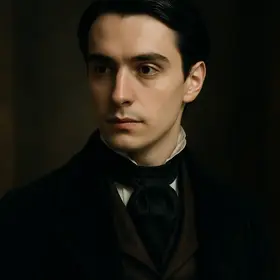
Montparnasse in Les Misérables
Minor character
A handsome, vain young dandy turned member of Patron-Minette whose elegance conceals casual cruelty and petty criminality.
Who is Montparnasse?
Montparnasse is a youthful member of the Parisian underworld and one of the four named ruffians who form the core of Patron-Minette. He cultivates an effeminate, dandyish appearance and seeks the refinements of dress and social cachet even as he lives by theft, violence, and association with professional thieves. Across the chapters in which he appears he plays supporting roles in criminal episodes: he is present in the gang’s self-description; he attacks an elderly man (Father Mabeuf) and is exposed when Gavroche lifts the purse from him; he slips away with Éponine during a police sweep; he helps execute a prison escape from La Force and later fetches Gavroche to assist Thénardier’s descent; and he menaces Éponine and the others while they reconnoiter the Rue Plumet. Montparnasse does not drive the novel’s main plot but repeatedly embodies the nocturnal, attractive, and morally bankrupt subculture that haunts Paris’s margins.
In the book: Montparnasse is a youthful member of the Parisian underworld, part of the Patron-Minette gang, whose elegance and vanity mask a cold, casual cruelty. He represents the seductive glamour of crime in the novel’s depiction of Paris’s shadows, crossing paths with major figures and highlighting the tension between appearance and morality without driving the central plot himself.
Personality
- vain
- Hugo emphasizes his coquettish dress and desire for fine clothes when profiling him among the four ruffians.
- cruel
- He attacks the elderly Father Mabeuf in the garden lane, taking the man’s purse until Gavroche intervenes.
- resourceful
- He participates in the organized escape from La Force, slipping along roofs and helping fugitives to freedom.
- pragmatic
- When Thénardier is stranded, Montparnasse brings Gavroche to rig the rope that lets Thénardier climb down.
- menacing
- At the Rue Plumet, he openly threatens Éponine, saying she would have been killed if the gang had wished it.
Character arc
Montparnasse appears consistently as an emblem of the nocturnal underworld rather than a character who undergoes deep transformation. He is first presented in a chapter of character studies as a handsome dandy who has become a murderer through idleness and vanity. Subsequent scenes show him operating within Patron-Minette’s flexible troupe: he slips away from arrest with Éponine, participates in La Force’s roof-and-chimney escape, and aids in practical rescues and burglaries. Small episodes reveal facets of him — his attack on Father Mabeuf exposes predatory instincts; his collaboration with fellow ruffians and his quick decision to fetch Gavroche for a rope show tactical membership in a criminal network; his menace toward Éponine and casual acceptance of violence underline a hardened moral indifference. Over the span of his appearances he does not reform or express remorse; instead he consistently embodies the alluring but dangerous permanence of the criminal subculture, remaining an agent of the city’s shadow life until his last cited action.
Relationships
- Éponine An associate and companion in the underworld who slips away with Montparnasse during the La Force affair and whom he later threatens at Rue Plumet.
- Gavroche A street urchin ally whom Montparnasse fetches to rig the rope that rescues Thénardier and who also lifts Montparnasse’s purse in the Mabeuf episode.
- Thénardier A fellow criminal and beneficiary of Montparnasse’s escape operations; Montparnasse helps effect Thénardier’s descent from a ledge after La Force’s breakout.
- Babet A close comrade within the Patron-Minette quartet and co-conspirator in escapes and nocturnal schemes.
- Gueulemer One of the other named ruffians in Patron-Minette who operates alongside Montparnasse in raids and the La Force escape.
- Brujon Another member of the criminal troupe whose plotting and prison activity intersect with Montparnasse’s movements and the gang’s operations.
Why Montparnasse matters
Montparnasse personifies Hugo’s theme of the seductive glamour of crime: his elegance and vanity make vice attractive while his actions reveal underlying brutality. As part of Patron-Minette he illustrates how social conditions and idleness produce recurring criminal types, and his scenes highlight the novel’s contrast between daylight virtue and nocturnal vice. Through his interactions with Gavroche, Éponine, and the fugitives from La Force, he helps map the social networks that sustain Paris’s shadows and underscores the moral instability of characters who choose appearance over conscience.
Chapters with Montparnasse
More Les Misérables characters
 Jean ValjeanProtagonist
 CosetteMajor character
 Marius PontmercyMajor character
 CourfeyracMajor character
 JavertAntagonist
 ThénardierAntagonist
 EnjolrasMajor character
- MMariusMajor character
All chapter summaries ›Characters ›
Read Les Misérables illustrated
Every scene in these notes comes from the Book2Life reader, where the full public-domain text is illustrated as you read, with character portraits and narration. Free in your browser and on iPhone.
