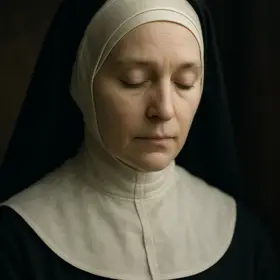
Sister Simplice in Les Misérables
Major character
A humble, devout Sister of Charity who nurses Fantine and quietly embodies truthful compassion and selfless service.
Who is Sister Simplice?
Sister Simplice is a pale, austere nun of the Sisters of Charity who tends the sick in the town infirmary. She devotes herself especially to Fantine, watching nights at her bedside, preparing medicines, and trying to preserve Fantine’s fragile peace. When Fantine clings to the belief that Monsieur le Maire has fetched her child, Simplice weighs the moral cost of truth versus mercy and chooses to protect the patient’s hope. Later, when Jean Valjean returns clandestinely after escaping arrest, Simplice is placed in danger by Javert’s questioning; to protect Valjean she gives an answer that conceals his presence. Throughout her appearances she acts from conscience and humility, preferring service over recognition; she keeps the household’s continuity after Fantine’s death by watching the body and assisting at the pauper’s burial, and she continues as part of the quiet convent world that shelters Cosette and Valjean in later chapters.
In the book: Sister Simplice is a humble nun and nurse whose unwavering honesty and quiet compassion make her a moral touchstone in Les Misérables. She tends to the suffering with self-effacing devotion and becomes briefly entangled in the fates of key characters, embodying the novel’s themes of mercy, conscience, and the quiet heroism of service—without seeking attention or reward.
Personality
- Truthful
- Introduced as having an 'unblemished habit of truth' and named for a martyr famed for refusing any falsehood.
- Compassionate
- She keeps continuous vigil at Fantine’s bedside, preparing chinchona and tending the invalid through fever and delirium.
- Humble
- She performs exhausting nursing tasks without seeking notice, conforming to the austerity and self-effacement of her order.
- Conscientious
- She agonizes about whether to tell Fantine the mayor’s true whereabouts and ultimately acts to spare the patient harm.
- Protective
- When Javert questions her about Jean Valjean, she gives an answer that shields him and thus aids his escape.
Character arc
Sister Simplice appears consistently steady rather than dramatically transformed; her arc is one of tested constancy. At first she is presented as an ideal of scrupulous truth and devout service, devoted to Fantine’s bedside and faithful to the rules and spirit of her order. The crisis moments—Fantine’s fevered insistence about Cosette and the later visitation by Javert—force Simplice to choose among competing moral goods. Faced with Fantine’s fragile hope, she suppresses a literal truth about the mayor’s absence in order to preserve the patient’s life-force; later, confronted by Javert’s interrogation, she again departs from rigid literalism to protect a person in need. These decisions do not signal a change of character so much as a deepening practical charity: she consistently privileges mercy and the well-being of those entrusted to her over abstract strictness. By the end of her appearances she remains the same devout, humble sister, but one whose fidelity has been strained and proven in concrete moral tests.
Relationships
- Fantine Sim plice is Fantine’s devoted nurse, keeping long watches and tending her through fever and delirium.
- M. Madeleine She reports Fantine’s condition to M. Madeleine and defends the patient's hope about Cosette while consulting him.
- Jean Valjean When Valjean returns clandestinely, Simplice accepts his presence and later helps conceal him from Javert during questioning.
- Javert Javert interrogates her about Jean Valjean’s whereabouts; her answer to him protects Valjean and thwarts his scrutiny.
- Cosette Though not Cosette’s nurse, Simplice’s care of Fantine and her role in the infirmary indirectly affect Cosette’s fate and the household’s stability.
- Bishop Myriel As a sister in the same religious tradition influenced by the bishop’s model of charity, her life of humble service reflects his example.
Quotes by Sister Simplice
“I, Monsieur le Maire.”
Volume 1, Chapter 4The portress announces herself at the door, bringing the external summons that ends the chapter's nocturnal solitude.
““Good God, sir!” she exclaimed; “what has happened to you? Your hair is perfectly white!””
Volume 1, Chapter 1The sister reacts to the startling change in M. Madeleine’s appearance, signaling an outward sign of his inner transformation.
Why Sister Simplice matters
Sister Simplice embodies Hugo’s theme that quiet, practical mercy can outweigh abstract truth. Her repeated choice to spare suffering—by withholding or softening truth—poses a moral argument that compassion sometimes requires bending literal honesty for a higher good. She also models the novel’s respect for modest, institutional charity: unlike grand gestures, her patient, unremarked service sustains vulnerable people and preserves human dignity. In the narrative she functions as a moral touchstone whose tested humility and protective acts reveal how conscience and tenderness operate inside social and legal pressures.
Chapters with Sister Simplice
More Les Misérables characters
 Jean ValjeanProtagonist
 CosetteMajor character
 Marius PontmercyMajor character
 CourfeyracMajor character
 JavertAntagonist
 ThénardierAntagonist
 EnjolrasMajor character
- MMariusMajor character
All chapter summaries ›Characters ›
Read Les Misérables illustrated
Every scene in these notes comes from the Book2Life reader, where the full public-domain text is illustrated as you read, with character portraits and narration. Free in your browser and on iPhone.
