
The Charwoman in Metamorphosis
Minor character
A coarse, practical cleaner hired after the maid leaves who handles unpleasant tasks and discovers Gregor's body.
Who is The Charwoman?
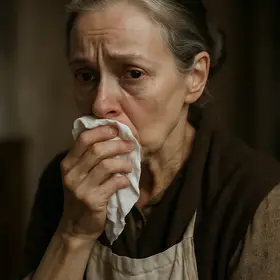
The Charwoman appears after the Samsa family dismisses their maid and takes over the household's heavy, unpleasant work. She wants straightforward pay and a clear routine rather than involvement in the family's emotions; she therefore treats the household's crisis with unflinching practicality. In the flat she dumps rejected items and rubbish, performs hard labour other members avoid, and tolerates the cramped, increasingly inhospitable conditions. Her behaviour punctures the family's anxious pretenses: she neither faints nor moralizes at Gregor's condition but treats the situation as a messy domestic problem to be managed. In the final chapter she continues her blunt routine, and it is she who finds Gregor's dead body. Her discovery allows the Samsas to move from private misery to a more performative relief; her presence and actions emphasize the prosaic, material consequences of Gregor's transformation and the family's pragmatic reordering of household life.
In the book: Hired by the Samsa family after their maid departs, the Charwoman becomes a practical, unflinching presence who treats the strange situation in the household with matter-of-fact curiosity rather than horror. She punctures the family’s anxious pretenses, handles chores others avoid, and provides a coarse, earthbound counterpoint to the story’s claustrophobic anxiety, highlighting class dynamics and the limits of bourgeois decorum without centering the narrative on herself.
Personality
- practical
- She takes over the heavy household labour after the maid leaves and continues routine tasks without dramatics.
- unflinching
- She does not faint or recoil when confronted with the household's disorder and the creature's room being used as a dump.
- coarse
- She habitually dumps items and rubbish in Gregor's room, using it as a place to discard unwanted things.
- matter-of-fact
- She discovers Gregor's body and treats the event as a practical finding rather than an occasion for overt sentimentality.
Character arc
The Charwoman's role is steady rather than developmental: she is introduced when the family dismisses their maid and needs a worker willing to do the household's hard, disagreeable tasks. From her first appearances she embodies a pragmatic approach—doing what must be done without indulging in the family's fear or sentiment. As the household contracts and life becomes governed by survival and work, she becomes the fixed, earthbound presence who manages the mess other members avoid. Her routine includes dumping refuse into Gregor's room and performing labour that underscores the household's declining standards and resources. At the end she finds Gregor's body; this discovery does not transform her but catalyzes the family's shift from anxious containment to visible relief and forward planning. She therefore remains functionally constant: a working-class agent who exposes and facilitates the household's pragmatic responses, rather than undergoing a personal change.
Relationships
- Gregor Samsa She treats Gregor's room as a convenient place to dump rubbish and is the one who discovers his corpse, interacting with him only functionally.
- Grete Samsa She replaces the maid's physical labour, indirectly supporting Grete's attempt to maintain order while Grete takes paid work and studies.
- Mr. Samsa She performs the hard labour Mr. Samsa no longer handles, embodying the classed division between managerial patriarch and manual worker.
- Mrs. Samsa She carries out household tasks Mrs. Samsa avoids or cannot manage amid the family's strain, highlighting the mother's diminished role.
- The Lodgers Her focus on cleanliness and dumping of refuse contrasts with the lodgers' fastidiousness and helps reveal the clash between needs and expectations that leads the lodgers to leave.
Quotes by The Charwoman
““Listen”, said the chief clerk in the next room, “he’s turning the key.””
IMarks the moment Gregor shows agency by opening the door, immediately followed by the family’s shocked, fearful reaction.
Why The Charwoman matters
The Charwoman functions as a material, classed counterpoint to the Samsas' emotional crisis. Her practical indifference and willingness to do dirty, humiliating work expose the family's reliance on labour they disdain and highlight the social distance between bourgeois pretence and working reality. By dumping rubbish in Gregor's room and discovering his body, she turns a private horror into a domestic fact to be managed, underscoring themes of dehumanization, the banality of care, and the limits of sentiment. Her presence makes the family's eventual relief and future planning appear less ethical than pragmatic, stressing how social roles and economic necessity shape responses to suffering.
Chapters with The Charwoman
More Metamorphosis characters
 Gregor SamsaProtagonist
 Grete SamsaMajor character
 Mr. SamsaAntagonist
 Mrs. SamsaMinor character
 The Chief ClerkMinor character
 The LodgersMinor character
All chapter summaries ›Characters ›
Read Metamorphosis illustrated
Every scene in these notes comes from the Book2Life reader, where the full public-domain text is illustrated as you read, with character portraits and narration. Free in your browser and on iPhone.
