
Edna Pontellier in The Awakening
Protagonist
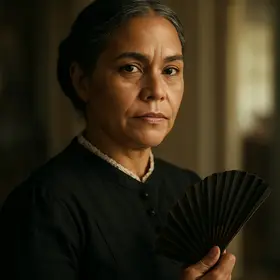
A young Creole wife and mother who awakens to her own desires and seeks independence from social expectations.
Who is Edna Pontellier?
Edna Pontellier is introduced as a polite, reserved wife and mother spending a summer at Grand Isle with her husband Léonce and their two sons. Beneath her domestic composure, she feels a growing restlessness that surfaces in solitary walks, a deepening friendship with Robert Lebrun, and an absorbent response to Mademoiselle Reisz’s music. After Robert’s initial departure she throws herself into the sea and into artistic pursuits, experiments with new habits, and later moves out of the family house into a small 'pigeon-house' of her own. She alternates between longing for Robert and allowing Alcée Arobin’s flirtations, hosts a small select dinner, cultivates an atelier for painting, and ultimately claims more control over her daily life—choosing solitude, rearranging possessions, and planning her own household routines. Throughout the chapters she resists conventional maternal and wifely duties while testing the limits of social freedom available to her.
In the book: We first meet Edna as a young wife and mother summering at Grand Isle near New Orleans, married to Léonce Pontellier and caring for two small boys. She’s polite and reserved among the Creole vacationers, but you can already feel her curiosity and restlessness as she wanders the beach, talks with Robert Lebrun, and starts listening to her own moods more closely.
Personality
- Restless
- She wanders the beach and feels an unaccountable grief on the porch at night (Chapter 3) and later abandons social routines and household duties (Chapter XIX).
- Sensitive
- She has a powerful, tearful reaction to Mademoiselle Reisz’s playing and reads Robert’s letter while the music overwhelms her (Chapter 21).
- Impulsive
- She stamps on her wedding ring, smashes a vase in a fit of passion, and soon after decisively moves into a small house without her husband’s consent (Chapters XVII and XXIX).
- Independent-minded
- She refuses Léonce’s command to come in from the hammock and later sets up her own household, dining alone and rearranging domestic life (Chapters XI and XXIV).
- Artistic
- She devotes herself to painting in an atelier at the top of the house and places her art at the center of her new habits (Chapter XIX).
Character arc
Edna’s arc begins as a conventionally dutiful wife and mother vacationing at Grand Isle, where small moments—intimate talks with Robert, solitary walks, and a moonlit swim—awaken a sense of inner life (Chapters I–X). This nascent self-awareness grows: she experiences repeated emotional surges (the night of tears in Chapter III; the trembling at Mademoiselle Reisz’s music in Chapter IX) and increasingly resists marital and social expectations (refusing Léonce’s orders in Chapter XI; breaking household rituals in Chapter XVII–XIX). After Robert’s temporary departure she seeks consolation in the sea and art (Chapters XVI and XIX), then pursues greater autonomy—seeking out Mademoiselle Reisz, moving into the pigeon-house, and claiming a domestic sphere of her own (Chapters XX–XXIV, XXXII–XXXIII). Her relationships complicate her experiment in freedom: Alcée Arobin’s advances and Arobin’s physical passion clash with her emotional longing for Robert (Chapters XXV–XXXI, XXXVI), and Robert’s return produces hope followed by a painful, final refusal captured in his farewell note (Chapter XXXVII). Over the course of the chapters she shifts from dutiful conformity toward deliberate separation and self-possession, repeatedly testing the costs and limits of independence.
Relationships
- Léonce Pontellier Her husband, whose conventional expectations and pragmatic responses clash with her growing independence.
- Robert Lebrun A younger friend and the principal object of her emotional awakening and romantic longing.
- Adèle Ratignolle Her close friend and foil: the idealized mother-woman whose domestic contentment contrasts with Edna’s restlessness.
- Mademoiselle Reisz A brusque, gifted pianist and confidante who provokes and interprets Edna’s deepest feelings and artistic impulses.
- Alcée Arobin A charming libertine whose flirtations and physical passion awaken Edna’s sensual side and test her resolve.
- Doctor Mandelet A family physician who understands Edna’s sensitivity and counsels patience while observing her unrest.
Quotes by Edna Pontellier
““It will buy a handsome wedding present for Sister Janet!””
IIIEdna’s quick acceptance of the money and reference to charity/family duties underscores social norms and appearances.
“I was really not conscious of thinking of anything; but perhaps I can retrace my thoughts.”
7Edna answers Adèle’s question about what she is thinking and begins to recall memories prompted by the sight of the sea.
“sometimes I feel this summer as if I were walking through the green meadow again; idly, aimlessly, unthinking and unguided.”
7Edna admits a recurrent sensation of aimlessness and comparison of the present summer with an early childhood memory.
“I thought I should have perished out there alone.”
XEdna admits the flash of terror she felt at sea, tempering her triumph with the recognition of real danger.
““I mean to stay out here. I don’t wish to go in, and I don’t intend to. Don’t speak to me like that again; I shall not answer you.””
XIEdna asserts her will explicitly, refusing obedience and setting a personal boundary that marks a shift in her behavior.
“Tell him I am going to the Chênière. The boat is ready; tell him to hurry.”
XIIEdna's unexpected command to fetch Robert marks a small but significant assertion of will.
Why Edna Pontellier matters
Edna functions as the novel’s focal vehicle for themes of identity, autonomy, and the constraints of gendered social roles. Her internal awakenings—prompted by the sea, music, and intimate relationships—expose the tension between personal desire and the expectations of wifehood and motherhood. By breaking routine, pursuing art, and establishing a separate household, she dramatizes the cost of self-possession within a restrictive social order. Her interactions with figures like Adèle, Mademoiselle Reisz, and Léonce map alternative responses to feminine identity—conformity, artistic independence, and pragmatic control—making Edna’s experiments central to the book’s exploration of freedom, responsibility, and the limits of social change.
Chapters with Edna Pontellier
More The Awakening characters
 Robert LebrunMajor character
 Léonce PontellierMajor character
 Adèle RatignolleMajor character
 Madame LebrunMinor character
 Mademoiselle ReiszMajor character
 Alcée ArobinMajor character
 Raoul PontellierMinor character
 Étienne PontellierMinor character
All chapter summaries ›Characters ›
Read The Awakening illustrated
Every scene in these notes comes from the Book2Life reader, where the full public-domain text is illustrated as you read, with character portraits and narration. Free in your browser and on iPhone.
