The Brothers Karamazov Chapter 1 Summary
The Fatal Day
Dmitri Karamazov's trial opens amid intense public interest, courtroom spectacle, witnesses and dramatic declarations.
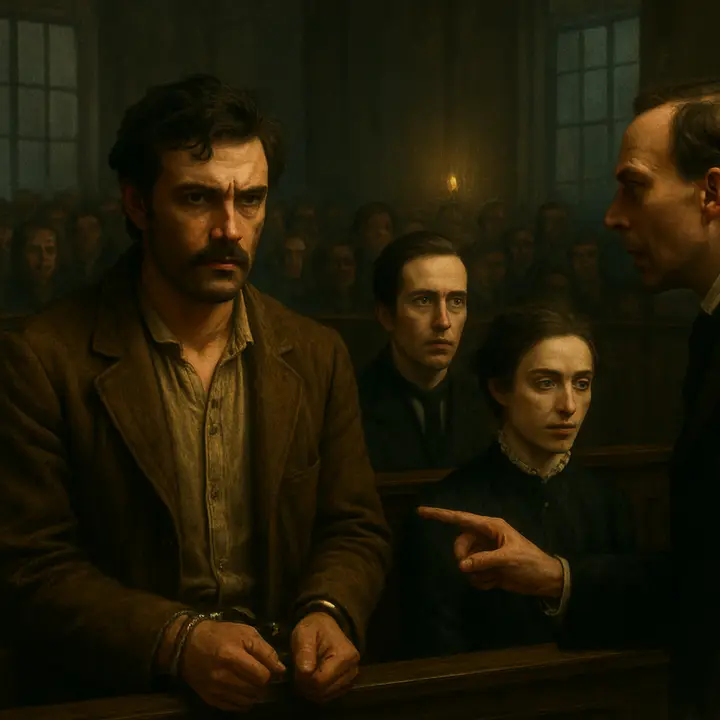
Summary
At ten o’clock the trial of Dmitri (Mitya) Karamazov opens in the district court before a packed and buzzing public that has come from across the province and from Moscow and Petersburg. The narrator warns that he cannot record every detail and will relate what struck him most. The hall is filled with curious visitors, many women who largely sympathize with Mitya, and many men who are biased against him; prominent lawyers and notable personages attend, and a special place is provided for distinguished visitors. Much of the town’s gossip about Katerina Ivanovna and Grushenka fuels the crowd’s interest and heightens anticipation of the rivals meeting in court. Fetyukovich, the celebrated defense counsel, and the prominent prosecutor (Ippolit Kirillovich) are both present, and there is talk about their reputations and rivalry.
The court layout, the material exhibits and the jurymen are described in detail: Fyodor Pavlovich’s bloodstained dressing-gown and pestle, Mitya’s bloodstained clothes and other objects are laid out on a table. The jury consists of officials, merchants, artisans and peasants—men whose capacity to judge such a psychological case is openly questioned. When the prisoner is brought in, Mitya’s appearance—immaculately dressed, composed, and yet provocative—makes a poor impression on the narrator. The sudden announcement of Smerdyakov’s death causes a stir; Mitya shouts that Smerdyakov “was a dog and died like a dog,” an outburst his counsel must check. The opening statement presents the charges and circumstances succinctly, and when asked if he pleads guilty, Mitya rises and admits to drunkenness and debauchery but fiercely denies murdering or robbing his father, declaring himself a scoundrel but not a thief. The court proceeds to swear and seat witnesses, while the brothers are allowed to give evidence without oath, and the case moves forward under the President’s formal direction.
Key events
- Courtroom packed with visitors, lawyers, and women largely sympathetic to Mitya
- Description of material exhibits: dressing-gown, pestle, Mitya's bloodstained clothes, pistol, envelope
- Jury composition noted (officials, merchants, peasants) and public doubts about their fitness
- Prisoner Dmitri enters in fine clothes and makes a poor impression
- Announcement of Smerdyakov’s death sparks Mitya’s outburst
- Opening statement read; Mitya denies patricide but admits vices
- Witnesses are sworn and case ordered to proceed
Analysis
This chapter functions as the formal staging of the novel's central public crisis: the trial. Dostoyevsky uses rich courtroom detail to crystallize social reactions, gender divisions, and public spectacle. The crowd’s composition—lots of women favoring Mitya, men biased against him, and visiting lawyers—makes the trial into a social barometer, revealing how gossip, reputation, and romantic scandal shape judgment as much as evidence does. The narrator’s repeated disclaimers about selective memory and perspective foreground narrative subjectivity and prepare readers to question what is emphasized or omitted.
The chapter contrasts theatrical surface and moral substance: Mitya’s flashy dress and loud outburst mark him as both charismatic and self-destructive, while the judicial apparatus (president, prosecutor, jurymen) appears at once solemn and socially limited—especially through the uncomfortable focus on the jury’s humble makeup. Objects on the table (the dressing-gown, the pestle, the bloodied shirt, the pistol, the envelope and ribbon) function as mute, forensic symbols that promise material proof yet also invite interpretation and emotional responses. The episode of Smerdyakov’s reported death and Mitya’s reaction foreshadow tensions between private motives and public pronouncements. Narratively, the chapter shifts the novel from interpersonal backstory into public legal drama and sets up courtroom procedure as a way to test character, community, and truth.
Important quotes
“At ten o’clock in the morning of the day following the events I have described, the trial of Dmitri Karamazov began in our district court.”
NarratorOpening line that situates the scene and signals the shift into the public legal episode.
“He was a dog and died like a dog!”
Dmitri Fyodorovich KaramazovMitya’s impulsive outburst at news of Smerdyakov’s death, revealing his temper and harming his image before jury and public.
“I plead guilty to drunkenness and dissipation,”
Dmitri Fyodorovich KaramazovMitya admits his moral failures while loudly denying the specific crime of murdering and robbing his father.
Characters in Chapter 1
- Dmitri Fyodorovich Karamazov
- Fyodor Pavlovich Karamazov
- Katerina Ivanovna
- Agrafena Alexandrovna Svetlova (Grushenka)
- Fetyukovich
- Ippolit Kirillovich
- Pavel Fyodorovich Smerdyakov
- Pyotr Alexandrovich Miusov
- Lise Khokhlakov (Madame Hohlakov)
- Maximov
- Trifon Borissovitch
- Perhotin
- The President (of the Court)
- The prosecutor
- The jurymen
All chapter summaries ›Characters ›
Read The Brothers Karamazov illustrated
Every scene in these notes comes from the Book2Life reader, where the full public-domain text is illustrated as you read, with character portraits and narration. Free in your browser and on iPhone.
Read The Brothers Karamazov free
