Treasure Island Chapter 1 Summary

The Old Sea-dog

A mysterious, scarred seaman takes up lodging at the Admiral Benbow and unsettles the inn with his stories, watchfulness, and threats.
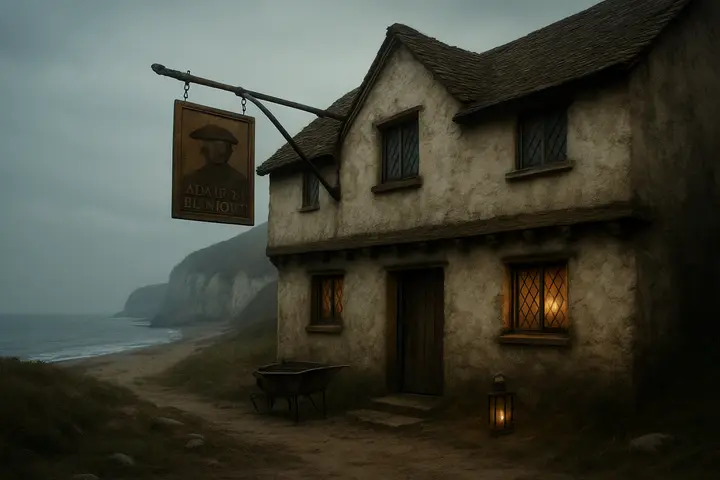
A weather‑beaten roadside inn clenches the edge of a low headland; its creaking sign and salt‑streaked timbers face a narrow cove where chalk cliffs tumble to a strand and a silver smear of sea fades into mist. A handbarrow and a battered lantern stand by the stoop, wind‑wrung grass and gull‑scattered rocks leading the eye to the brooding horizon.

Summary

The narrator, Jim Hawkins, opens by explaining why he is writing the story and returns to the time when a tall, nut-brown seaman with a sabre cut first arrives at his father's inn, the Admiral Benbow. The man hauls his sea-chest in a barrow, pays a few gold pieces, and establishes himself as a rough, heavy, and solitary lodger who drinks rum, sings a haunting sea-song, and prowls the cliffs with a brass telescope. He calls himself a captain and behaves like an officer used to being obeyed. The innfolk learn to avoid provoking him; he is sociable only in fits of drunkenness, when he compels the company to listen to terrifying tales of hanging, piracy, and the Spanish Main.

Jim describes how the captain constantly asks whether any seafaring men have passed, and how he pays Jim a small monthly fee to watch for "a seafaring man with one leg," a figure who haunts Jim's nightmares. Though the captain terrifies the neighborhood, Jim's father tolerates him until his money runs out; the lodger refuses to be pressed for payment and cowes the host. One evening Dr. Livesey visits the Benbow; the captain's song and domineering manner provoke a confrontation. When the captain threatens the doctor with a clasp-knife, Dr. Livesey calmly orders him to put it away and, asserting his role as magistrate, warns that he will have the man hunted and routed out if any complaint reaches him. The captain backs down, and though resentful, keeps silent for some time afterward. The chapter sets the scene at the inn and establishes the captain as a menacing, secretive presence whose past and motives are obscure.

Key events

  1. A scarred, sabre-cut seaman arrives and takes lodging at the Admiral Benbow.
  2. He pays gold, claims the cove as his berth, and behaves like a commanding captain.
  3. He drinks, sings a grim sea-song, and tells terrifying tales that alarm locals.
  4. He hires young Jim to watch for a one-legged seafaring man, haunting Jim's dreams.
  5. Dr. Livesey confronts the captain when threatened with a knife and warns to have him routed out.

Chapter 1 in pictures

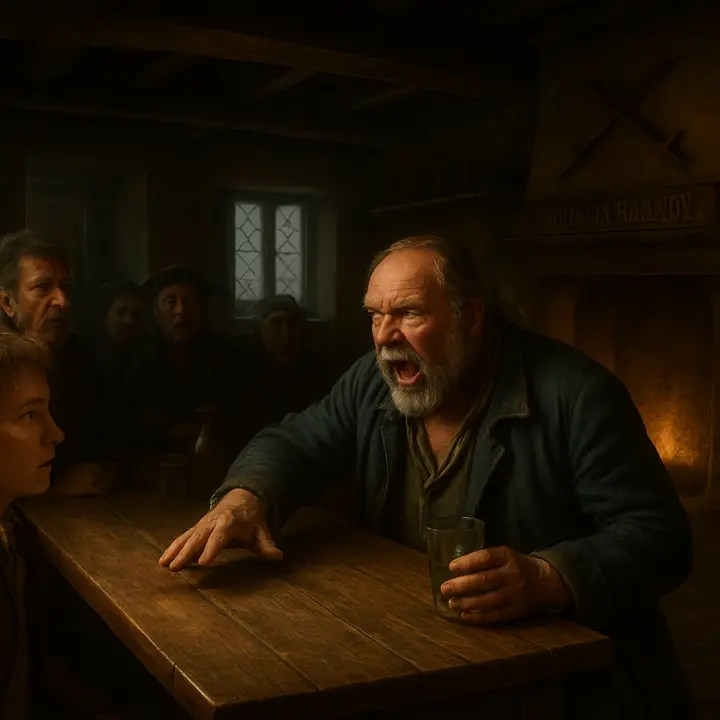
A bleared, sabre‑scarred seaman leans over the parlour table, snarling as he balances a sailor's clasp‑knife on his open palm; opposite him Dr. Livesey stands calm and composed, ordering the knife away while the room holds its breath. Firelight throws the faces of frozen patrons into harsh relief, the open door hints at the waiting horse outside, and the tension between the furious pirate and the unflinching doctor vibrates in the smoke‑hung air.
Inside the taproom the same sea-dog sits in a corner by the fire, glass of rum and water in hand, and suddenly flaps his palm on the table and belts out the savage chorus — 'Fifteen men on the dead man's chest — Yo-ho-ho!' — while the room answers in forced, frightened chorus. Faces around the table are half-amused, half-terrified; a young Jim watches with a mixture of awe and alarm as the captain rants and commands the company.
Alone in the cramped upstairs garret, the sea‑dog sits slumped amid patched clothes and a half‑empty bottle of rum; his cocked hat hangs askew and the great sea‑chest remains shut and mysterious in the dim light. He mumbles the refrain of his song to himself, brooding and solitary, while shadows from the window fall across the unopened chest.
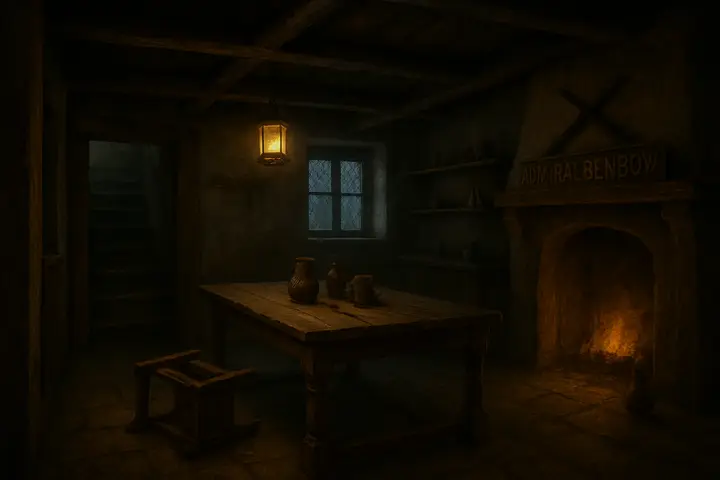
A dim parlour lit by a sputtering hearth and a single lamp: a heavy wooden table scarred by tankards, a pipe and an overturned chair, with soot‑stained walls and a shadowed staircase leading upstairs where a locked sea‑chest might lie. Smoke curls in the rafters and the room feels too small for its talk, every surface bearing the stain of long habitation and low company.
A hulking, weather-beaten seaman staggers up the Inn's muddy road and slams open the heavy door, rain-slick coat and a battered sea‑chest thudding behind him; his sun‑burned face is shadowed under a black beaver hat, eyes wary, a hand lingering near his belt as if to ward off foes. The Inn sign swings in the wind above, lamplight spilling onto the cobbles and catching the brass nails of the chest—a moment that announces danger and secrets arriving in a quiet country tavern.

Analysis

This opening chapter establishes mood, setting, and a central source of unease: the mysterious lodger. Through Jim's first-person narration the reader receives immediate, intimate impressions—sights, sounds, and local gossip—anchoring the tale in a small coastal community disturbed by a violent outsider. The captain functions as a catalyst: his presence exposes tensions between lawless seafaring violence and local civility (embodied by Dr. Livesey and the innkeeper). The recurring sea-song and the locked sea-chest are early symbols of hidden pasts and buried treasure, while the repeated reference to "the seafaring man with one leg" plants a specific, obsessive fear that foreshadows future conflict. Narrative technique matters: the story begins with a retrospective frame (the narrator writing at the request of others), which both promises a full account and creates suspense by admitting some facts remain concealed (the island’s bearings). The encounter with Dr. Livesey demonstrates character contrasts—calm, lawful reason versus bluff, threatening swagger—and establishes social authority that will oppose the captain's lawlessness. The chapter therefore prepares the reader emotionally and thematically, promising adventure, danger, and the clash between civilized order and piratical disorder while keeping much of the captain’s past deliberately obscure.

Important quotes

“Fifteen men on the dead man’s chest— Yo-ho-ho, and a bottle of rum!”

Narrator (singing by the captain)The captain's recurring sea-song that startles the inn, becomes a communal chorus, and marks his seafaring identity.

“This is a handy cove, ... and a pleasant sittyated grog-shop.”

The captainHis first appraisal of the Admiral Benbow that explains why he chooses to lodge there and shows his blunt, commanding manner.

“If you do not put that knife this instant in your pocket, I promise, upon my honour, you shall hang at the next assizes.”

Dr. LiveseyDr. Livesey's calm, authoritative rebuke to the captain's knife threat, asserting legal power over the inn's violent resident.

Characters in Chapter 1

Read Treasure Island illustrated

Every scene in these notes comes from the Book2Life reader, where the full public-domain text is illustrated as you read, with character portraits and narration. Free in your browser and on iPhone.

Read Treasure Island free

Download Book2Life on the App Store