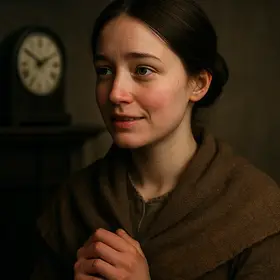
Caroline in A Christmas Carol
Minor character
A gently spoken, anxious wife who feels sudden relief when a merciless creditor dies, lifting a crushing threat of ruin.
Who is Caroline?
Caroline appears briefly in Stave Four as a modest, nervous wife in a humble London room. She and her husband are living under the shadow of a creditor’s claim; their whispered hopes and anxieties humanize the everyday pressure that debt exerts on ordinary families. When the Ghost of Christmas Yet to Come guides Scrooge to the scene, Caroline and her husband are shown reacting with immediate relief and even quiet joy at the news that the merciless creditor has died — their ruin is lifted because his death removes the threat of legal or financial punishment. Caroline’s presence is small but vivid: she gives a face and voice to the private, domestic consequences of economic hardship, and her moment contrasts sharply with other scenes of grief and indifference. Though she does not act beyond her frightened waiting and subsequent relief, her reaction contributes to the Spirit’s demonstration of how other people’s fates intersect with the cold calculations of commerce and mortality.
In the book: Caroline is a gently spoken wife in a humble London room, nervously watching the clock while she and her husband dread a creditor’s claim. When we first meet her, their whispered hopes and worries put a human face on how hard debts press ordinary families, making her moment feel close and real.
Personality
- anxious
- She sits in a humble room nervously watching the clock while dreading the creditor’s claim.
- humble
- She appears in a small, modest London room with her husband, suggesting limited means and simple circumstances.
- relieved
- When news arrives that the merciless creditor is dead, she and her husband feel their ruin is lifted and show immediate relief.
- quiet
- Her hopes and worries are whispered, giving a low, intimate tone to the scene.
Character arc
Caroline’s role is static but narratively important: she is introduced already under strain, waiting with her husband for a creditor’s claim. She does not experience a moral transformation or undertake actions that alter the plot; instead, her emotional journey is brief and situational. At first she is tense and fearful, the ticking clock emphasizing the immediacy of the threat. The Ghost of Christmas Yet to Come then reveals that the creditor has died; Caroline’s arc completes in that instant as fear turns to relief. Her final state is one of liberation from impending ruin, but this change is circumstantial — it results from another person’s death rather than from any change in her own behavior or circumstances beyond that death. The scene leaves her materially better off but morally unchanged, serving as a human detail in the Spirit’s larger lesson to Scrooge about consequences and the varied outcomes of mortality and commerce.
Relationships
- Caroline's Husband Her spouse and companion in the small room, sharing the same anxiety about the creditor’s claim.
- Ebenezer Scrooge Scrooge witnesses her private relief through the Spirit’s vision, making her an indirect lesson for him.
- The Portly Gentlemen They are part of the business district context that frames her situation, representing the commercial world that threatens families like hers.
- Old Joe An occupant of the same grim scene of scavengers and profiteers who profit from death, highlighting the economic backdrop to her relief.
- The Undertaker's Man Present in the squalid quarter the Spirit shows, he is part of the machinery that turns death into financial consequence for people like Caroline.
- Ghost of Christmas Yet to Come The silent spirit who reveals to Scrooge the vision in which Caroline’s fate is seen, making her moment visible.
Why Caroline matters
Caroline represents the ordinary victims of hard-hearted economic systems: small, private lives shaped by creditors and commerce. Her quick shift from fear to relief when a merciless creditor dies dramatizes the cruel calculus by which people’s fates can turn on someone else’s death. Placed beside the Cratchits’ tender grief, her moment emphasizes Dickens’s themes about social responsibility, the human cost of greed, and the uneven distribution of suffering and relief in Victorian London. She is a microcosm of how poverty and debt produce constant, intimate anxieties that the story urges readers and characters like Scrooge to acknowledge and address.
Chapters with Caroline
More A Christmas Carol characters
 Ebenezer ScroogeProtagonist
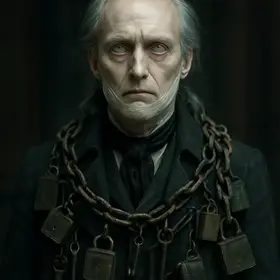 Jacob MarleyMajor character
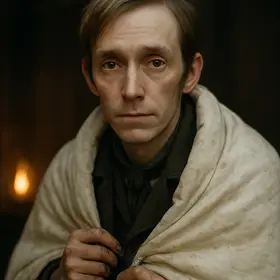 Bob CratchitMajor character
 FredMajor character
 Ghost of Christmas PastMajor character
 Ghost of Christmas PresentMajor character
 Ghost of Christmas Yet to ComeMajor character
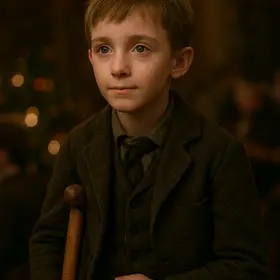 Tiny TimMajor character
All chapter summaries ›Characters ›
Read A Christmas Carol illustrated
Every scene in these notes comes from the Book2Life reader, where the full public-domain text is illustrated as you read, with character portraits and narration. Free in your browser and on iPhone.
