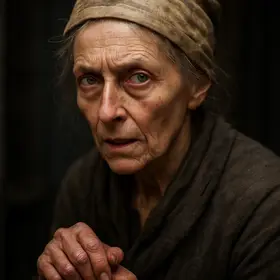
Mrs. Dilber in A Christmas Carol
Minor character
A practical charwoman who strips valuables from a corpse, bluntly revealing the street-level greed around Scrooge.
Who is Mrs. Dilber?
Mrs. Dilber appears in Stave Four as a no-nonsense charwoman working among rag-and-bone people who strip possessions from a recently dead man. She is brisk, unsentimental and alert to small profit, handling the corpse’s belongings with matter-of-fact economy. In the vision shown by the Ghost of Christmas Yet to Come, she is one of the figures who laugh and barter over the dead man’s clothing and items, demonstrating how the poor exploit whatever value remains in death. Her presence gives Scrooge a raw, everyday view of how his own death might be treated and provides a contrast to the private sorrow of the Cratchit household and the indifferent remarks of businessmen. Mrs. Dilber’s conduct emphasizes the social realities of the city: scarcity, opportunism, and a survival ethic that permits moral bluntness toward the dead.
In the book: We first meet Mrs. Dilber as a practical charwoman tied to Scrooge’s rooms—brisk, unsentimental, and always alert for a small profit. She speaks plainly, haggles without embarrassment, and gives the reader a street‑level glimpse of London’s poorer working folk around him.
Personality
- Practical
- She briskly takes and bargains over the dead man’s belongings without hesitation during the street scene.
- Unsympathetic
- She helps strip the corpse while laughing with others, showing no visible mourning or respect.
- Opportunistic
- She is alert for small profit, seizing whatever value remains from the dead man’s possessions.
- Blunt
- She speaks and acts plainly among the rag-and-bone people, offering no euphemism about their trade.
Character arc
Mrs. Dilber does not undergo a moral transformation in the text; she serves as a fixed social presence in the Ghost of Christmas Yet to Come’s tableau. From her first appearance in the vision to the end of the stave, she remains pragmatic and unsentimental, focused on extracting material value from what death leaves behind. Her consistent behavior—laughing and bartering over a corpse—functions less as personal development and more as a static, revealing mirror for Scrooge. By refusing sentimentality, she intensifies Scrooge’s horror and realization: if his life continues unchanged, he will be remembered and treated with the same callous economy. Thus her lack of change is purposeful: she embodies the persistent social forces (poverty, survival, commodification of people) that will not soften simply because an individual recognizes them, unless he acts to alter his own conduct toward others.
Relationships
- The Undertaker's Man Works alongside him in the scene where they strip and prepare the dead man's possessions for sale.
- Old Joe Operates in the same market of buyers and sellers who profit from others’ deaths, representing the trade that benefits her.
- Ebenezer Scrooge Her actions toward the unnamed corpse become a possible fate for Scrooge, prompting his horror and self-reflection.
- Bob Cratchit Provides a contrast to her conduct: where she strips value from death, the Cratchits show grief and tenderness for Tiny Tim.
- The Portly Gentlemen Belong to the broader social milieu that regards death and charity with varying degrees of indifference or calculation, giving context to her behavior.
Why Mrs. Dilber matters
Mrs. Dilber is significant because she embodies the theme of materialism and social indifference at the street level. Her practical stripping of the dead exposes how poverty and commerce can erode customary respect for persons after death. As a contrast to the Cratchits’ warmth and the private grief that Scrooge witnesses elsewhere, she highlights the moral consequences of a life lived without compassion. Her presence forces Scrooge (and the reader) to confront how social and economic pressures produce callous behavior, sharpening the novella’s critique of self-interest and underlining the need for social responsibility and personal change.
Chapters with Mrs. Dilber
More A Christmas Carol characters
 Ebenezer ScroogeProtagonist
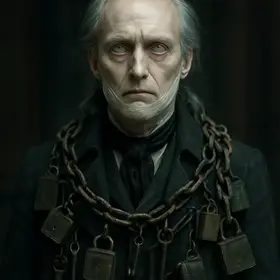 Jacob MarleyMajor character
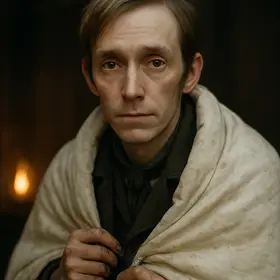 Bob CratchitMajor character
 FredMajor character
 Ghost of Christmas PastMajor character
 Ghost of Christmas PresentMajor character
 Ghost of Christmas Yet to ComeMajor character
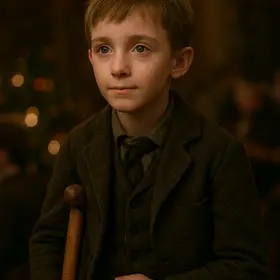 Tiny TimMajor character
All chapter summaries ›Characters ›
Read A Christmas Carol illustrated
Every scene in these notes comes from the Book2Life reader, where the full public-domain text is illustrated as you read, with character portraits and narration. Free in your browser and on iPhone.
