Adventures of Huckleberry Finn Chapter 15 Summary

Lost in the Fog

Huck loses the raft in a thick fog, drifts alone until he finds Jim asleep on the ruined raft, and then feels guilty when Jim reveals his painful dream about Huck's treatment of him.

A thick white fog swallows the river, reducing the world to a drifting maze of low tow‑heads and inset islands; cut banks loom as dark, slick walls and unseen snags send water roaring past. Small hummocks of sand and brush punctuate the mist like ghostly stones, the current slipping and eddying through narrow, confusing channels. The surface gleams with diffused light, everything softened and indistinct, as if the river itself had become a lost, breathing thing.

Summary

Huck and Jim are traveling downriver on their raft toward Cairo, hoping to sell the raft and travel into the free States. On the second night a fog rolls in; Huck goes ahead in the canoe to make fast to a tow-head but the raft tears the sapling out and floats off. The fog closes in, and Huck, disoriented, paddles and listens for Jim’s whoops, chasing sounds that seem to move unpredictably through islands and tow-heads. Exhausted and fearful, Huck finally gives up, dozes, and later wakes under a sky of stars to find he has drifted far downstream.

Huck spots specks of wreckage and at last finds the raft. Jim is asleep, worn out, with one oar broken and the raft littered with leaves and branches. Huck wakes him and they argue about what happened—Jim insists a fog and separation really occurred, while Huck insists he must have been dreaming. Jim recounts the whole episode and then “interprets” the dream as a warning about good and bad influences, islands as troubles, and the big clear river as the free States. At first Huck treats Jim’s story lightly, but then Jim reveals he dreamed of Huck being lost and felt ashamed that Huck had lied about his absence; Jim equates the trash on the raft with people who humiliate their friends. Huck feels deep remorse, goes to humble himself to Jim, resolves not to play such mean tricks again, and never does so thereafter.

Key events

  1. Fog rises; Huck paddles to tie raft to a tow-head but the raft breaks free.
  2. Huck becomes lost in thick fog and is unable to navigate by sound.
  3. Huck drifts among tow-heads and briefly dozes, fearing Jim is lost.
  4. Huck wakes under stars and finds the raft damaged and Jim asleep.
  5. Jim recounts his ordeal and interprets his dream as a warning.
  6. Jim reveals his emotional reaction to Huck’s earlier lie, shaming Huck into remorse and apology.

Chapter 15 in pictures

A suffocating white fog envelopes the river as Huckleberry Finn sits alone in the canoe, pale and trembling, paddles idly while currents spin him among tow‑heads and uprooted saplings. Distant whoops and the roar of snags punctuate the void; indistinct shapes loom and vanish in the mist, making the scene claustrophobic and disorienting.
Under bright stars as the fog lifts, Huck chases specks across a widening river and finally finds the battered raft: Jim asleep on deck with his head between his knees, one arm slung over the steering‑oar, the other oar smashed and leaves strewn everywhere. Huck rouses him; Jim explodes into grateful, bewildered joy—tears and laughter mingling as he cries, 'You ain't dead...too good for true!'
Dawn settles on a quiet raft as Jim, still shaken, retells his terrifying dream and interprets its meaning of danger and deliverance; Huck, stung by guilt, humbles himself and apologizes, abandoning his teasing tricks. The two sit in a charged silence that softens into renewed loyalty and mutual tenderness as the river beyond opens toward the free States.
The fog has burned off to reveal a huge river bend ringed in dense timber; black trunks crowd the shoreline, their canopies closing above like a dark wall. In the river a flat raft drifts stern‑first, its deck scattered with leaves, branches, and a snapped oar, the detritus catching starlight and trailing ripples. The sky is clear and brimming with stars, the quiet water reflecting pinpricks of light and the slow motion of the current around the bend.
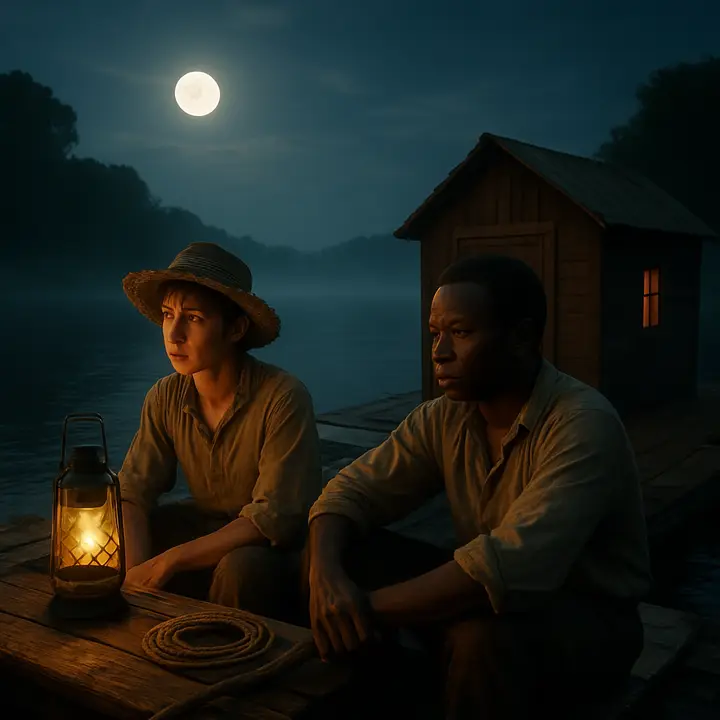
Huck and Jim crouch on a battered raft as a bank of blue-black fog rolls across the river; moonlight picks out the edges of their faces and the slow, reflective sweep of the water. A single lantern throws a warm pool of light on an oar and a coil of rope, making the raft feel like a fragile island in an immense, watching night.

Analysis

This chapter heightens tension and deepens the moral bond between Huck and Jim through a crisis of separation and a subsequent emotional reckoning. Structurally it provides a self-contained episode of danger—fog and river islands—that underscores the river’s unpredictability and acts as a test of Huck’s responsibility. The fog functions as both literal and figurative obscurity: it disorients perception and moral clarity, allowing Huck to confront the consequences of his earlier thoughtless behavior. Jim’s dream and its interpretation operate symbolically: tow-heads and islands signify obstacles and social entanglements, while the big clear river stands for freedom and safety. The wrecked raft and broken oar visually reinforce vulnerability and the costs of carelessness.

Narratively, Twain uses Huck’s first-person voice for immediacy and to reveal Huck’s shifting self-awareness—his fear, denial, and then guilt. Jim’s speech—emotional, measured, and moral—reorients Huck (and the reader) to the human reality behind the journey; Jim is not merely a companion but a moral center whose suffering elicits Huck’s conscience. This chapter thus advances themes of friendship, responsibility, and moral growth while preserving the episodic river-travel structure that frames Huck’s internal development against external hazards.

Important quotes

“I see the fog closing down, and it made me so sick and scared I couldn’t budge for most a half a minute it seemed to me—and then there warn’t no raft in sight; you couldn’t see twenty yards.”

NarratorHuck describes the moment he realizes the raft has been torn away and he is alone in a blinding fog, establishing fear and disorientation.

“When I got to it Jim was setting there with his head down between his knees, asleep, with his right arm hanging over the steering-oar.”

NarratorHuck finds Jim physically exhausted and the raft damaged, revealing the toll the separation and fog took on them and the raft.

“Dat truck dah is trash; en trash is what people is dat puts dirt on de head er dey fren's en makes 'em ashamed.”

JimJim interprets his dream and uses the raft's trash as a moral metaphor, pointing out how people humiliate friends and causing Huck deep shame.

Characters in Chapter 15

Read Adventures of Huckleberry Finn illustrated

Every scene in these notes comes from the Book2Life reader, where the full public-domain text is illustrated as you read, with character portraits and narration. Free in your browser and on iPhone.

Read Adventures of Huckleberry Finn free

Download Book2Life on the App Store