
Jim in Adventures of Huckleberry Finn
Major character
An enslaved man who escapes bondage and becomes Huck Finn’s loyal companion and moral center during their voyage on the Mississippi.
Who is Jim?
Jim is Miss Watson’s enslaved man who runs away after hearing he may be sold. He meets Huck on Jackson’s Island and becomes Huck’s closest companion as they live and travel on a raft down the Mississippi. Jim’s immediate desire is freedom and to secure money so he can buy his family; he repeatedly expresses love and concern for them and shows practical wisdom about survival and human behavior. Across their journey he cares for Huck, shares folk knowledge and superstitions, and suffers indignities—most painfully when the duke and the king exploit and eventually sell him. Jim also demonstrates deep humanity in private moments, especially when he weeps over a scare about his daughter and later steadfastly refuses to leave Tom wounded without a doctor. Jim’s actions—steadfastness in danger, affectionate mentorship, and sacrifice—anchor Huck’s moral development and drive several plot pivots (escape, near capture, and the rescue scheme).
In the book: Jim is an enslaved man who becomes Huck Finn’s closest companion on the Mississippi River, and much of the novel centers on their journey together. Through his courage, compassion, and hard-won wisdom, he challenges Huck—and readers—to confront the morality of slavery and the meaning of freedom, serving as a powerful moral center of the story.
Personality
- Compassionate
- He cares tenderly for Huck (bringing him breakfast on Jackson’s Island and later rejoicing at Huck’s return) and weeps over believing he injured his daughter (Chapter 23).
- Practical
- Jim improvises survival techniques on the island and raft—finding food, predicting weather, and repairing the raft after storms and floods (Chapters 8–13, 15–16).
- Superstitious
- He consults a hair-ball for prophecies (Chapter 4) and repeatedly interprets dreams and omens—most notably explaining the fog episode as a warning (Chapter 15).
- Dignified
- Even when the duke paints him blue and turns him into a spectacle, Jim endures the humiliation with restraint, preferring any role that keeps him safe (Chapter 24).
- Loving/family-centered
- His deepest sorrow and motivation is family: he dreams of buying his family back and is devastated by the story of hurting his child (Chapters 12, 23).
Character arc
Jim’s arc runs from a fearful, resourceful fugitive to a figure who, through constant caregiving and moral consistency, becomes the novel’s conscience. He begins by fleeing sale and hiding on Jackson’s Island (Chapter 8), where he immediately forms a reciprocal bond with Huck—sharing food, stories, and superstitions that reveal his intelligence and humanity (Chapters 8–9, 12). On the raft he shows skill and caution, repeatedly prioritizing safety, and he reveals his capacity for deep feeling in the tragic recollection about his child (Chapter 23). Jim’s dignity is tested by the duke and king’s scams: he is publicly degraded (painted and exhibited) and ultimately betrayed when he is sold (Chapters 24, 31). Even then, Jim’s character remains steady—he endures captivity without losing his moral center. During the Phelps rescue, he displays loyalty by refusing to abandon Tom or flee before a doctor comes (Chapters 36–40). By the end, Jim is freed and cared for; his constancy and humane behavior vindicate him even as Huck resolves to keep running, shaped by their relationship (Epilogue). Jim changes little in principle—he remains devoted to family and freedom—but his hardships reveal and deepen his moral stature in Huck’s eyes and for the reader.
Jim in pictures


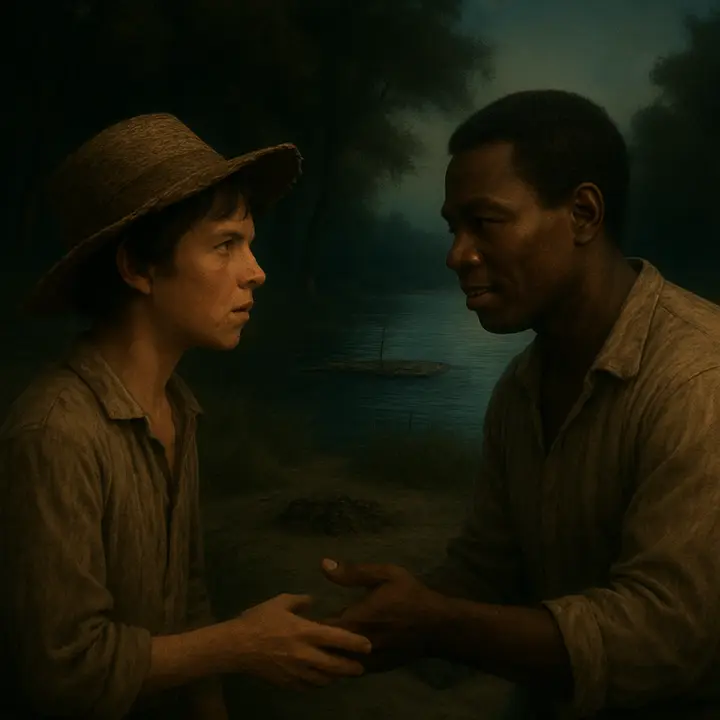


Relationships
- Huckleberry Finn Huck’s closest companion and surrogate family on the raft; Jim protects, mentors, and loves Huck while they travel together.
- Miss Watson Jim’s legal owner whose plans to sell him prompt his flight and set the novel’s central conflict in motion.
- The Duke A con man who, with the King, exploits Jim for profit and theatrical schemes, contributing to his humiliation and eventual sale.
- The King The more ruthless con man who participates in scams that endanger Jim and ultimately helps sell him, sparking Huck’s moral crisis.
- Tom Sawyer A childhood friend of Huck who treats Jim romantically as part of his adventure plans, engineering an elaborate rescue that both helps and imposes extra trials on Jim.
- Aunt Sally At whose house Jim is held and from whom, after the rescue, he receives care and eventual freedom and small rewards.
Quotes by Jim
“Say, who is you? Whar is you? Dog my cats ef I didn’ hear sumf’n.”
Chapter 2Jim wakes and listens, creating a tense moment that the boys survive by remaining still and quiet.
“You wants to keep ’way fum de water as much as you kin, en don’t run no resk, ’kase it’s down in de bills dat you’s gwyne to git hung.”
Chapter 4Jim’s warning combines superstition and dark foreshadowing, heightening Huck’s anxiety and the chapter’s ominous mood.
“I owns mysef, en I's wuth eight hund'd dollars.”
Chapter 8Jim claims personal dignity and places monetary value on himself in the terms his society uses, highlighting slavery's dehumanizing economics.
“Never you mind, honey, never you mind. Don’t you git too peart. It’s a-comin’. Mind I tell you, it’s a-comin’.”
Chapter 10Jim warns Huck that the supposed good luck from found money will be followed by bad luck, foreshadowing the snake incident.
“Doan’ talk to me ’bout Sollermun, Huck, I knows him by de back.”
Chapter 14Jim refuses Huck’s lecture about King Solomon, asserting his own practical knowledge with humorous finality.
“Dat truck dah is trash; en trash is what people is dat puts dirt on de head er dey fren's en makes 'em ashamed.”
Chapter 15Jim interprets his dream and uses the raft's trash as a moral metaphor, pointing out how people humiliate friends and causing Huck deep shame.
Why Jim matters
Jim embodies the human cost of slavery and serves as the novel’s moral compass: his tenderness, intelligence, and steady decency challenge racist assumptions and force Huck (and the reader) to confront the immorality of treating a man as property. Through Jim’s experiences—flight, friendship, public degradation, and final release—Twain examines themes of freedom, family, and conscience. Jim’s presence reframes adventure as an ethical journey: Huck’s growth hinges on recognizing Jim’s full humanity, and the novel uses Jim’s steadfastness to criticize social hypocrisy and to show how individual bond and empathy can undermine institutional injustice.
Chapters with Jim
More Adventures of Huckleberry Finn characters
 Huckleberry FinnProtagonist
 Tom SawyerMajor character
 The DukeMajor character
 Pap FinnAntagonist
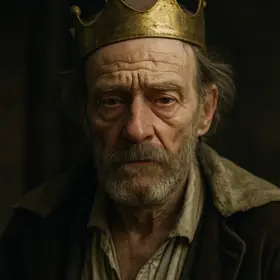 The KingAntagonist
 Aunt SallyMajor character
 Miss WatsonMajor character
 Silas PhelpsMinor character
All chapter summaries ›Characters ›
Read Adventures of Huckleberry Finn illustrated
Every scene in these notes comes from the Book2Life reader, where the full public-domain text is illustrated as you read, with character portraits and narration. Free in your browser and on iPhone.
Read Adventures of Huckleberry Finn free
