Carmilla XIII Summary
The Woodman
The General recounts a vampire story at a ruined chapel; a woodman guides them and tells of a Moravian who destroyed a vampire and the lost grave of Mircalla.
Summary
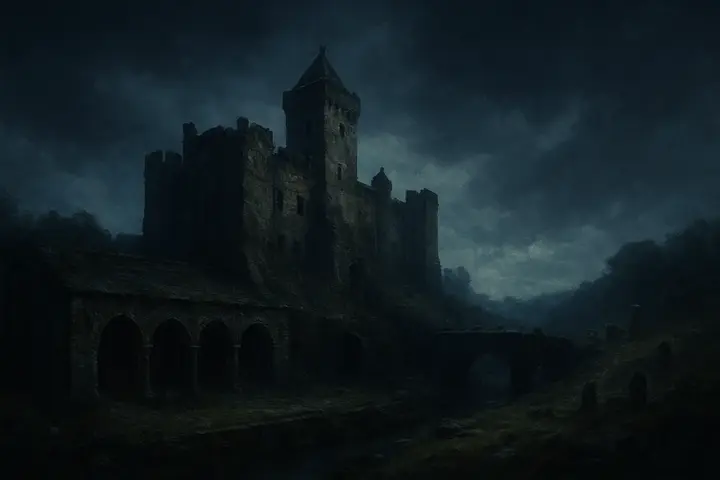
The narrator and his companions approach a ruinous village and chapel while the General continues his account of a tragic vampiric case. The General first relates strange habits and nocturnal wanderings of a girl named Millarca, and he describes terrifying symptoms—dreams, spectral visitations, cold sensations, needle-like stabs under the throat, and paroxysms of strangulation—that mirror the narrator’s own experiences with Carmilla. The castle and the empty village loom before them as they dismount and enter the Gothic ruin to inspect local monuments connected to the Karnstein family.
At the chapel the General reveals his intent to wreak vengeance on Mircalla, Countess Karnstein, and dramatically describes his desire to decapitate the monster. A woodman working nearby is summoned and, though he cannot identify specific tombs, promises to fetch an elderly ranger who remembers the family monuments. The woodman tells how the village was once plagued by revenants: graves were opened and supposed vampires were destroyed by decapitation, staking, or burning, yet the hauntings persisted. He recounts a notable intervention by a Moravian nobleman who, watching from the chapel tower, lured a vampire up the steeple, cleft its skull, descended to cut off the head, and allowed the villagers to impale and burn the remains. The man also removed Mircalla’s tomb so thoroughly that its site is now forgotten. Time presses; the woodman departs to fetch the ranger, and the party remains at the chapel, left to hear the rest of the General’s narrative.
Key events
- The General describes Millarca’s nocturnal wandering and mysterious illnesses mirroring the narrator's symptoms.
- The party arrives at the ruined Karnstein village and its Gothic chapel.
- The General vows vengeance and speaks of decapitating Mircalla, Countess Karnstein.
- A woodman is summoned and offers to fetch an old ranger who knows the monuments.
- The woodman recounts past vampire-executions in the village and a Moravian nobleman’s final destruction of a vampire.
- The Moravian removed Mircalla’s tomb so effectively its location is now uncertain; the woodman leaves to fetch the ranger.
Analysis
This chapter shifts the narrative from intimate domestic unease to local, antiquarian horror by situating the personal afflictions within a landscape of historical violence. The General’s storytelling broadens the scope: what began as personal symptoms becomes part of a documented tradition of vampirism tied to the Karnstein line. The ruined chapel and deserted village function as Gothic settings that externalize the decay and secrecy surrounding Mircalla; these spaces also enable folkloric testimony—the woodman’s account—that offers pseudo-eyewitness authority. The motif of decapitation and the detailed method of the Moravian nobleman act as both practical folklore (how to destroy a vampire) and thematic violent rupture: cutting ties between past sins and present hauntings. Narrative technique here juxtaposes the intimate, first-person recollection with an almost folkloric third-person transmission (the woodman’s tale), reinforcing the frame-tale structure and creating layers of mediation—what we are told is filtered through several witnesses. Foreshadowing appears in the uncanny parallels between Millarca’s symptoms and Carmilla’s conduct; the forgotten tomb and the Moravian’s removal suggest secrets literally and figuratively buried, raising questions about identity and the persistence of the dead. The General’s ferocious vow of vengeance also intensifies the emotional stakes and moral certainty guiding the search for a tangible solution to the narrator’s ordeal.
Important quotes
“She was at first visited by appalling dreams; then, as she fancied, by a specter, sometimes resembling Millarca, sometimes in the shape of a beast, indistinctly seen, walking round the foot of her bed, from side to side.”
Narrator (quoting the General)Describes the progressive and alarming symptoms of Millarca that echo the narrator’s own experiences and deepen the uncanny connection.
“I mean, to decapitate the monster," he answered, with a fierce flush, and a stamp that echoed mournfully through the hollow ruin, and his clenched hand was at the same moment raised, as if it grasped the handle of an axe, while he shook it ferociously in the air.”
General Spielsdorf (reported by Narrator)Reveals the General’s violent resolve and the visceral desire to end the vampiric threat, heightening dramatic tension.
“This Moravian nobleman had authority from the then head of the family to remove the tomb of Mircalla, Countess Karnstein, which he did effectually, so that in a little while its site was quite forgotten.”
woodman (reported by Narrator)Explains why Mircalla’s grave cannot be located, introducing mystery about the countess’s fate and the loss of tangible evidence.
Characters in XIII
- General Spielsdorf
- Laura's father
- Laura
- Carmilla
- Millarca
- Mircalla, Countess of Karnstein
- woodman
- forester
- Moravian nobleman
- ranger
All chapter summaries ›Characters ›
Read Carmilla illustrated
Every scene in these notes comes from the Book2Life reader, where the full public-domain text is illustrated as you read, with character portraits and narration. Free in your browser and on iPhone.
