Carmilla XV Summary
Ordeal and Execution
A mysterious antiquarian is found; an investigation uncovers Countess Mircalla's tomb and the corpse is executed as a vampire.
Summary
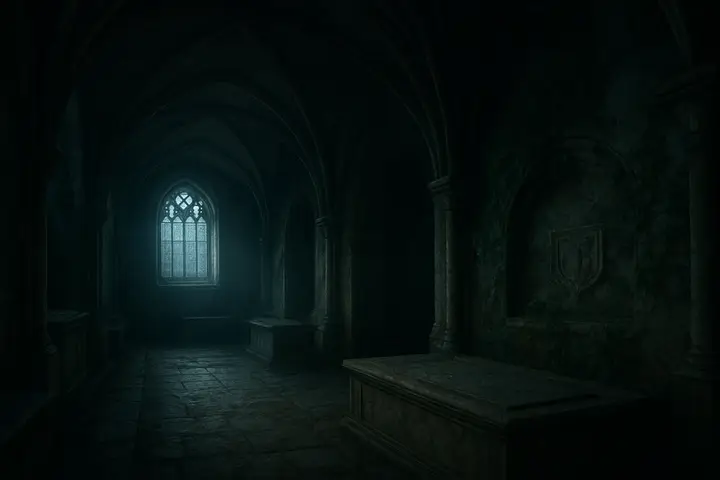
In the ruined chapel where Carmilla once appeared, a strange, stooping old man in black arrives and is greeted warmly by General Spielsdorf and introduced to Laura's father. The old man consults a plan and a small book, and with the General and others examines the chapel walls, uncovering a hidden marble tablet and, with the woodman’s help, a long-lost monumental inscription and escutcheon that identify the tomb of Mircalla, Countess Karnstein. The discovery excites the General, who announces that a commissioner will convene and an inquisition will be held the next day.
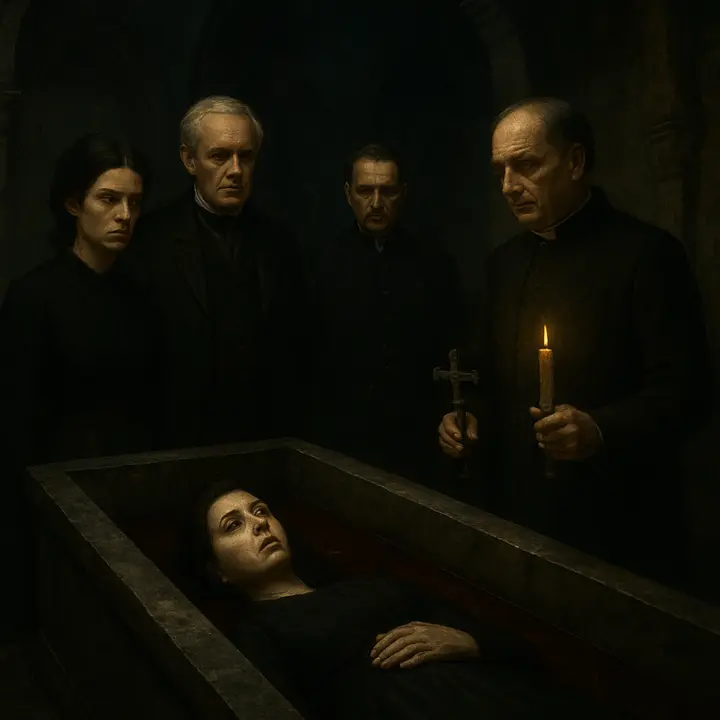
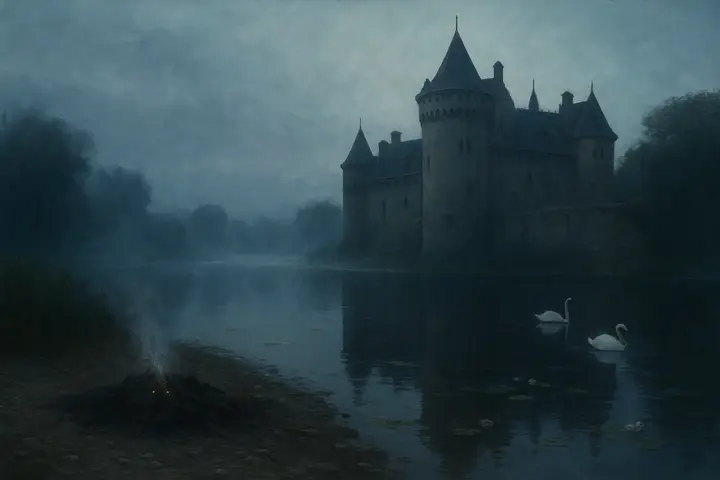
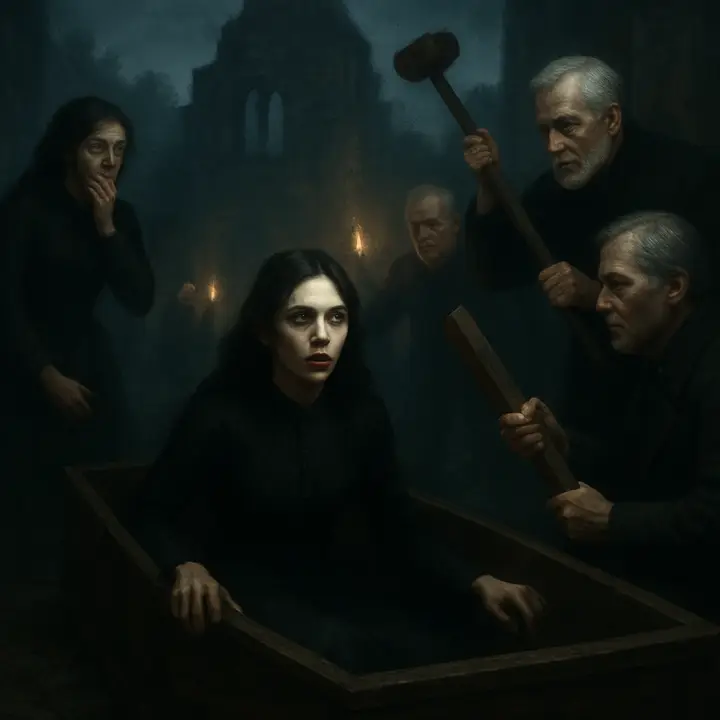
Laura is kept partly in the dark about the precise nature of the proceedings; she returns home exhausted and finds Carmilla missing. Her father arranges extraordinary nocturnal precautions — servants and Madame Perrodon watch in her room, and an ecclesiastic performs rites in the adjoining dressing room. Laura’s nightly attacks cease after Carmilla’s disappearance. The next day, formal proceedings open in the Chapel of Karnstein: the Countess Mircalla’s grave is opened, and the corpse is found remarkably preserved — warm-looking flesh, open eyes, faint respiration and heartbeat, flexible limbs, and a coffin filled with blood. These signs are taken as proof of vampirism. Following ancient practice, the corpse is staked through the heart, the head is severed, blood pours forth, and the body and head are burned and cast into the river. Laura’s narrator notes that her father preserves the Imperial Commission’s formal report, which verifies the events and asserts that the district has since been freed from the vampire’s scourge.
Key events
- A strange old man in black arrives and is introduced as the Baron to the General and Laura's father
- They examine the chapel, uncover a marble tablet and the monument of Mircalla, Countess Karnstein
- Carmilla is absent; extraordinary night watches and rites take place at Laura's home
- Laura's nightly sufferings cease after Carmilla's disappearance
- An official inquisition opens Mircalla's grave in the Chapel of Karnstein
- The corpse displays signs judged to be vampiric (warmth, respiration, blood-filled coffin)
- The body is staked, decapitated, burned, and the ashes thrown into the river
XV in pictures
Analysis
This chapter functions as the narrative climax for the supernatural plotline by converting rumor and private horror into a public, official investigation. The formal discovery of Countess Mircalla’s tomb and the judicial procedures remove the mystery’s ambiguity: the text foregrounds institutional authority (the General, the commissioner, the Imperial Commission) to validate a folkloric explanation (vampirism). Structurally, the chapter shifts the story from intimate, personal terror to communal resolution and legal ritual, providing documentary weight through reference to an official report. The chapter also resolves Laura’s bodily suffering without offering a rational medical explanation, reinforcing the novel’s tension between Enlightenment skepticism and local superstition.
Symbolically, the preserved corpse, floating in blood, and the stake, decapitation, and burning enact purification through violent, ritualized destruction; water (the river) carries the ashes away, suggesting cleansing and finality. The stranger in spectacles (Baron Vordenburg) functions as the learned agent whose antiquarian knowledge and measurements translate folkloric traces into decisive action — he embodies a bridge between scholarly inquiry and archaic ritual. Narrative technique continues the framed, testimonial voice: the narrator claims documentary verification (the Imperial report), which aims to persuade the reader while preserving the eerie immediacy of witnessed events and maintaining the novel’s gothic atmosphere.
Important quotes
““The very man!” exclaimed the General, advancing with manifest delight.”
General SpielsdorfThe General recognizes and greets the strange old man who helps identify the tomb.
““Tomorrow,” I heard him say; “the commissioner will be here, and the Inquisition will be held according to law.””
General SpielsdorfThe General announces the formal legal proceeding to investigate the discovered tomb.
“Here then, were all the admitted signs and proofs of vampirism.”
NarratorThe narrator summarizes the corpse’s condition and the medical attestations that justify the vampire execution.
Characters in XV
All chapter summaries ›Characters ›
Read Carmilla illustrated
Every scene in these notes comes from the Book2Life reader, where the full public-domain text is illustrated as you read, with character portraits and narration. Free in your browser and on iPhone.
