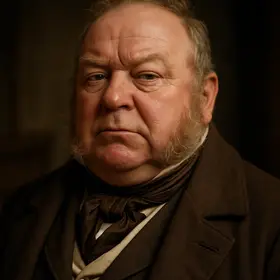
Uncle Pumblechook in Great Expectations
Minor character
A pompous, self-important corn chandler who flatters rank, takes credit, and revels in others' misfortunes to boost his standing.
Who is Uncle Pumblechook?
Uncle Pumblechook is Joe Gargery’s fawning, self‑important uncle and a local corn chandler who appears repeatedly at key domestic and village scenes. He relishes ceremonial moments — the Gargery Christmas, Pip’s apprenticeship feast, and the public display around Mrs. Joe’s funeral — and uses them to inflate his own importance. He questions and lectures Pip about sums and proprieties, takes credit for Pip’s connections to Miss Havisham, and ostentatiously toasts Pip when Pip’s prospects change. Though comic and superficially genial, his behavior repeatedly shames Pip and magnifies Pip’s sense of class embarrassment. Pumblechook does not drive the plot’s central mysteries, but his bluster and opportunism expose the social pretensions of the village and contribute to Pip’s anxieties about status and respectability.
In the book: Joe Gargery’s uncle and a local corn chandler, Uncle Pumblechook is a comic figure of pomp and hypocrisy who fawns over social rank and claims undue credit when it suits him. Through his bluster and self-congratulation, he embodies the novel’s satire of snobbery and shallow respectability without driving the central plot himself.
Personality
- Pompous
- At the celebratory feast after Miss Havisham gives money, Pumblechook presides over the party and insists on theatrical pomp when Pip is bound as an apprentice (Chapter 13).
- Opportunistic
- When news of Pip’s ‘great expectations’ reaches the village, Pumblechook lavishes fawning hospitality and repeatedly toasts Pip to display his connection to the opportunity (Chapter 19).
- Hypocritical
- He moralizes and publicly shames Pip at the Christmas dinner, yet later revels in Pip’s supposed improvements and takes credit for Pip’s advancement (Chapter 4, Chapter 13).
- Theatrical
- He orchestrates a noisy feast and a pompous binding ceremony at the magistrates’ court to celebrate Pip’s apprenticeship premium (Chapter 13).
- Social‑climber
- He fawns over Miss Havisham’s gift and debates what she might ‘do’ for Pip, treating the boy’s prospects as a means to social capital (Chapter 9, Chapter 13).
Character arc
Uncle Pumblechook’s behavior remains largely consistent from his earliest appearances to his later ones: he is a figure of boastful self-importance who seeks social advantage and public recognition. Early on he presides at the Gargery Christmas and displays comical fussiness and moralizing toward Pip, then quickly shifts to claiming credit when Miss Havisham’s gift becomes public, orchestrating pomp and theatrical ceremonies. He continues to insert himself into moments of public display — attending feasts, commenting loudly at Mrs. Joe’s funeral, and basking in the spectacle of Pip’s changing fortunes. He rarely experiences genuine self‑reflection or growth; instead, his responses adapt to whichever event offers him visibility and a chance to bolster his status. In short, Pumblechook’s arc is one of repeated self‑promotion and opportunistic display rather than transformation: he remains a static exemplar of social pretence across the chapters in which he appears.
Relationships
- Pip He fawns over and questions Pip, uses Pip’s fortunes for his own display, and shames Pip publicly while later taking credit for Pip’s connections.
- Joe Gargery He is Joe’s uncle and treats Joe with condescending conviviality, presiding over celebrations that highlight Joe’s awkwardness.
- Mrs. Joe Gargery He is a frequent companion to Mrs. Joe at household gatherings and supports her theatrical management of Pip for the village’s amusement.
- Miss Havisham He claims association with Miss Havisham’s favor toward Pip and parlays that connection into local status, celebrating and publicizing her gifts.
- Mr. Trabb He appears alongside the village’s ceremonial figures (like Trabb and his assistants) at public spectacles and funeral preparations, sharing in the communal display.
- Sarah Pocket He participates in the same social circuit that gawks at and discusses Pip’s transformation, aligning with other self-interested local figures such as Sarah Pocket.
Why Uncle Pumblechook matters
Pumblechook embodies Dickens’s satire of snobbery, false respectability, and social opportunism. By ostentatiously celebrating others’ changes in fortune and loudly claiming credit, he highlights the gap between genuine moral worth (represented by Joe) and social pretence. His comic pomposity also provokes and amplifies Pip’s shame about class, helping to drive Pip’s internal conflict over identity and aspiration. As a recurring, static figure of social climbing, Pumblechook clarifies the novel’s critique of manners that value appearance over integrity.
Chapters with Uncle Pumblechook
More Great Expectations characters
 PipProtagonist
 Joe GargeryMajor character
 Miss HavishamMajor character
 Herbert PocketMajor character
 EstellaMajor character
 Mr. JaggersMajor character
 Mrs. Joe GargeryMinor character
 BiddyMajor character
All chapter summaries ›Characters ›
Read Great Expectations illustrated
Every scene in these notes comes from the Book2Life reader, where the full public-domain text is illustrated as you read, with character portraits and narration. Free in your browser and on iPhone.
