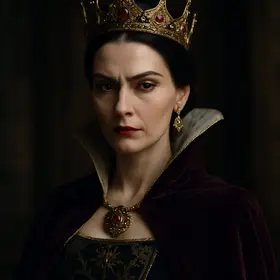
The Evil Queen in Grimms' Fairy Tales
Antagonist
Snow White’s vain stepmother who uses a magic mirror, disguise, and poison to eliminate her rival for beauty.
Who is The Evil Queen?
The Evil Queen appears as the new queen who marries the king after Snow White’s birth; she is obsessed with being declared the "fairest" and consults a magic looking-glass to confirm her beauty. When the mirror names Snow White lovelier, the queen’s jealousy drives the plot: she orders a servant to abandon Snow White in the forest, then orchestrates three covert attempts to kill her—tightening a bodice until Snow White faints, offering a poisoned comb, and finally tricking her with a poisoned apple. The dwarfs intervene twice to save Snow White but cannot revive her after the apple; the queen believes she has succeeded and continues to preside in beauty and power until Snow White is brought back to life. When the mirror ultimately proclaims the revived bride the fairest, the queen dies of rage. The tale presents the Evil Queen as a calculating, image-driven antagonist whose actions create the story’s central conflicts without requiring a detailed personal history.
In the book: The Evil Queen is Snow White’s stepmother and the story’s driving antagonist, a proud and vain monarch whose obsession with being the “fairest” propels the plot. Guided by a magic mirror and skilled in cunning and sorcery, she schemes from the shadows, setting the central conflict in motion and embodying themes of jealousy, vanity, and the corrupting nature of power—without the narrative relying on detailed backstory.
Personality
- Vain
- She repeatedly consults the magic looking-glass and acts violently when it names Snow White lovelier.
- Jealous
- Her envy of Snow White’s beauty leads her to order the child abandoned and later to attempt murder three times.
- Cunning
- She disguises herself to approach Snow White and employs poisoned items—a comb and an apple—to conceal her intent.
- Ruthless
- She commands a servant to leave Snow White to the wild beasts and persists in plots to kill her stepdaughter.
Character arc
From her first appearance the Evil Queen is defined by pride and a single-minded need to be the fairest. She uses royal authority to send Snow White into the forest and then shifts to covert methods—disguises and poisoned gifts—when the child survives and finds refuge. Across the episodes she shows no remorse or internal conflict; her methods escalate from delegation (ordering abandonment) to direct action (personally visiting Snow White disguised). Her reliance on the mirror remains constant, and its pronouncements function as her moral compass. The queen’s end is abrupt and absolute: when the mirror finally names Snow White the fairest after the princess’s revival and marriage, the queen dies of rage. She does not learn, repent, or soften; her arc is a steady intensification of jealousy leading to self-destructive fury and death, reinforcing her role as a static embodiment of vanity and envy rather than a character transformed by events.
Relationships
- The King Her husband and the monarch whose remarriage creates the stepmother-stepdaughter dynamic.
- Snow White Her stepdaughter and the rival whose youth and beauty provoke the queen’s jealousy and murderous plots.
- The Huntsman He is ordered to abandon Snow White in the forest at the queen’s command, acting as her instrument.
- The Seven Dwarfs Unwitting obstacles to her designs: they shelter Snow White and foil her first two attempts to kill the girl.
- The Wicked Stepmother A related archetype in the collection that parallels the queen’s role as a jealous, punitive maternal figure.
Quotes by The Evil Queen
“Tell me, glass, tell me true! Of all the ladies in the land, Who is fairest, tell me, who?”
SnowdropThe recurring mirror question triggers the queen’s jealousy and the plot’s central conflict.
Why The Evil Queen matters
The Evil Queen embodies the tale’s warnings about vanity, envy, and the corrupting influence of power rooted in appearance. As an antagonist, she externalizes social anxieties about aging, competition for status, and the malicious use of authority. Her reliance on the magic mirror literalizes the destructive feedback loop of external validation; her refusal to change or repent makes her a moral counterpoint to Snow White’s innocence and purity. The queen’s ultimate death by rage serves as a didactic conclusion: unchecked jealousy destroys the jealous, reinforcing the story’s moral architecture.
Chapters with The Evil Queen
More Grimms' Fairy Tales characters
 The KingMajor character
- TThe QueenMajor character
- tthe king's daughterMajor character
 The WolfAntagonist
- mmotherMajor character
- tthe cookMinor character
- tthe foxMajor character
 The HuntsmanMajor character
All chapter summaries ›Characters ›
Read Grimms' Fairy Tales illustrated
Every scene in these notes comes from the Book2Life reader, where the full public-domain text is illustrated as you read, with character portraits and narration. Free in your browser and on iPhone.
