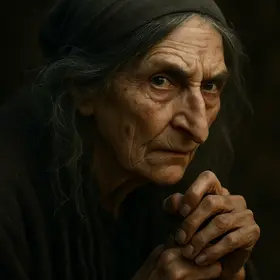
The Witch in Grimms' Fairy Tales
Antagonist
A solitary, cunning sorceress at the forest’s edge who tempts, betrays, and menaces children and travelers.
Who is The Witch?
Across multiple tales the Witch appears as a recurring dangerous presence: she lures or shelters wanderers only to exploit them, and she actively plots to steal, destroy, or consume those she envies. In Hansel and Gretel she is the old woman who feigns kindness, imprisons Hansel to fatten him, and forces Gretel into servitude until Gretel kills her by pushing her into the oven. In The Blue Light she houses a wounded soldier, forces him into dangerous labor (including fetching a magical blue light), betrays him by abandoning him in a well, and thus triggers the soldier’s discovery of the dwarf who later has the witch hanged. In The Salad she poses as a grateful old woman who then conspires with a young lady to steal the huntsman’s talismans and plots to profit from his misfortune. In Sweetheart Roland she openly plots murder against an undesired stepdaughter, pursues the lovers with magic boots, and is killed after being forced into a deadly enchanted dance. She repeatedly functions as the tale’s moral and physical antagonist, provoking tests of cunning and courage in protagonists.
In the book: A classic Grimm antagonist, the witch is a solitary sorceress on the forest’s edge who uses cunning, temptations, and spells to ensnare the unwary. She embodies danger and moral testing, setting the stakes for the tale’s young protagonists and driving them to courage, cleverness, and self-reliance without needing detailed backstory.
Personality
- Deceptive
- In Hansel and Gretel she pretends to be kindly and feeds the children before revealing her plan to eat them.
- Predatory
- She imprisons Hansel to fatten him for slaughter and intends to bake Gretel alive in the oven.
- Vindictive
- In Sweetheart Roland she hates the beautiful stepdaughter and plots to have her killed in her sleep.
- Resourceful
- In The Blue Light she sets the soldier arduous tasks (digging, fetching the blue light) to secure her own advantage.
- Magical
- She uses spells, a magic well, and many-league boots to pursue or control others, as in Blue Light and Sweetheart Roland.
Character arc
The Witch rarely redeems or softens; instead, her role across the stories is to initiate a moral or survival test and then suffer defeat by the protagonists’ cunning or by supernatural justice. In Hansel and Gretel she begins as a seemingly hospitable old woman who lures the children inside; once exposed as a child-eater, she is outwitted and thrown into her own oven by Gretel, ending her threat. In The Blue Light she acts as an exploiter who betrays the soldier; that betrayal leads to his discovery of the dwarf and her subsequent binding and hanging at the dwarf’s command. In Sweetheart Roland she escalates from plotting domestic murder to pursuing the lovers with magical boots and is forced into a fatal enchanted dance. In The Salad she uses trickery to seize talismans and riches but is undone by the huntsman’s countermeasures (the reversing salad) that expose and punish her scheme. Across these tales she consistently refuses reform; rather, her persistent malice ensures she meets violent or humiliating ends that restore order and reward the clever or virtuous characters who resist her.
Relationships
- Hansel Predatory antagonist who imprisons him to fatten him as food.
- Gretel Deceiver and captor whom Gretel ultimately kills by thrusting into the oven.
- The Huntsman Opponent in The Salad who is tricked by the witch and later foils her via the restorative/transformative salad ruse.
- the king's daughter Victim of the dwarf’s abduction scheme that the witch’s betrayal of the soldier helps set in motion in The Blue Light.
- the cook Fellow household threat in the Fundevogel environment (both represent domestic danger), though the witch does not appear in that chapter directly.
Quotes by The Witch
“‘I’ll tell you what, husband,’ answered the woman, ‘early tomorrow morning we will take the children out into the forest to where it is the thickest; there we will light a fire for them, and give each of them one more piece of bread, and then we will go to our work and leave them alone. They will not find the way home again, and we shall be rid of them.’”
HANSEL AND GRETELThe stepmother proposes abandoning the children to solve the family's hunger, revealing her cruel pragmatism that sets the plot in motion.
“‘Nibble, nibble, gnaw, Who is nibbling at my little house?’”
HANSEL AND GRETELThe witch’s chant from inside the sugar-and-bread house signals the children’s danger and the moment their innocent consumption invites peril.
“'Lord, what are your commands?'”
The Blue LightThe dwarf appears and offers complete obedience to the soldier, establishing the power relationship that drives the plot.
“'Strike down to earth that false judge there, and his constable, and spare not the king who has treated me so ill.'”
The Blue LightAt his execution, the soldier orders the dwarf to incapacitate the authorities and the king, forcing a final political reversal.
Why The Witch matters
The Witch embodies externalized moral danger and the test of character that forces protagonists to grow: she is the catalyst for resourcefulness, courage, and reciprocal justice. Her magical cunning and malicious intent create high stakes that reveal which characters are clever, faithful, or corrupt. Repeatedly defeated by trickery, bravery, or supernatural retribution, she functions as a narrative device that restores moral order and rewards ingenuity, while underscoring the Grimms’ recurring theme that evil brought on by envy, cruelty, or selfishness ultimately destroys itself.
Chapters with The Witch
More Grimms' Fairy Tales characters
 The KingMajor character
- TThe QueenMajor character
- tthe king's daughterMajor character
 The WolfAntagonist
- mmotherMajor character
- tthe cookMinor character
- tthe foxMajor character
 The HuntsmanMajor character
All chapter summaries ›Characters ›
Read Grimms' Fairy Tales illustrated
Every scene in these notes comes from the Book2Life reader, where the full public-domain text is illustrated as you read, with character portraits and narration. Free in your browser and on iPhone.
