Romeo and Juliet Act 2, Scene 2 Summary
The Balcony Scene
Romeo overhears Juliet at her window, they confess love, debate names and vows, and arrange to be married the next day.
Summary
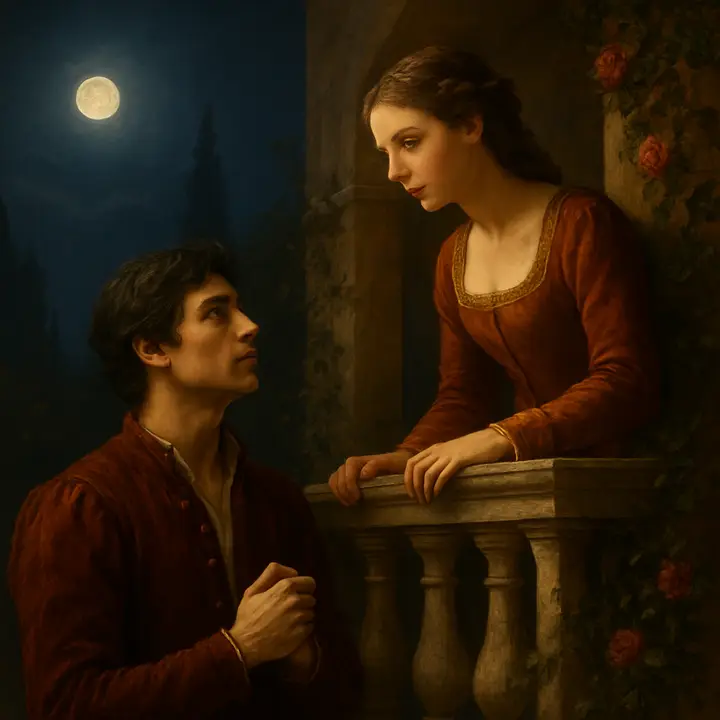
Romeo slips into the Capulet orchard and watches Juliet appear above at a window; he compares her to the sun and is swept into a private, fervent soliloquy about her beauty. When Juliet speaks, believing herself alone, Romeo listens and answers only when he cannot contain himself. The two exchange compliments and metaphors as Juliet worries aloud about the barrier of names—Montague and Capulet—and argues that a name is meaningless compared with the person.
They quickly move from rhetorical debate to direct confession: each professes deep, boundless love and tests the other's constancy. Juliet worries that their sudden passion may be impulsive and asks Romeo not to swear by the moon; she instead demands a promise grounded in his true self. They negotiate the peril of Romeo’s presence under Capulet protection, the risks if discovered, and finally arrange concrete action — if Romeo intends honorably to seek marriage, Juliet will send a messenger the next day to learn the time and place of the wedding. The scene closes with repeated tender partings and a vow to meet again at nine, as Romeo departs to consult Friar Laurence about their fortunes.
Key events
- Romeo arrives in the Capulet garden and admires Juliet from below.
- Juliet delivers her famous meditation on names; Romeo reveals himself.
- They exchange vows of love and test each other's sincerity.
- They discuss the danger of Romeo’s being on Capulet ground and his motives.
- Juliet demands that Romeo prove his intent through marriage plans.
- They arrange for Juliet to send a messenger the next day with wedding details.
- They part with tender farewells and Romeo leaves to seek Friar Laurence.
Analysis
This scene crystallizes the play’s central themes: passionate love, the social barrier of family names, and the impulsive intensity of youth. Dramatically, Shakespeare shifts from public comedy (the street fights and party) to private lyricism, using the close quarters of the balcony to create intimacy and suspended time. The elevated, imagistic language—sun, stars, moon, and the repeated religious metaphors (saint, shrine, idolatry)—casts Romeo and Juliet’s love as both spiritual and dangerously transgressive. Juliet’s argument that “What’s in a name?” reframes the feud as an arbitrary social division, advancing the play’s critique of inherited enmity.
The scene also foreshadows structural consequences: the haste and secrecy of their vows set up conflict with social order and adult authority. Shakespeare uses dramatic irony (Romeo overhears what the audience and Juliet initially think is private speech) and alternating short speeches to accelerate emotional stakes. Symbolically, night and secrecy shelter their tenderness but also imply fragility—Juliet calls the love “too rash, too unadvis’d, too sudden,” anticipating that haste may carry cost. The scene thereby functions as the play’s emotional fulcrum: it transforms infatuation into sworn commitment while making the audience aware of the precariousness of young lovers defying public boundaries.
Important quotes
“But soft, what light through yonder window breaks? It is the east, and Juliet is the sun!”
RomeoRomeo’s opening metaphor that elevates Juliet and begins the scene’s lyric celebration of her beauty.
“O Romeo, Romeo, wherefore art thou Romeo? Deny thy father and refuse thy name.”
JulietJuliet questions the importance of names and expresses the central conflict between love and family identity.
“Parting is such sweet sorrow That I shall say good night till it be morrow.”
JulietJuliet’s famous line captures the bittersweet emotion of leaving and emphasizes the depth of the lovers’ attachment.
Characters in Act 2, Scene 2
All chapter summaries ›Characters ›
Read Romeo and Juliet illustrated
Every scene in these notes comes from the Book2Life reader, where the full public-domain text is illustrated as you read, with character portraits and narration. Free in your browser and on iPhone.
