
Rakitin in The Brothers Karamazov
Minor character
A cynical former seminarian turned gossiping would‑be journalist who flatters, pries, and manipulates around the Karamazovs.
Who is Rakitin?
Rakitin is a young divinity student who leaves the seminary world for journalism and local influence. He circulates among monks, townspeople, and the Karamazov family, cultivating contacts and exploiting scandals for reputation and possible advancement. He flatters and goads Alyosha, taunting his faith and nudging him into compromising situations; at the monastery path he spins corrosive theories about the Karamazovs’ passions and potential crimes. Rakitin escorts Alyosha to Grushenka, but later leaves in anger when the visit unsettles his hopes; he appears in conversations with Dmitri in custody, where Dmitri repeats that Rakitin’s mockery has shaken him. In the trial Rakitin gives eloquent testimony about social causes and Grushenka that initially impresses, but cross‑examination exposes a petty implication that he received money for introducing Alyosha to Grushenka, tarnishing his credibility. Throughout the chapters where he appears Rakitin functions less as a driver of events than as an instigator of gossip, a moral provocateur, and an opportunist seeking to turn other people’s crises into his own social capital.
In the book: A young seminarian turned would‑be journalist and town gossip, Rakitin hovers on the edges of the Karamazov drama as a cynical opportunist. He flatters and manipulates, especially targeting Alyosha, nudging people toward choices that serve his own ambitions. Through his prying, petty schemes, and worldly materialism, he embodies the novel’s strain of skepticism and moral compromise without driving the central plot himself.
Personality
- Cynical
- On the monastery path he mocks Zosima’s reverence and spins a corrosive interpretation of the Karamazov household, suggesting secret sensuality and crime.
- Manipulative
- He goads and flatters Alyosha into leaving the monastery and later into visiting Grushenka, anticipating personal advantage in the scandal.
- Ambitious
- He presents himself as a worldly, high‑minded witness at Dmitri’s trial, aiming to gain public approval and influence.
- Gossipy
- He circulates rumors and composes mocking newspaper paragraphs referenced by Madame Hohlakov and others in town.
- Opportunistic
- During cross‑examination at the trial, a suggestion surfaces that he may have been paid to introduce Alyosha to Grushenka, revealing self‑serving dealings.
Character arc
Rakitin appears consistently as a provocateur who prefers intrigue to moral commitment and who seeks personal gain in others’ misfortune. From his first notable appearance in the monastery, where he taunts Alyosha and interprets Zosima’s gestures as evidence of hidden crime, he cultivates the role of a worldly critic of piety. He engineers or encourages moments that expose private tensions (pressing Alyosha toward Grushenka; goading Dmitri in custody), then stands aside to watch the fallout. When those moments produce public consequences — the scandal at the monastery, the visit to Grushenka, and finally the trial — Rakitin attempts to translate them into social standing by testifying eloquently and positioning himself as a man of ideas. Yet his veneer cracks under scrutiny: cross‑examination reveals petty motives and possible payments, diminishing his authority. He does not undergo moral reform; instead, the narrative shows him exposed and discredited in part, leaving him much the same morally but with less credibility than he had hoped to gain.
Relationships
- Alexei Fyodorovich Karamazov Rakitin flatters, goads, and manipulates Alyosha, pushing him toward Grushenka and exploiting Alyosha’s religious tenderness for his own ends.
- Agrafena Alexandrovna Svetlova He brings Alyosha to Grushenka and is implicated in town gossip about introductions involving her, tying him to her affairs of scandal and testimony.
- Dmitri Fyodorovich Karamazov Dmitri complains that Rakitin’s mocking and skeptical talk has shaken him; Rakitin also appears in Dmitri’s prison scene and influences public perception of him.
- Fyodor Pavlovich Karamazov Rakitin is present among the circle that observes Fyodor’s buffoonery at the monastery and later benefits from the family’s scandals he helps circulate.
- Madame Hohlakov She accuses Rakitin of writing spiteful gossip paragraphs and treats him as part of the town’s rumor mill about the Karamazovs.
- Ippolit Kirillovich Though not intimate, Rakitin’s courtroom testimony is one of the pieces the prosecutor’s case and the defense expose and respond to during the trial.
Quotes by Rakitin
“Your house stinks of it.”
Chapter 7Rakitin crudely accuses the Karamazov household of moral corruption while interpreting Zosima’s bow as a sign that a crime is imminent.
“Let’s go to Grushenka,”
Chapter 2Rakitin suggests—and then leads—Alyosha toward Agrafena Alexandrovna Svetlova, seeing an opportunity to humiliate him and to gain advantage.
Why Rakitin matters
Rakitin embodies the novel’s skeptical, worldly current that challenges genuine faith and moral seriousness. He acts as a social corrosive: flattering piety while secretly undermining it, stirring scandals that reveal character, and profiting from other people’s suffering. His presence highlights themes of hypocrisy, the moral dangers of gossip and publicity, and the thin line between intellectual critique and cynical exploitation. By being exposed in court and through the reactions he provokes, Rakitin helps dramatize how public opinion, rumor, and personal ambition can distort truth and damage conscience.
Chapters with Rakitin
More The Brothers Karamazov characters
 Dmitri Fyodorovich KaramazovProtagonist
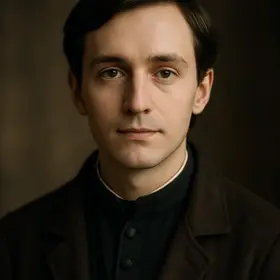 Alexei Fyodorovich KaramazovMajor character
 Fyodor Pavlovich KaramazovAntagonist
 Ivan Fyodorovich KaramazovMajor character
 Katerina IvanovnaMajor character
 Pavel Fyodorovich SmerdyakovMajor character
 Agrafena Alexandrovna SvetlovaMajor character
 Grigory VasilievichMajor character
All chapter summaries ›Characters ›
Read The Brothers Karamazov illustrated
Every scene in these notes comes from the Book2Life reader, where the full public-domain text is illustrated as you read, with character portraits and narration. Free in your browser and on iPhone.
Read The Brothers Karamazov free
