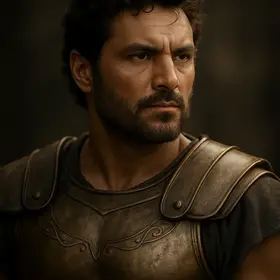
Deiphobus in The Iliad
Major character
Trojan prince, son of Priam and Hecuba; a battlefield leader who fights beside his brothers to defend Troy.
Who is Deiphobus?
Deiphobus is a son of Priam and Hecuba and a Trojan prince who appears repeatedly on the battlefield. He commands one of the five Trojan companies during the assault on the Achaean wall, sharing leadership of that division with Helenus and Asius, and he fights in the desperate engagements around the Achaean ships. Deiphobus presses the attack with other Trojan nobles, takes part in close combats (notably contending with Aeneas and Idomeneus), and figures among the royal household defending the city. Though he does not dominate the poem’s central confrontations, his presence helps show how Troy’s princes rally, coordinate, and endure under intense pressure. He represents the embattled aristocracy who personally lead men in assaults and hold the line when Achaean counterattacks threaten the ships and Patroclus’ corpse.
In the book: Deiphobus is a Trojan prince, son of Priam and Hecuba, and brother to Hector and Paris. A capable battlefield leader, he commands Trojan forces in several engagements and represents the city’s embattled nobility and family solidarity. His appearances help illuminate the royal household’s influence on the war effort and the pressures on Trojan defenders without dominating the central narrative.
Personality
- military leader
- Book 12 places him as one of the captains leading a company (with Helenus and Asius) in the assault on the Achaean wall.
- steadfast
- He remains with the Trojan assault through the fierce fighting at the ships described in Books 12 and 13.
- combative
- Book 13 records him in personal combat against Aeneas and Idomeneus amid the struggle beneath the Achaean ships.
- representative of family solidarity
- As a son of Priam and Hecuba and brother to Hector and Paris, his presence underscores the royal household’s role in leading Troy’s defense in Books 11–17.
- instrument in deception (appearance)
- In Book 22 Athena assumes Deiphobus’ likeness to persuade Hector to face Achilles, using his identity to trick Hector.
Character arc
Deiphobus’ role unfolds through repeated battlefield service rather than through a personal transformation. He first appears as part of Troy’s leadership during Hector’s advance when Zeus gives Hector the advantage, and he is subsequently assigned a company in the crucial assault on the Achaean wall (Book 12). There he stands among other princes and helps press the city’s central offensive; in Book 13 he engages directly in brutal hand-to-hand fighting at the ships, showing his readiness to fight alongside Troy’s foremost warriors. He continues operating as a loyal royal commander through the chaotic contests over Patroclus’ body (Book 17), where the princely forces swarm and contest the corpse, though Deiphobus is not singled out for heroic individual glory. By Book 22 his name becomes the vehicle for divine trickery: Athena takes his shape to deceive Hector into standing against Achilles. The arc thus moves from active leader in pitched assaults to the eerie role of a likeness used in the pivotal scene that seals Hector’s fate, illustrating how his identity is woven into Troy’s collective effort and into the gods’ interventions without a distinct personal turning point or moral change of his own.
Relationships
- Priam His father and king, Deiphobus is part of the royal household that leads and suffers during the assaults on the Achaeans.
- Hecuba His mother, whose household presence helps frame the stoic, familial defense of Troy in the narrative.
- Hector His brother and Troy’s foremost commander; Deiphobus fights beside and under Hector’s overall leadership in major assaults.
- Paris His brother, another royal prince whose actions and wounds feature in the wider dynastic stakes shown among Troy’s leaders.
- Helenus Co-leads the same Trojan company with Deiphobus (Book 12), indicating close operational cooperation during the assault.
- Asius Appears alongside Deiphobus and Helenus in the company that attacks the Achaean wall, sharing responsibility in the charge.
Why Deiphobus matters
Deiphobus functions less as an individualized hero and more as a representative of Trojan aristocratic solidarity and the mortal manpower behind Hector’s leadership. His repeated presence in the assaults on the wall and at the ships emphasizes the collective stakes of Troy’s ruling family and the city’s reliance on princely commanders. The later use of his likeness by Athena in the climactic encounter underlines how individual identities among Troy’s princes are entangled with divine strategy and the tragic outcomes the gods enforce, reinforcing themes of communal duty, the manipulation of fate, and the human cost of honor-driven warfare.
Chapters with Deiphobus
More The Iliad characters
 Hector
 Achilles
 Agamemnon
 Apollo
 Menelaus
 Zeus
Zeus Nestor
 Patroclus
All chapter summaries ›Characters ›
Read The Iliad illustrated
Every scene in these notes comes from the Book2Life reader, where the full public-domain text is illustrated as you read, with character portraits and narration. Free in your browser and on iPhone.
