
Odysseus in The Odyssey
Protagonist
The long-absent king of Ithaca, famed for his cunning and endurance, struggling to return home and reclaim his household.
Who is Odysseus?
Odysseus is the wily king of Ithaca whose long absence after Troy leaves his household besieged by suitors. He wants above all to return home to Penelope and Telemachus and to reestablish his rule. His journey involves surviving shipwreck (Book 5), escaping divine detainment on Calypso’s island, seeking refuge and help among the Phaeacians (Books 6–8), and recounting his adventures (Book 9–12). He uses guile and fortitude—feigning names, disguising himself as a beggar, and devising clever stratagems—to survive monsters, temptations, and the sea. Once back in Ithaca (Books 13–14) he conceals his identity, tests loyalties, reunites with Telemachus (Book 16), and, with a small band of faithful servants, exacts violent justice on the suitors (Books 21–22). After recognition by Penelope (Book 23) he restores his household and ultimately secures peace for Ithaca (Book 24). Throughout the poem he balances cunning tactics with deep longing for home and family.
In the book: When we first hear of him, he’s the long-absent king of Ithaca—famed from the Trojan War for brains as much as brawn—while his island is overrun by pushy suitors eating his food. Everyone talks about his cunning and toughness, and his not being home yet is the problem that sets everything in motion.
Personality
- Cunning
- He tricks Polyphemus by giving him wine, calling himself 'Noman,' and then blinds the Cyclops so they can escape (Book 9).
- Resilient
- After Poseidon smashes his raft, he clings to wreckage, accepts Ino’s veil, and swims for two nights to reach Scheria (Book 5).
- Strategic
- He returns to Ithaca disguised, tests household loyalty, hides the arms, and times the slaughter of the suitors with Telemachus and faithful servants (Books 13, 16, 21–22).
- Emotionally guarded
- He weeps privately when Demodocus sings of the Trojan Horse but hides his tears beneath his cloak until pressed by Alcinous (Book 8).
- Devoted to home
- He resists offers of marriage in Phaeacia and insists on returning to Penelope and Ithaca rather than remaining with hosts (Books 7–8, 23).
Character arc
Odysseus enters the poem as a famous absentee: a celebrated warrior detained far from home and the subject of gods’ debate (Book 1). His arc is primarily a return—physical, social, and moral—achieved by a mixture of endurance, cunning, and tests of character. At sea he suffers setbacks born of fate and his men’s errors (Books 5–11), endures sorrow and longing (Books 8–11), and learns limits set by the gods (Tiresias’ prophecy in Book 11). Arrival in Phaeacia begins the final stage: he tells his story, gains safe conduct, and finally reaches Ithaca (Books 7–13). There he adopts a beggar’s disguise to assess loyalty and to orchestrate a precise coup: he reveals himself first to Telemachus (Book 16), secures allies (Eumaeus, Philoetius), and executes ruthless justice on the suitors (Books 21–22). By Book 23 he is reunified with Penelope and must accept the remainder of Tiresias’ prophecy—a final, symbolic wandering—before a restored rule and a negotiated peace bring closure (Book 24). Over the poem his ingenuity remains constant, but he softens privately in reunion and takes on responsibility for restoring order at home rather than pursuing further glory.
Relationships
- Penelope His faithful wife, whose cautious recognition and shared secret (the bed) finalizes his restoration (Book 23).
- Telemachus His son, whom Odysseus instructs, tests, and finally reveals himself to so they can jointly expel the suitors (Books 16, 21–22).
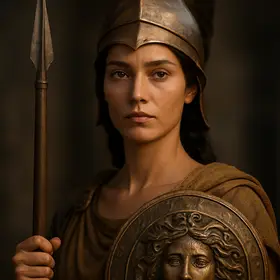
- Athena A protective divine ally who repeatedly aids him with counsel, disguises, and tactical support throughout his return (Books 1, 13–16, 22).
- Poseidon A vengeful antagonist whose wrath—for Polyphemus’ blinding—causes storms and delays throughout Odysseus’ voyage (Books 1, 5, 9).
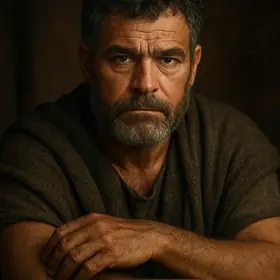
- Eumaeus The loyal swineherd who shelters the disguised Odysseus, displays steadfast fidelity, and becomes a trusted co-conspirator (Books 14, 16, 21).
- Alcinous The Phaeacian king who receives Odysseus hospitably, learns his story, and furnishes the ship that finally returns him to Ithaca (Books 7–8, 13).
Quotes by Odysseus
“I dare not clasp your knees, but I am in great distress; yesterday made the twentieth day that I had been tossing about upon the sea.”
Book 6Odysseus speaks humbly and persuasively to Nausicaa, presenting himself as a pitiable supplicant and eliciting her sympathy.
“I stayed with Calypso seven years straight on end, and watered the good clothes she gave me with my tears during the whole time;”
Book 7Odysseus gives a condensed account of his time with Calypso to explain the origin of his clothing and recent ordeals.
“Pray, Alcinous, do not take any such notion into your head. I have nothing of the immortal about me, neither in body nor mind, and most resemble those among you who are the most afflicted.”
Book 7Odysseus rejects the suggestion that he might be a god and stresses his mortal suffering to gain sympathy and aid.
“I am a good hand at every kind of athletic sport known among mankind.”
Book 8After being taunted by Euryalus, Odysseus asserts his prowess and agrees to compete, then astonishes the crowd with his discus throw.
“Ulysses will return in this self same year; with the end of this moon and the beginning of the next he will be here to do vengeance on all those who are ill treating his wife and son.”
Book 14The disguised stranger swears an oath predicting Odysseus' return to win Eumaeus' trust and stake his credibility.
“The gods, having hidden me thus easily, then took me to a good man’s door—for it seems that I am not to die yet awhile.”
Book 14Part of the guest's tale of shipwreck and escape, emphasizing divine intervention and his continued survival.
Why Odysseus matters
Odysseus embodies the poem’s central tension between wanderlust and homecoming: his intellect and resourcefulness allow survival, while his yearning for Ithaca gives moral purpose to his travels. Through his trials the epic explores themes of hospitality and its abuse (the contrast of Phaeacian generosity and the suitors’ presumption), the limits of human agency under divine will (Poseidon’s vengeance, Tiresias’ prophecies), and the costs of cunning—heroic cleverness brings survival but also violent reckonings. His gradual shift from a solitary wanderer to a husband and father restoring order highlights the poem’s valuation of household, justice, and the restorations that close a heroic life.
Chapters with Odysseus
More The Odyssey characters
 TelemachusMajor character
 AthenaMajor character
 PenelopeMajor character
 ZeusMajor character
 LaertesMinor character
 The SuitorsAntagonist
 AntinousAntagonist
 EumaeusMajor character
All chapter summaries ›Characters ›
Read The Odyssey illustrated
Every scene in these notes comes from the Book2Life reader, where the full public-domain text is illustrated as you read, with character portraits and narration. Free in your browser and on iPhone.
