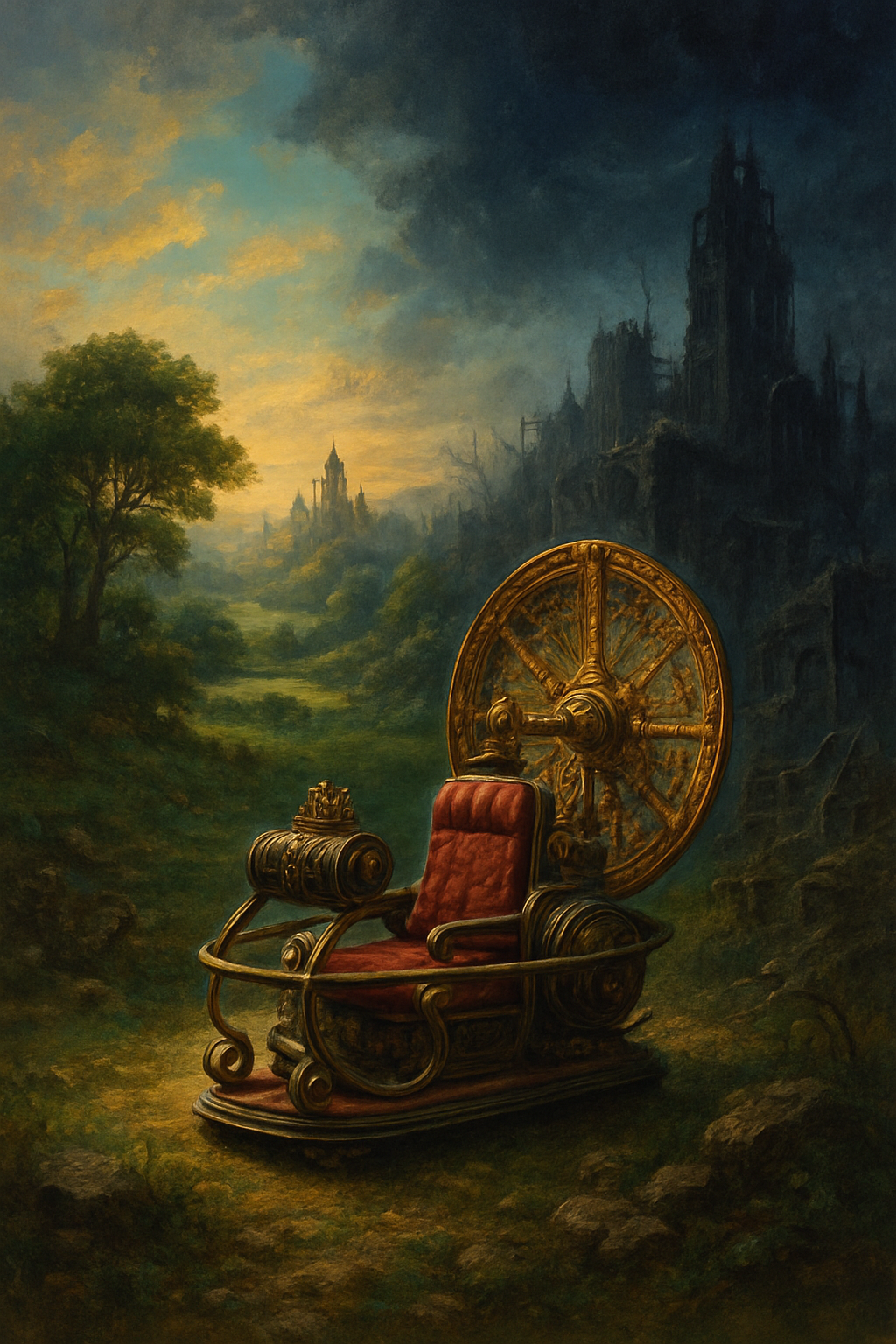
The Time Machine
1895 · Science fiction
Free to read in your browser. Public-domain edition from Project Gutenberg, illustrated as you read.
About This Book
The Time Machine is H. G. Wells’s compact science-fiction fable about a Victorian inventor who claims to have built a device that travels through the fourth dimension: time. Told as a frame story, the book opens at a dinner where the unnamed Time Traveller sketches his theory, demonstrates a small model, and later returns with a larger machine that actually carries him into the future. His tale is relayed to a skeptical group of friends by an unnamed narrator who records the astonishing account. The Time Traveller hurtles forward into ages to come and alights in a world inhabited by two strikingly different descendants of humanity: the gentle, childlike Eloi and the pale, subterranean Morlocks. He befriends a delicate Eloi girl named Weena, learns something of their language and customs, and explores ruined museums and landscaped gardens that suggest both cultural amnesia and a long decline. When his machine disappears, he must contend with the hostile Morlocks, the night terrors they bring, and the baffling social split of this far future. Part thought experiment, part adventure, the novel endures because it compresses speculative physics, social satire and vivid imagery into a brisk, readable narrative. Wells’s clear prose and moral urgency invite readers to consider technological progress, class division, and the fragility of civilization without burying them in exposition.
Characters in The Time Machine
 The Time TravellerA brilliant, iconoclastic inventor and thinker, the Time Traveller hosts friends to demonstrate his theory that time is a fourth dimension and then undertakes a daring journey to test it. Through his explorations, he becomes the lens through which readers encounter distant eras, social evolution, and the consequences of human choices, anchoring the novella’s scientific speculation to a personal, first‑hand account without heavy exposition.
 WeenaWeena is a member of the Eloi who befriends the Time Traveller, becoming his closest companion in the distant future and offering a tender, human anchor amid a strange world. Through her innocence, dependence, and affection, she helps reveal the Eloi’s nature and the broader themes of vulnerability, compassion, and societal decline without being a traditional guide or expositor.
 The NarratorAn educated dinner guest and friend of the Time Traveller, he frames the story by recounting the dinners, listening to the astonishing tale, and relaying it to the reader. As a skeptical yet open-minded observer, he provides a grounded perspective that lends credibility and structure to the narrative without being a direct agent of the plot.
 FilbyFilby is one of the Time Traveller’s dinner guests, serving as a vocal skeptic who challenges the Time Traveller’s ideas about the fourth dimension and time travel. His interruptions and debates help frame the story’s early scientific discussion and highlight the controversy of the Time Traveller’s claims without dominating the narrative.
 The Medical ManA dinner guest and interlocutor at the Time Traveller’s gatherings, the Medical Man represents scientific skepticism and professional caution. He questions methods and evidence, helping to frame the story’s speculative ideas against contemporary scientific thinking and grounding the conversation in rational inquiry without dominating the narrative.
 The PsychologistA rational, analytically minded dinner guest, the Psychologist serves as a skeptical foil to the Time Traveller, testing ideas, probing assumptions, and framing the book’s discussion of time as a scientific question. His presence helps ground the extraordinary claims in the give-and-take of educated debate, guiding readers through the conceptual stakes without overshadowing the protagonist.
 The EditorA skeptical, quick‑witted dinner guest in the frame narrative, the Editor prods the Time Traveller with pointed questions and wry remarks. His role is to test the plausibility of the tale, voice the reader’s doubts, and keep the conversation lively, helping to shape how the extraordinary account is received without driving the plot himself.
 The JournalistThe Journalist is one of the unnamed dinner guests in the frame narrative. As a sharp, inquisitive observer, he questions and prods the Time Traveller’s story, representing the skeptical, news-minded public and helping frame the tale’s themes of evidence, credibility, and how extraordinary claims are received.
 The Provincial MayorThe Provincial Mayor is one of the Time Traveller’s dinner companions who serves as a polite, civic-minded skeptic. He participates in the early parlor discussion, poses conventional, commonsense questions, and helps frame the story’s scientific and social themes by representing officialdom and public prudence, though he plays only a minor role in the narrative.
 The Very Young ManA minor figure among the Time Traveller’s dinner companions, he serves as an eager, impressionable listener whose reactions help draw out the story’s scientific ideas and themes. His presence underscores youthful curiosity and conventional assumptions, providing a foil that highlights the Time Traveller’s bold theorizing without playing a direct role in the central adventure.
 Mrs. WatchettMrs. Watchett is the Time Traveller’s reliable housekeeper, running his household and admitting his dinner guests. Her steady, domestic presence establishes the ordinary Victorian world against which the story’s extraordinary events unfold, grounding the narrative and highlighting the contrast between everyday life and radical discovery.
Study guide
Summaries and analysis of all 17 chapters, and profiles of 12 characters, illustrated with scenes from the book.
Themes
- time travel
- social decay
- class division
- evolution
- speculative future
Why Read The Time Machine?
Read The Time Machine for its elegant combination of imaginative speculation and social critique. Wells uses a short, brisk story to pose big questions about where technology and social systems might lead, turning scientific curiosity into an unsettling moral parable. The book’s mix of atmospheric scenes, clear pacing, and memorable figures like the Time Traveller and Weena makes these ideas feel immediate rather than abstract.
For contemporary readers the novel still resonates: its concerns about inequality, engineered comforts, and unintended consequences of progress are surprisingly modern. At the same time, it’s an accessible introduction to early science fiction—compact, provocative, and designed to be read in a few sittings while leaving you thinking long after the last page.
Experience The Time Machine on Book2Life
Read with AI-generated visuals, character portraits, audio narration, smart summaries, and more — free in your browser and on iPhone.



