All Quiet on the Western Front Chapter 11 Summary
Crater, Summer 1918
Paul and comrades fight in a crater, suffer losses, and Paul carries wounded Kat to a dressing station only to find him dead from a tiny head splinter.
Summary
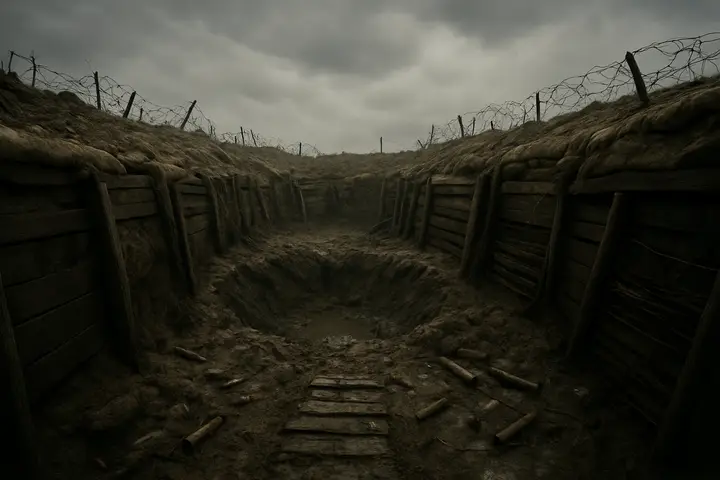
Paul and his comrades occupy a crater under heavy attack and face the terror of enemy flame-throwers; Lieutenant Bertinck exposes himself to fire and is wounded, Leer receives a fatal hip wound from a fragment, and the assault leaves the men shaken. The narrative shifts to a broader picture of summer 1918: the soldiers perceive that the German armies are being crushed by overwhelming material and numerical superiority, while the lasting small beauties of life—poppies, stars, warm rooms—become achingly desirable amid the endless bombardments and muddy, soaked trenches.
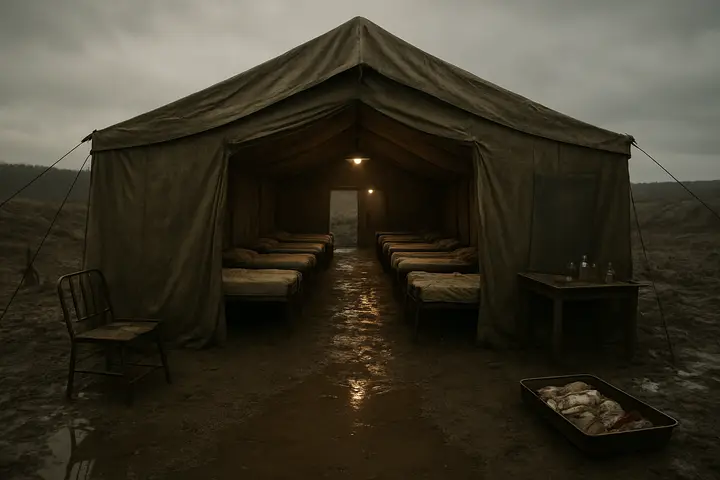
During a late summer advance while bringing food, Kat is struck in the shin and Paul carries him on his back toward a dressing station, pausing only briefly for rest and tea. They exchange memories and addresses; Paul worries about losing his closest friend. As Paul reaches the dressing station exhausted, an orderly tells him Kat is dead; Paul at first cannot accept it, but discovers a tiny splinter wound in Kat's head and realizes that the man has been killed almost instantly. Paul is left stunned and numb, surrounded by the ordinary bustle of the station while his intimate companion has just been taken from him.
Key events
- Soldiers in a crater face flame-throwers; Bertinck is wounded while firing.
- A fragment tears away Bertinck's chin and also mortally wounds Leer in the hip.
- Narrator reflects on the summer of 1918: scarcity, overwhelming enemy strength, and longing for life.
- Kat is hit (initially believed to be a leg wound); Paul carries him toward the dressing station.
- Paul and Kat share memories and addresses en route; Paul hopes Kat will survive.
- At the dressing station Paul learns Kat has a fatal head splinter and is dead.
Chapter 11 in pictures
Analysis
Chapter XI deepens the novel's central contrasts: the banality of comradeship against sudden, brutal loss; the sensory immediacy of battlefield violence against moments of tender recollection. Remarque uses tight, present-tense narration to place readers in Paul's exhausted body and mind, making the shock of Kat's death feel both personal and randomly absurd. The sequence opens with intense close-quarter combat (flame-throwers, fragments) to remind readers that death often arrives in tiny, arbitrary ways—a splinter through the head, a piece of shell that rends a hip—undermining notions of heroic death. The chapter’s long, lyrical middle section on the summer of 1918 functions as thematic commentary: small natural pleasures become unbearably precious, while soldiers recognize the strategic hopelessness caused by material shortages. This juxtaposition heightens the tragedy of individual losses amid impersonal mass warfare.
Structurally, the chapter alternates between episodic action and reflective passages, sustaining rhythm and offering a lull before the emotional blow of Kat's sudden death. Symbolically, the crater, mud, and incessant rain suggest the earth reclaiming men, while the tiny splinter that kills Kat underscores the randomness of fate in industrialized conflict. The narrator’s numb reaction—staring at routine life as his friend dies—reinforces the theme of emotional desensitization: the front both forges deep bonds and leaves survivors stunned, isolated, and bereft.
Important quotes
“Bertinck lets the gun drop and says: "Good," and slips back into the hole.”
NarratorShows a soldier’s resigned acceptance even as he is wounded, highlighting stoicism amid chaos.
“"At last—just at the last——"”
Stanislaus KatczinskyKat’s groan expresses bitter inevitability and the frustration of being wounded near an expected end.
“"He is stone dead."”
An orderlyThe blunt announcement snaps Paul out of disbelief and forces him to accept Kat's sudden death.
Characters in Chapter 11
All chapter summaries ›Characters ›
Read All Quiet on the Western Front illustrated
Every scene in these notes comes from the Book2Life reader, where the full public-domain text is illustrated as you read, with character portraits and narration. Free in your browser and on iPhone.
Read All Quiet on the Western Front free
