All Quiet on the Western Front Chapter 11 Summary
Life on the Front
Paul reflects on how war reshapes men, recounts Detering's desertion, Berger's madness retrieving a dog, Müller's death, and Bertinck's fall.
Summary
Paul opens by describing the altered rhythm of life at the front: seasons change but the soldiers' inner time no longer counts weeks. He explains how continual exposure to death has flattened social distinctions and transformed the men into a tightly bonded, survival-focused brotherhood. Life becomes reduced to essentials; instinct and comradeship replace reflective thought, and an artificial primitiveness preserves them from breaking under horror. Yet fragile equilibrium sometimes snaps, producing violent longing or breakdown.
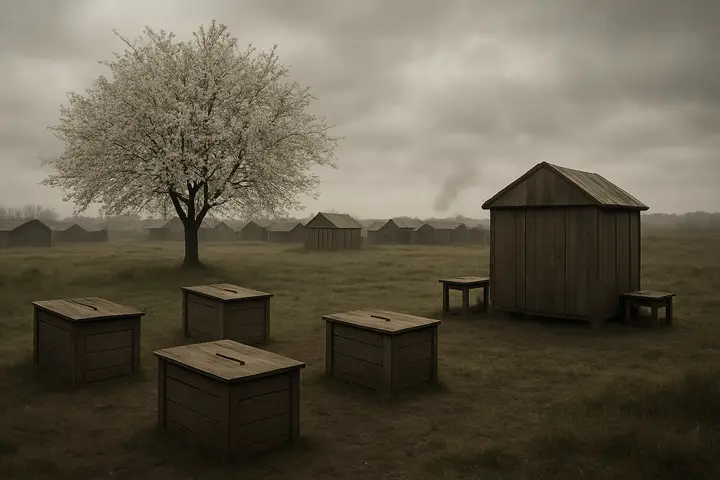
Paul then gives concrete examples of that breakdown. Detering, a peasant homesick for the blossoming cherry trees of his orchard, steals away and attempts to go home; he is captured by the field gendarmes and his fate becomes unknown. Next, Paul recounts Berger's irrational dash through barrage fire to fetch or kill a wounded messenger-dog in a cratered, chaotic section of line; Berger is wounded in the attempt and a rescuer is hit. Paul reports Müller's death — shot at close range and suffering before he dies — and takes Müller's boots for himself, promising them later to Tjaden. He laments the collapsing material and moral conditions: shortages of food and shells, worn artillery, dysentery, inexperienced fresh troops, and the new horror of tanks. Paul closes with the death of their capable company commander, Lieutenant Bertinck, taken in an attack, underlining the steady attrition and futility that permeate their existence.
Key events
- Paul reflects on the flattening effect of war and the survival-based brotherhood among soldiers.
- Detering, overcome by homesickness at sight of cherry blossoms, deserts and is captured by military police.
- Berger runs through enemy barrage toward a wounded messenger-dog, is wounded while attempting to reach it.
- Müller is shot at close range, dies painfully, and bequeaths his pocketbook and boots to Paul.
- Paul describes worsening conditions: shortages, illness, tanks, and the steady draining of men and morale.
- Lieutenant Bertinck, the respected company commander, falls in an attack.
Analysis
Chapter XI functions as a thematic centerpiece: it generalizes the novel's depiction of war's corrosive effects and then grounds those abstractions in painful episodes. Paul’s philosophical opening sketches the novel’s central transformations — social leveling, instinctive survival, comradeship as psychological lifeline, and the brittle boundary between sanity and dissolution. The prose switches from reflection to vignette, using Detering and Berger as case studies of homesickness and front-line madness; these incidents dramatize how ordinary human attachments (an orchard, a dog) become triggers for fatal acts when set against relentless violence. Müller's death provides a mundane, material consequence of attrition — boots passed along, burial threatened by shifting lines — emphasizing the interchangeable, depersonalized nature of casualties. The arrival of tanks and the description of shortages extend the theme to structural and technological changes that make individual valor pointless. Narratively, the chapter balances panoramic meditation with concrete scenes, reinforcing the novel’s realist technique: close sensory detail (craters, hand-grenades, cooling-water) anchors the philosophical claims. Symbolically, the cherry tree and the dog stand for prewar life and ordinary compassion, now fatal in their anachronism; the boots signify the economy of loss and inheritance among soldiers. The tone — resigned, skeptical, occasionally bitter — consolidates sympathy for the men while indicting the war’s machinery and its institutions (court martials, fraud in medical grading).
Important quotes
“We count the weeks no more.”
NarratorOpens the chapter and signals how soldiers' sense of time and ordinary measures of life have been erased by the front.
“It is a great brotherhood, which to a condition of life arising out of the midst of danger, out of the tension and forlornness of death, adds something of the good-fellowship of the folk-song, of the feeling of solidarity of convicts, and of the desperate loyalty to one another of men condemned to death—seeking in a wholly unpathetic way a fleeting enjoyment of the hours as they come.”
NarratorPaul explains the intense comradeship that binds the men, a key survival mechanism and central moral feature of their wartime existence.
“Müller is dead.”
NarratorA blunt report of a comrade's death that leads into the practical aftermath: Paul takes Müller's boots and reflects on burial and the shifting front.
Characters in Chapter 11
All chapter summaries ›Characters ›
Read All Quiet on the Western Front illustrated
Every scene in these notes comes from the Book2Life reader, where the full public-domain text is illustrated as you read, with character portraits and narration. Free in your browser and on iPhone.
Read All Quiet on the Western Front free
