All Quiet on the Western Front Chapter 8 Summary
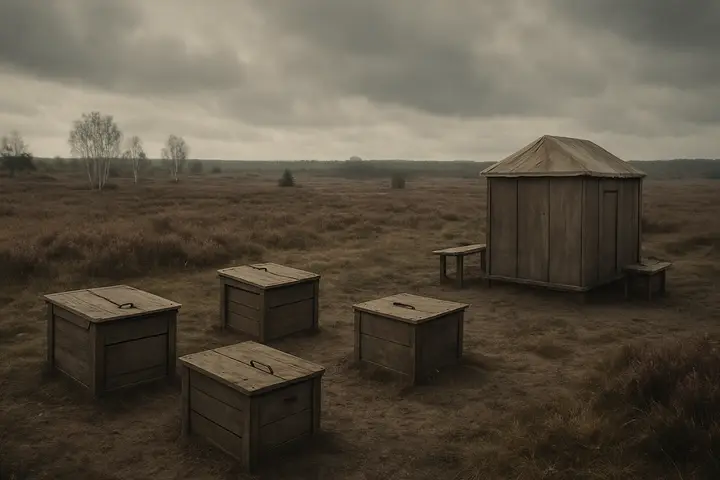
Camp on the Moors
Paul describes daily life in the moor camp, his encounters with Russian prisoners, and a brief visit from his family before returning to the front.
Summary
Paul Bäumer returns to a camp on the moors that he already knows but finds most faces unfamiliar; he goes through routine tasks, plays the piano in the Soldiers' Home, and observes the camp's surroundings and drill. He notes the camp's barbed-wire fences, the Soldiers' Home with two attendants, and the nearby Russian prison camp separated by wire; much of his time is spent alone, watching nature, practicing drill, and avoiding close companionship with his comrades.
Paul gives a detailed, sympathetic account of the Russian prisoners: their gaunt appearance, their scavenging for garbage, their barter of carved objects and boots for bread, and their general apathy caused by dysentery and undernourishment. He reflects on how arbitrary the enemy distinction is—how a document or a command turns ordinary, childlike men into enemies—and struggles with the moral implications of this thought. He slips cigarettes and some food to the Russians, listens to a Russian violinist play, and attends burials. Near the end of the chapter Paul receives a visit from his father and eldest sister; they speak about his mother's serious illness and the family's financial worries. After they depart, Paul cannot bring himself to eat the homemade cakes his mother prepared and gives most of them to the Russians instead.
Throughout the chapter Paul alternates close natural observation with contemplative moral questioning: he watches light on birches, the thieves and bargains of camp life, and the life-draining effects of imprisonment while quietly recording the human detail of those around him.
Key events
- Paul describes camp routine, Soldiers' Home, and daily company drill on the moor.
- He observes and sympathizes with the nearby Russian prison camp and its starving prisoners.
- Paul exchanges cigarettes and food with the Russians and listens to a Russian violinist play.
- He attends a burial of a Russian prisoner and notes their chorale-like singing.
- Paul's father and eldest sister visit; they discuss his mother's illness and financial strain.
- After they leave, Paul gives most of his mother's potato-cakes to the Russians.
Analysis
This chapter deepens the novel's humanizing impulse by juxtaposing routine camp life and natural description with close, compassionate observation of the enemy. Paul’s lyrical attention to light on birches and the small pleasures of playing the piano contrasts with the bleakness of the prisoners' hunger, creating moral tension that foregrounds the book's anti-war stance. The Russian prisoners function as living symbols of shared humanity: their childlike faces, musical singing, and small crafts make the abstract notion of 'enemy' concrete and sympathetic. Paul’s ethical unease—realizing that a single signed paper and a command separate men who otherwise resemble each other—introduces a central thematic conflict between obedience to authority and personal moral judgment.
Structurally, the chapter slows the narrative pace to allow reflection and to expand the novel’s world beyond the front lines, showing consequences of war in captivity and home life. The piano and violin scenes emphasize music as a fragile bridge between peoples; burial and cigarette exchanges underline rituals of common humanity. The visit from Paul’s family links front and home, highlighting class and economic strain, and reinforces Paul's emotional distance: he cannot fully partake of his mother's cooking because it represents both love and suffering. The narrative technique remains first-person, introspective, and observational, blending sensory detail with ethical rumination, and foreshadows further internal conflict about how to live after the war.
Important quotes
“It is when one is alone that one begins to observe Nature and to love her.”
NarratorPaul explains how solitude in camp leads him to notice and take solace in delicate natural details like the birches and shifting light.
“If I could know more of them, what their names are, how they live, what they are waiting for, what are their burdens, then my emotion would have an object and might become sympathy.”
NarratorPaul articulates the difficulty of sympathizing with faceless prisoners and how lack of individual knowledge keeps emotion abstract rather than directed.
“A word of command has made these silent figures our enemies; a word of command might transform them into our friends.”
NarratorPaul reflects on the arbitrariness of enemy labels and the moral implications of political decisions that create lifelong hostility.
Characters in Chapter 8
- Paul Bäumer
- Corporal Himmelstoss
- Tjaden
- Russians
- Musician (Russian violinist)
- Father
- Eldest sister
- Mother
All chapter summaries ›Characters ›
Read All Quiet on the Western Front illustrated
Every scene in these notes comes from the Book2Life reader, where the full public-domain text is illustrated as you read, with character portraits and narration. Free in your browser and on iPhone.
Read All Quiet on the Western Front free
