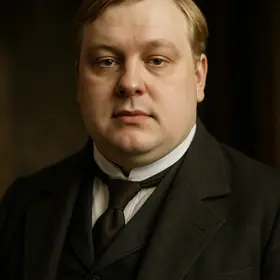
Zosimov in Crime and Punishment
Minor character
A young physician and acquaintance of Razumikhin who examines and monitors Raskolnikov, offering clinical explanations for his behavior.
Who is Zosimov?
Zosimov is a young, competent physician who appears when Raskolnikov falls ill and at other tense domestic moments. Summoned or accompanied by Razumikhin, he inspects Raskolnikov’s condition, prescribes practical measures, and occasionally administers sedatives; his calm, medical language helps to shape how the household interprets the student’s oddity. He speaks with a cool rationalism, treating moral distress and feverish delirium as matters for diagnosis rather than moral verdict. Though he never penetrates Raskolnikov’s inner motives or becomes involved in the central criminal plot, Zosimov’s pronouncements and measured presence provide social texture: he reassures the family, offers a secular account of apparent monomania, and stands as a contrast to characters who read symptoms as signs of conscience or guilt. His interventions—arriving with Razumikhin, advising on occupation and routine, and giving Raskolnikov a sedative after Marmeladov’s death—anchor the novel’s domestic responses to illness and underline the tension between medical explanation and moral interpretation.
In the book: Zosimov is a young physician and acquaintance of Razumikhin who examines and monitors Raskolnikov after his collapse. He embodies a cool, clinical rationalism—offering medical explanations for odd behavior—and his confident pronouncements shape how other characters initially interpret Raskolnikov’s condition. Though not central to the plot’s action, he adds social texture and helps frame the novel’s debates about illness, conscience, and responsibility.
Personality
- Clinical
- He examines Raskolnikov and reports cautiously that the patient’s state is partly physical and partly moral, treating odd behavior as diagnosable.
- Calm
- His measured reassurance calms Pulcheria and allows the family to leave planning to rest, showing his even temper in crises.
- Rational
- In conversation with Razumikhin he discusses hypochondria, fever, and the risk of delusions, offering medical explanations for suspicious conduct.
- Practical
- He prescribes occupation and routine as remedies and gives Raskolnikov a sedative after the Marmeladov carriage accident and death.
Character arc
Zosimov’s role remains steady from his first arrival to his later brief interventions: he is summoned as a medical authority and consistently offers clinical, secular readings of Raskolnikov’s condition. Early on he helps calm the family by categorizing the student’s unrest as a mixture of physical malaise and moral distress rather than outright insanity; this initial diagnosis shapes how others choose to act and speak around Raskolnikov. He accompanies Razumikhin, drops by to confer about the patient’s state, and later provides a sedative after the traumatic events surrounding Marmeladov’s death. He does not undergo a personal transformation or become drawn into moral debates; instead his presence steadily reinforces a medical frame for interpreting symptoms. In short, Zosimov remains a constant, stabilizing professional voice: unchanged in motive or method, he provides pragmatic care and rational commentary while other characters shift between suspicion, accusation, and emotional turmoil.
Relationships
- Dmitri Prokofych Razumikhin An acquaintance and colleague of Razumikhin who visits with or at Razumikhin’s request and confers about Raskolnikov’s condition.
- Rodion Romanovich Raskolnikov Raskolnikov’s examining physician who diagnoses his mixed physical and moral malaise and gives him a sedative when needed.
- Pulcheria Alexandrovna Raskolnikova Present during Zosimov’s examination, she accepts his reassurance about her son’s state, trusting his medical judgment.
- Avdotya Romanovna Raskolnikova Seen by Zosimov in the family scenes where his calm diagnosis helps settle tensions around her brother’s behavior.
- Pyotr Petrovich Luzhin A social interlocutor in scenes where Zosimov and Razumikhin respond skeptically to Luzhin’s utilitarian pronouncements.
Why Zosimov matters
Zosimov functions as the novel’s medico-rational counterpoint to readings of Raskolnikov that center conscience, criminality, or metaphysical theory. By framing agitation and delirium as medical problems—hypochondria, fever, or monomania—he highlights the limits of purely moralizing explanations and emphasizes social, bodily, and institutional responses to suffering. His presence also grounds domestic scenes in practical care, showing how ordinary people manage disturbance: with diagnoses, sedatives, and routines rather than only interrogation or condemnation. In this way Zosimov helps Dostoevsky stage the tension between scientific explanation and ethical responsibility without becoming a central actor in Raskolnikov’s moral drama.
Chapters with Zosimov
More Crime and Punishment characters
 Rodion Romanovich RaskolnikovProtagonist
 Dmitri Prokofych RazumikhinMajor character
 Avdotya Romanovna RaskolnikovaMajor character
 Sofya Semyonovna MarmeladovaMajor character
 Pulcheria Alexandrovna RaskolnikovaMajor character
 Nastasya PetrovnaMinor character
 Pyotr Petrovich LuzhinAntagonist
 Katerina Ivanovna MarmeladovaMajor character
All chapter summaries ›Characters ›
Read Crime and Punishment illustrated
Every scene in these notes comes from the Book2Life reader, where the full public-domain text is illustrated as you read, with character portraits and narration. Free in your browser and on iPhone.
Read Crime and Punishment free
