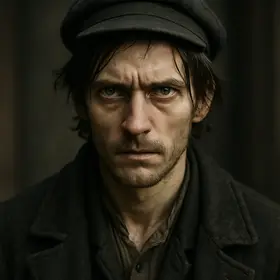
Rodion Romanovich Raskolnikov in Crime and Punishment
Protagonist
An impoverished, brilliant former student whose isolation and theory lead him to murder and then to a painful path toward confession and possible redemption.
Who is Rodion Romanovich Raskolnikov?
Rodion Romanovich Raskolnikov is a destitute ex-student in St. Petersburg, driven by pride, intellectual theorizing, and desperate concern for his family. Haunted by an article distinguishing "ordinary" and "extraordinary" men, he plans and carries out the double murder of the pawnbroker Alyona Ivanovna and her sister Lizaveta to test a moral hypothesis and to obtain money. After the murders he sinks into feverish paranoia, oscillating between arrogance and self-hatred, and becomes entangled with investigators, friends, and dependents: Razumikhin cares for his household; Porfiry probes him psychologically; Sonia inspires both pity and confession; Svidrigaïlov threatens and unsettles him; his mother Pulcheria and sister Avdotya complicate his motives. Tormented by conscience and by Porfiry’s appeals, he ultimately confesses to Sonia and then at the police station, is tried, and sent to Siberia where illness, Sonia’s fidelity, and suffering open the possibility of spiritual renewal.
In the book: An impoverished former student in St. Petersburg, Raskolnikov is the novel’s central figure, whose fierce intellect, pride, and isolation propel the narrative’s moral and psychological conflicts. Through his turbulent inner life and fraught relationships, the story probes questions of conscience, justice, and the possibility of redemption without relying on simple right‑and‑wrong answers.
Personality
- Intellectual
- He articulates and defends a theory about "extraordinary" men driving history during his visit with Porfiry and in salons where his article is discussed.
- Obsessive
- He counts the exact number of steps to the pawnbroker’s flat, surveys keys and room layouts, and rehearses the murder in meticulous practical detail before acting.
- Proud
- He lashes out at Luzhin and refuses to accept what he perceives as humiliating compromises for his family, insisting Dounia reject Luzhin despite consequences.
- Morally conflicted
- After the killings he alternates between rationalizing the crime as a test and calling it devilish and monstrous in his confession to Sonia.
- Self-destructive
- He drifts toward suicide, wanders the streets in feverish states, and ultimately places himself under investigation before confessing and accepting Siberian punishment.
Character arc
Raskolnikov begins as a proud, isolated thinker convinced that exceptional individuals can transgress moral law for a greater good; his intellectual abstraction hardens into action when he murders Alyona Ivanovna and, in panic, Lizaveta. Immediately afterward he collapses into fever, paranoia, and furtive attempts to hide evidence, yet alternates with moments of dangerous confidence when others appear to provide false leads. Encounters with Razumikhin, Porfiry, Sonia, and Svidrigaïlov force him into repeated moral reckonings: Porfiry uses psychological pressure and appeals to repentance; Svidrigaïlov’s presence menaces Dounia and exposes Raskolnikov’s vulnerabilities; Sonia embodies suffering, compassion, and religious perseverance. These pressures culminate in Raskolnikov’s voluntary confession—first to Sonia, then publicly at the police station—and a legal sentence to Siberian penal servitude. In the epilogue he arrives in prison sullen and defiant but, through illness, Sonia’s steadfast visits, and prolonged suffering, he begins to relinquish pride and open to the possibility of spiritual renewal, ending the novel at the threshold of moral regeneration.
Rodion Romanovich Raskolnikov in pictures


Relationships
- Dmitri Prokofych Razumikhin A loyal, practical friend who nurses Raskolnikov through illness and defends his family; Razumikhin provides material and moral support.
- Avdotya Romanovna Raskolnikova His devoted sister (Dounia) whose proposed marriage he violently opposes; their bond provokes much of his protective and self‑sacrificing rhetoric.
- Sofya Semyonovna Marmeladov Sonia is the compassionate confidante to whom he confesses the murders and who follows him faithfully, becoming the instrument of his moral appeal and later comfort in Siberia.
- Porfiry Petrovich The perceptive investigator who confronts Raskolnikov with psychological strategies, urging voluntary confession and testing his conscience.
- Arkady Ivanovich Svidrigaïlov A disturbing, ambiguous figure who knows about Raskolnikov’s confession and exerts a menacing influence around Dounia and Raskolnikov alike.
- Pulcheria Alexandrovna Raskolnikova His devoted mother whose arrival and affection both soften and exacerbate his turmoil, and whose decline follows his conviction.
Quotes by Rodion Romanovich Raskolnikov
““I want to attempt a thing like that and am frightened by these trifles,” he thought, with an odd smile.”
Chapter 1Raskolnikov’s internal conflict—he recognizes his fear of small details even as he contemplates a bolder, unnamed project.
““It must be the top drawer,” he reflected. “So she carries the keys in a pocket on the right. All in one bunch on a steel ring.... And there’s one key there, three times as big as all the others, with deep notches; that can’t be the key of the chest of drawers... then there must be some other chest or strong-box... that’s worth knowing.””
Chapter 1He inspects the pawnbroker’s habits and belongings, revealing curious, calculating attention to possible valuables and access points.
“"Good God!" he muttered "I must fly, fly,"”
Chapter 7The moment after the killings when panic and the urge to escape burst through his numbed and dissociated state.
“They’re in! All out of sight, and the purse too!”
Chapter 1His brief elation after stuffing the stolen items into the hole, immediately followed by horror at the improvised concealment.
“A search—there will be a search at once,”
Chapter 1His closing thought as he hurries home, convinced that the police suspect him and will search his room.
““I don’t want it,” said Raskolnikov, pushing away the pen. “Not want it?” “I won’t sign it.””
Chapter 3Raskolnikov resists signing to receive the remittance, showing inner refusal to accept aid even while weak.
Why Rodion Romanovich Raskolnikov matters
Raskolnikov embodies the novel’s central moral and psychological inquiry: whether intellectual theory can justify transgression and what punishment, suffering, or compassion is required for conscience to awaken. His crime tests utilitarian and exceptionalist ideas, and his ensuing torment shows how isolation, pride, and abstract reasoning detach a person from human ties. Through his interactions—especially Sonia’s patience and Porfiry’s probing—the book explores redemption as a process conditioned by confession, love, and suffering rather than simple legal retribution. Raskolnikov’s gradual movement from arrogance to humility anchors the novel’s meditation on guilt, responsibility, and spiritual renewal.
Chapters with Rodion Romanovich Raskolnikov
- Chapter 1
- Chapter 2
- Chapter 3
- Chapter 4
- Chapter 5
- Chapter 6
- Chapter 7
- Chapter 1
- Chapter 2
- Chapter 3
- Chapter 4
- Chapter 5
- Chapter 6
- Chapter 7
- Chapter 1
- Chapter 2
- Chapter 3
- Chapter 4
- Chapter 5
- Chapter 6
- Chapter 1
- Chapter 2
- Chapter 3
- Chapter 4
- Chapter 5
- Chapter 6
- Chapter 1
- Chapter 2
- Chapter 3
- Chapter 4
- Chapter 5
- Chapter 1
- Chapter 2
- Chapter 3
- Chapter 4
- Chapter 5
- Chapter 6
- Chapter 7
- Chapter 8
- Epilogue I
- EPILOGUE II
More Crime and Punishment characters
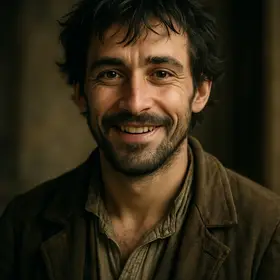 Dmitri Prokofych RazumikhinMajor character
 Avdotya Romanovna RaskolnikovaMajor character
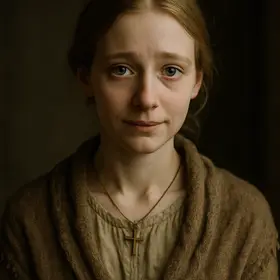 Sofya Semyonovna MarmeladovaMajor character
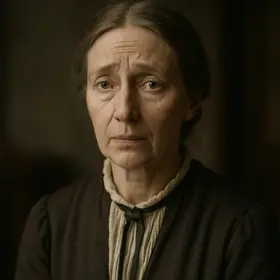 Pulcheria Alexandrovna RaskolnikovaMajor character
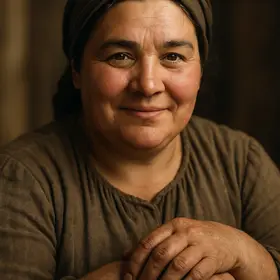 Nastasya PetrovnaMinor character
 Pyotr Petrovich LuzhinAntagonist
 Katerina Ivanovna MarmeladovaMajor character
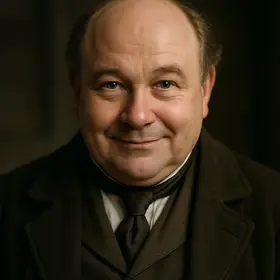 Porfiry PetrovichMajor character
All chapter summaries ›Characters ›
Read Crime and Punishment illustrated
Every scene in these notes comes from the Book2Life reader, where the full public-domain text is illustrated as you read, with character portraits and narration. Free in your browser and on iPhone.
Read Crime and Punishment free
