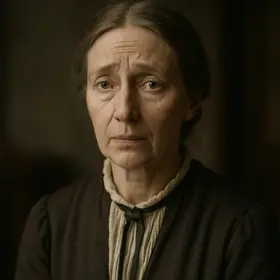
Pulcheria Alexandrovna Raskolnikova in Crime and Punishment
Major character
Raskolnikov’s devoted, anxious mother whose letters and visit reveal family hopes, pride, and moral anguish.
Who is Pulcheria Alexandrovna Raskolnikova?
Pulcheria Alexandrovna is Rodion Raskolnikov’s devoted mother whose long, affectionate letter and subsequent arrival in St. Petersburg catalyze much of the domestic tension around Raskolnikov. She wants security and respectable prospects for her children, so she champions Dounia’s practical match with Luzhin and brings family news and hoped-for money. In person she is gently authoritative, pleading to stay with her son, weeping over his illness and trying to mediate hostile encounters; her presence intensifies Raskolnikov’s inner conflict and exposes the moral strains in the household. Pulcheria repeatedly expresses maternal protectiveness and moral concern—reading Luzhin’s correspondence, urging reconciliation, and weeping over Rodion—thereby humanizing the abstract debates about crime, dignity, and poverty. Her mind and health fray after Rodion’s arrest: her hopes and public talk endanger the family’s plans, she succumbs to brain fever, and she dies in the aftermath of the trial, her decline underscoring the novel’s personal cost.
In the book: Pulcheria Alexandrovna is Raskolnikov’s devoted mother, whose letters and visit to St. Petersburg help propel the story and illuminate his inner turmoil. She represents steadfast maternal love, social respectability, and moral concern, providing a humane counterpoint to her son’s isolation and ideas while deepening the novel’s emotional stakes without driving the plot’s central actions.
Personality
- Devoted
- She writes a long, fond letter and travels to Petersburg to support her children and offer money and moral backing (Chapter 3).
- Anxious
- She pleads to stay with Rodion during his illness and repeatedly worries about the family’s reputation and Dounia’s prospects (Chapter 1 and Chapter 3).
- Respectable
- She frames Luzhin as a ‘respectable, practical man’ and hopes his match will restore the family’s social standing (Chapter 3 letter).
- Maternal moralist
- She weeps over Rodion, urges prayer for him, and senses a terrible moral burden without knowing details of his crime (Chapter 7).
- Fragile
- After the trial and Raskolnikov’s conviction, her mind unravels into delirium and dreams about her son before dying of brain fever (Epilogue I).
Character arc
Pulcheria enters the story as a source of hope and practical intent: through her letter she brings news of Dounia’s social rehabilitation and proposes Luzhin as a stabilizing match that might relieve the family’s poverty. Her arrival in Petersburg heightens the emotional stakes—she pleads to stay with her sick son, reads the offending letter, and is repeatedly reduced to tears while trying to protect and comfort Raskolnikov. As conflicts erupt (Luzhin’s insults, Svidrigaïlov’s threats, and the family’s domestic upheavals), Pulcheria remains a protective but increasingly vulnerable figure, often unaware of the full moral collapse taking place. After Raskolnikov’s confession and trial, the strain of public exposure and anxious boasting about her son damages her mind; she develops brain fever, lapses into delirium, and ultimately dies in the aftermath of his conviction. Her decline from hopeful matron to a bereaved, broken parent mirrors the personal toll of the crimes and the social consequences for those who love the perpetrator.
Relationships
- Rodion Romanovich Raskolnikov Her only son; she is devoted, weeps over his illness, pleads for him and hopes for his moral recovery.
- Avdotya Romanovna Raskolnikova Her daughter (Dounia); Pulcheria supports Dounia’s marriage plans as a means of family security and pride.
- Pyotr Petrovich Luzhin She views Luzhin as a potentially respectable suitor who might help the family, and reads his correspondence critically in the household disputes.
- Dmitri Prokofych Razumikhin She depends on Razumikhin’s practical assistance and accepts his protection and plans for the family after crises.
- Sofya Semyonovna Marmeladov She receives Sonia in her home with concern and gratitude after Sonia’s modest, frightened visit, recognizing her dignity and need.
Quotes by Pulcheria Alexandrovna Raskolnikova
““My dear Rodya,” wrote his mother—“it’s two months since I last had a talk with you by letter which has distressed me and even kept me awake at night, thinking.”
Chapter 3The letter begins Pulcheria’s long, affectionate account that delivers the chapter’s key family news about Dounia and Luzhin.
Why Pulcheria Alexandrovna Raskolnikova matters
Pulcheria embodies the novel’s human, domestic stakes: maternal love, social respectability, and the everyday moral responsibility that counters abstract criminal theories. Her letters and presence force Raskolnikov’s private ideas into public, familial terms, highlighting how theories about ‘extraordinary’ crime damage those who depend on ordinary decency. Her mental collapse and death after the trial illustrate the collateral suffering that crime inflicts on the innocent and emphasize themes of guilt, compassion, and the social cost of intellectual isolation.
Chapters with Pulcheria Alexandrovna Raskolnikova
More Crime and Punishment characters
 Rodion Romanovich RaskolnikovProtagonist
 Dmitri Prokofych RazumikhinMajor character
 Avdotya Romanovna RaskolnikovaMajor character
 Sofya Semyonovna MarmeladovaMajor character
 Nastasya PetrovnaMinor character
 Pyotr Petrovich LuzhinAntagonist
 Katerina Ivanovna MarmeladovaMajor character
 Porfiry PetrovichMajor character
All chapter summaries ›Characters ›
Read Crime and Punishment illustrated
Every scene in these notes comes from the Book2Life reader, where the full public-domain text is illustrated as you read, with character portraits and narration. Free in your browser and on iPhone.
Read Crime and Punishment free
