Don Quixote Chapter 49 Summary
Sancho's island rounds
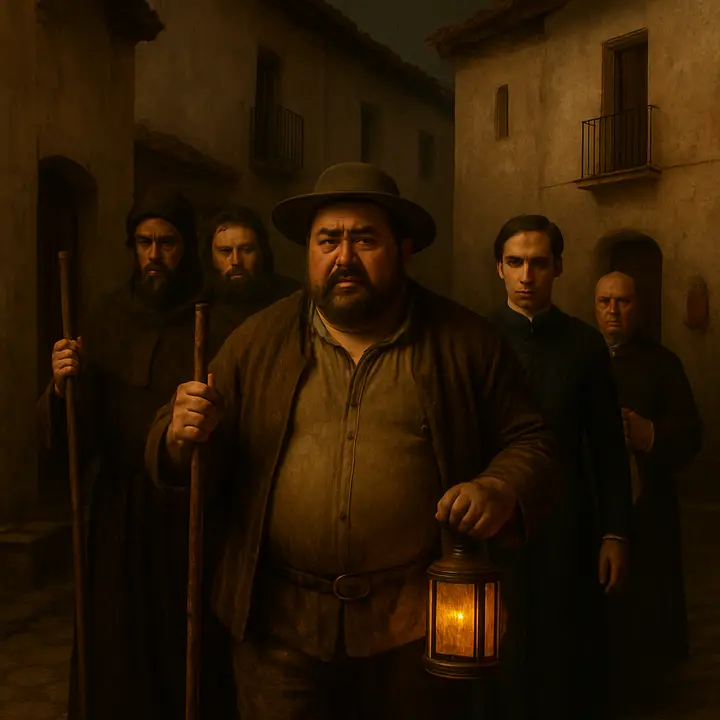
Sancho conducts his night rounds as governor, settling disputes, encountering a disguised pair, and returning the young cross-dressed siblings home.
Summary
Sancho Panza, installed as governor of an island by the duke, presides over his first night round accompanied by the majordomo, secretary, head-carver, chronicler, alguacils, and notaries. Before supper he gives a homely speech about judges and food, praising simple fare and promising to govern without taking bribes while warning idlers and rogues. After supper the party patrols the town and encounters several disturbances that test Sancho’s practical—if unsophisticated—sense of justice.
They first break up a quarrel between two men who argue over a share of gambling winnings; Sancho fines the winner and orders the poorer man banished for ten years, then resolves to curb harmful gambling houses. Next a youth who ran from officers boasts that no one can make him sleep in prison; Sancho cleverly points out that, since sleep is voluntary, there’s no point imprisoning a man who will not sleep, and lets him go with a warning. Later tipstaffs present a fair young person in man’s clothing who, when questioned, reveals she is a sheltered gentleman’s daughter who begged her brother to dress her in his clothes so she might see the town; both siblings are discovered—the brother in feminine attire—and Sancho, after hearing their childish curiosity and remorse, returns them home safely. The head-carver and others are smitten by the beauty of the siblings, and Sancho imagines advantageous marriages, while he maintains his pledge to protect honest people and punish idleness. The round ends uneventfully, though Sancho’s government will face upheavals later.
Key events
- Sancho gives a homespun speech on judges, food, and governance before supper.
- During the night round he mediates a quarrel over gambling winnings and fines the winner.
- A youth refuses to be frightened into prison by officers and Sancho lets him go after a clever exchange.
- Tipstaffs bring a youth disguised as a man; a beautiful maiden in male dress is revealed as a sheltered gentleman’s daughter.
- Sancho returns the siblings to their home; onlookers and servants remark on their beauty and folly.
- The head-carver plans to court the maiden; Sancho contemplates marrying off his daughter—round ends.
Analysis
This chapter showcases Sancho’s practical, commonsense approach to justice and highlights Cervantes’ comic interest in social order and the limits of authority. Sancho functions as a foil to formal law: his rulings are improvised, rooted in everyday morality, and often pragmatic rather than legalistic. His judgments—punishing rogues, protecting honest poor, and rebuking youthful folly—establish him as a populist magistrate who values sustenance, decency, and local customs. The episodes (gambling quarrel, the boastful youth, and the cross-dressed siblings) illustrate recurring themes: appearance versus reality, social performance, and the tension between private desire and public reputation.
Narratively, the chapter is episodic, each short vignette testing Sancho’s authority and revealing character through dialogue and reaction rather than introspection. The disguised sister and brother motif points to gender play and the constraints placed upon women of rank—her curiosity punished more by shame than law. The head-carver’s immediate romantic fantasies and Sancho’s matrimonial schemes introduce social satire about ambition and vanity in service of the elite. Cervantes also uses irony and colloquial speech to humanize Sancho and to undermine the dignity of formal institutions, suggesting that good governance may be as much about common sense and compassion as about learned law. The chapter’s light tone masks questions about reputation, control, and the performative nature of authority.
Important quotes
“I mean to govern this island without giving up a right or taking a bribe; let everyone keep his eye open, and look out for the arrow;”
Sancho PanzaSancho declares his intentions as governor—promising integrity, protection of the honest, and warnings to idlers and rogues.
“Have I not the power to arrest thee and release thee whenever I like?”
Sancho PanzaSancho asserts his authority to a young man who boasts that no one can make him sleep in prison, prompting a witty exchange about voluntary sleep.
Characters in Chapter 49
- Sancho Panza
- Doctor Pedro Recio
- majordomo
- the duke
- the head-carver
- the secretary
- the chronicler
- alguacils
- notaries
- a winner (unnamed gambler)
- an assaulted man (unnamed)
- a tipstaff (unnamed)
- a young boastful weaver
- a gaoler (mentioned)
- a maiden (daughter of Diego de la Llana)
- the brother (of the maiden)
- Pedro Perez Mazorca
- Diego de la Llana
- the head-carver (in love; same as head-carver above)
All chapter summaries ›Characters ›
Read Don Quixote illustrated
Every scene in these notes comes from the Book2Life reader, where the full public-domain text is illustrated as you read, with character portraits and narration. Free in your browser and on iPhone.
