Don Quixote Chapter 48 Summary
Don Quixote and Doña Rodriguez
Don Quixote befriends the duchess’s duenna, Doña Rodriguez, who asks him to right a wrong, but both are mysteriously assaulted in his bedchamber.
Summary
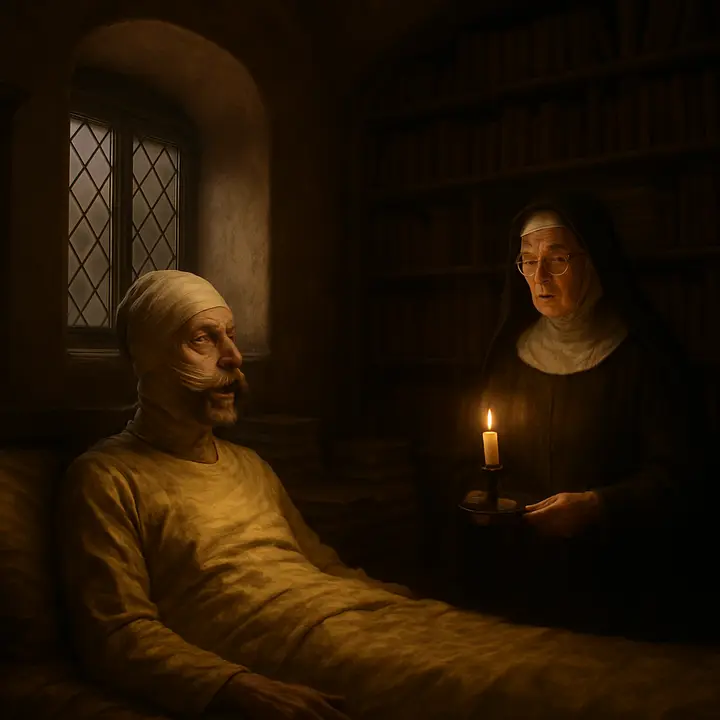
Don Quixote is bandaged and despondent after recent wounds and has lain hidden for six days. One night he hears a key at his door and, fearing a nocturnal seduction that might compromise his fidelity to Dulcinea, prepares himself in bed, wrapped in a yellow satin coverlet and with his face bound. The figure who enters is not Altisidora but Doña Rodriguez, the venerable duenna of the Duchess, who at first surprises and frightens him and is herself alarmed by his frightening appearance.
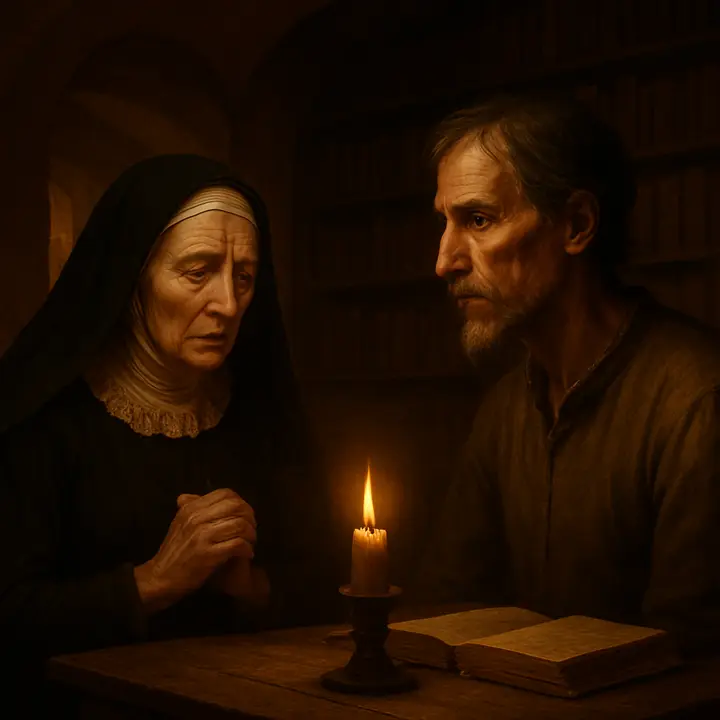
After initial mutual mistrust they calm each other and sit down; Don Quixote pledges chaste attention and protection while Doña Rodriguez unburdens her life story. She explains her origins in Oviedo, her marriage and widowhood, and how her beautiful daughter has been seduced by a wealthy farmer’s son who promised to marry her but refuses to do so now. Doña Rodriguez has petitioned the Duke and Duchess to intervene without success, and she implores Don Quixote to redress this grievance in keeping with his role as a champion of the wronged. Their conversation ranges into comic asides about the Duchess’s ailments and Don Quixote’s credulous reactions. Suddenly, in the dark after a slammed door, both are assaulted: Doña Rodriguez is seized, her petticoats hoisted, and someone then strips and pins Don Quixote, pinching him until he defends himself briefly; the attackers depart silently. The chapter closes with Don Quixote left bruised and puzzled, and the narrative shifting focus to Sancho for the moment.
Key events
- Don Quixote, bandaged and in a yellow coverlet, mistakes an entering figure for a witch or seductress.
- Doña Rodriguez reveals herself and explains her background and grievance about her daughter.
- Don Quixote promises chaste aid and listens as the duenna recounts the seduction and the Duke’s refusal to act.
- They share comic exchanges about the Duchess; Doña Rodriguez asks Don Quixote to right the wrong.
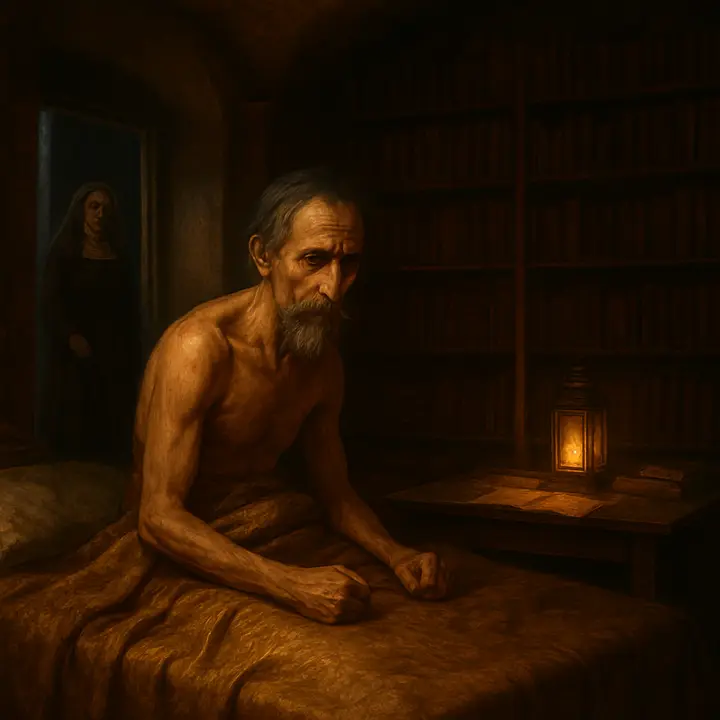
- A sudden noisy door and darkness; both are secretly assaulted—Doña Rodriguez beaten and exposed, Don Quixote pinched and stripped.
- Attackers flee; Don Quixote remains injured and bewildered as the chapter ends.
Chapter 48 in pictures
Analysis
This chapter blends comic humiliation with social grievance, moving the novel from public misadventures into intimate, late-night vulnerability. It develops Don Quixote’s chivalric self-image—he insists on chastity and public duty even while physically disfigured—which creates dramatic irony when he proves unable to prevent his own private humiliation. Doña Rodriguez functions as both a credible petitioner and a comic figure: her earnest plea about her daughter’s ruined honor gives the knight a legitimate quest, anchoring his idealism in a social wrong, while her bawdy domestic anecdotes and the Duchess’s bodily ailments satirize aristocratic pretensions. The nighttime assault — silent, secretive, and humiliating — undercuts Don Quixote’s authority and exposes the limits of his supposed prowess: his pledges of protection are impotent in his own bedroom. The narrator’s aside about Cide Hamete and the parenthetical praise of the odd couple marching “linked hand in hand” heighten Cervantes’s metafictional voice, reminding readers this is an authored tale with playful commentary. Symbolically, the yellow coverlet, the spectacles, and the bandages emphasize vision and misperception—what is seen and what is imagined—while the unseen attackers foreshadow recurring themes of deception and the slipperiness of honor claims. Structurally, the chapter introduces a new, plausible grievance to motivate further action and shifts focus to other characters, sustaining narrative momentum.
Important quotes
“No," said he, firmly persuaded of the truth of his idea (and he said it loud enough to be heard), "the greatest beauty upon earth shall not avail to make me renounce my adoration of her whom I bear stamped and graved in the core of my heart and the secret depths of my bowels; be thou, lady mine, transformed into a clumsy country wench, or into a nymph of golden Tagus weaving a web of silk and gold”
Don QuixoteDon Quixote vows fidelity to Dulcinea when he thinks an intruder might tempt him; reveals his steadfast chivalric ideal.
“I conjure thee, phantom, or whatever thou art, tell me what thou art and what thou wouldst with me. If thou art a soul in torment, say so, and all that my powers can do I will do for thee; for I am a Catholic Christian and love to do good to all the world, and to this end I have embraced the order of knight-errantry to which I belong, the province of which extends to doing good even to souls in pu”
Don QuixoteDon Quixote ceremonially addresses the apparently supernatural intruder, showing his knightly language and sense of duty.
“Señor Don Quixote—if so be you are indeed Don Quixote—I am no phantom or spectre or soul in purgatory, as you seem to think, but Doña Rodriguez, duenna of honour to my lady the duchess, and I come to you with one of those grievances your worship is wont to redress.”
Doña RodriguezDoña Rodriguez reveals her identity and frames her request, giving Don Quixote a socially grounded cause to champion.
Characters in Chapter 48
All chapter summaries ›Characters ›
Read Don Quixote illustrated
Every scene in these notes comes from the Book2Life reader, where the full public-domain text is illustrated as you read, with character portraits and narration. Free in your browser and on iPhone.
