Don Quixote Chapter 58 Summary
Adventures Crowd In
Don Quixote and Sancho leave the duke's castle, meet image-carriers, a mock Arcadia of shepherds, are celebrated, and are trampled by a herd on the road.
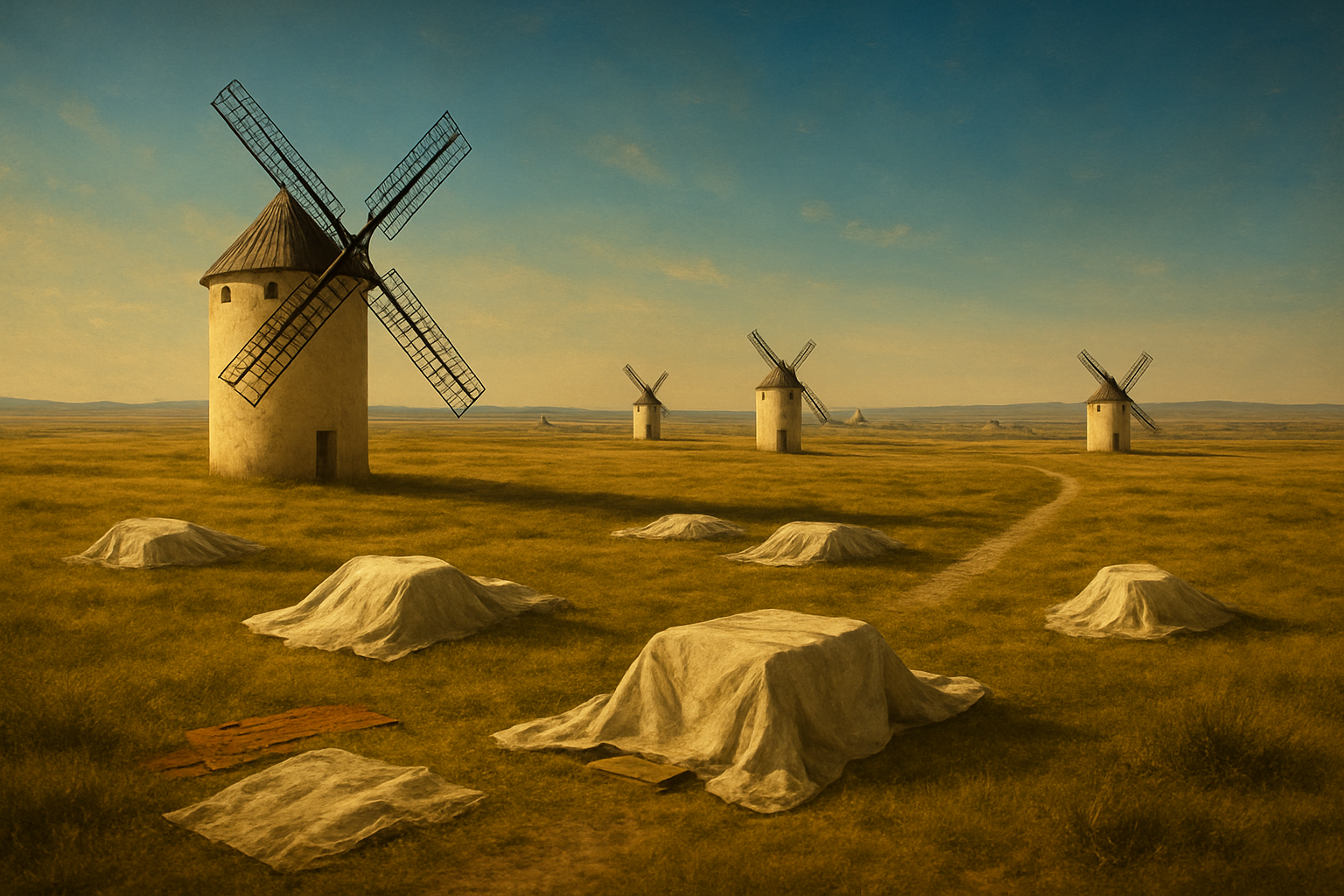
Summary
Don Quixote and Sancho, relieved to be free from the obligations and attentions of the duke’s household and Altisidora, resume their journey and discuss freedom, gratitude, love, and omens. Shortly after setting out they encounter a group of labourers carrying gilded religious images for a village retablo; Don Quixote inspects and praises each saintly figure, reading them as chivalric exemplars and taking the meeting as a happy omen for his vocation. Sancho admires his master’s learning and the two move on, debating Spanish invocations, the nature of beauty, and the cause of Altisidora’s infatuation.
As they pass into a wood they become entangled in green nets meant to snare birds, whereupon two shepherdesses (actually disguise-clad young noblewomen) appear and invite them to a pastoral celebration nearby. The group has prepared tents, tables, and pastoral entertainments; recognizing Don Quixote and Sancho from circulated tales, they urge them to stay. Don Quixote grandly offers to proclaim the disguised shepherdesses the fairest in the world (save Dulcinea), a declaration that prompts Sancho’s loud defense of his master's sanity and leads Don Quixote to mount Rocinante and plant himself in the road to formalize the challenge. Fate intervenes when a hurried drove of cattle and herdsmen arrives: the animals and drovers trample Don Quixote, Sancho, Rocinante and Dapple, throwing them to the ground. Though bruised and humiliated, they recover and continue their journey, leaving the mock Arcadia behind.
Key events
- Don Quixote and Sancho leave the duke's castle and discuss freedom and gratitude.
- They meet labourers carrying gilded images for a village retablo and Don Quixote praises the saints.
- Two disguised shepherdesses invite them to a pastoral fête; Don Quixote is treated as a celebrity.
- Don Quixote publicly offers to proclaim the shepherdesses supremely fair, excepting Dulcinea.
- He posts himself in the highway to defend his declaration; a passing drove tramples him, Sancho, Rocinante and Dapple.
- Bruised and humiliated, they recover and ride off, abandoning the pastoral gathering.
Chapter 58 in pictures


Analysis
This chapter mixes comic set-pieces with thematic reflection, advancing character and tone while reinforcing Cervantes’s interplay of reality and fiction. Don Quixote’s inspection of religious images lets him read saintly hagiography as chivalric exemplum, demonstrating his persistent tendency to interpret the world through the frame of knight-errantry; it also highlights his moral earnestness—he equates spiritual heroism with his own martial vocation even as he admits his human flaws. The pastoral episode stages theatricality and social performance: the noble youths’ Arcadian playfulness, the nets that both trap birds and ensnare the knight’s path, and the mock-ceremonial praise Don Quixote insists on all call attention to the porous boundary between literature, reputation, and real consequences. Sancho functions as comic foil and loyal commentator—his earthy proverbs and literal-minded questions puncture and humanize Don Quixote’s rhetoric, while also revealing a shrewd common sense.
Structurally the chapter is episodic yet tightly arranged: a sequence of encounters accelerates from discourse to invitation to public proclamation and then abrupt physical humiliation. The drove that tramples the protagonists acts as comic anti-climax and a grounding force, resetting Don Quixote’s elevated rhetoric with bodily reality. Symbolically the nets and the pastoral disguise suggest themes of appearance versus essence and artifice entrapping both spectators and participants. Narratively, the chapter continues Cervantes’s pattern of inserting self-aware scenes that call attention to stories and reputations—here, the circulating history of Don Quixote shapes how others receive him—while also allowing immediate physical comedy to destabilize heroic claims.
Important quotes
“Freedom, Sancho, is one of the most precious gifts that heaven has bestowed upon men; no treasures that the earth holds buried or the sea conceals can compare with it; for freedom, as for honour, life may and should be ventured;”
Don QuixoteDon Quixote reflects on leaving the duke's household and on the value of liberty versus indebted obligation.
“Hold, sir knight, and do not break these nets; for they are not spread here to do you any harm, but only for our amusement;”
ShepherdessA disguised shepherdess explains the nets and invites Don Quixote to the pastoral celebration, initiating the mock Arcadia.
“Ho ye travellers and wayfarers, knights, squires, folk on foot or on horseback, who pass this way or shall pass in the course of the next two days! Know that Don Quixote of La Mancha, knight-errant, is posted here to maintain by arms that the beauty and courtesy enshrined in the nymphs that dwell in these meadows and groves surpass all upon earth, putting aside the lady of my heart, Dulcinea del T”
Don QuixoteDon Quixote issues a public challenge on the highway to defend his extravagant proclamation in honor of the disguised shepherdesses.
Characters in Chapter 58
- Don Quixote
- Sancho Panza
- Altisidora
- Dulcinea del Toboso
- Rocinante
- Dapple
- Saint George
- Saint Martin
- Saint James
- Saint Paul
- Shepherdess (two, disguised ladies)
- Herder / Labourers (image-carriers)
All chapter summaries ›Characters ›
Read Don Quixote illustrated
Every scene in these notes comes from the Book2Life reader, where the full public-domain text is illustrated as you read, with character portraits and narration. Free in your browser and on iPhone.
