Dracula Chapter 11 Summary
Lucy’s Recovery and Night Terror
Lucy seems to recover under Van Helsing’s care, a strange zoo-episode is reported, Renfield attacks Seward, and Lucy records a terrifying night with her mother.
Summary
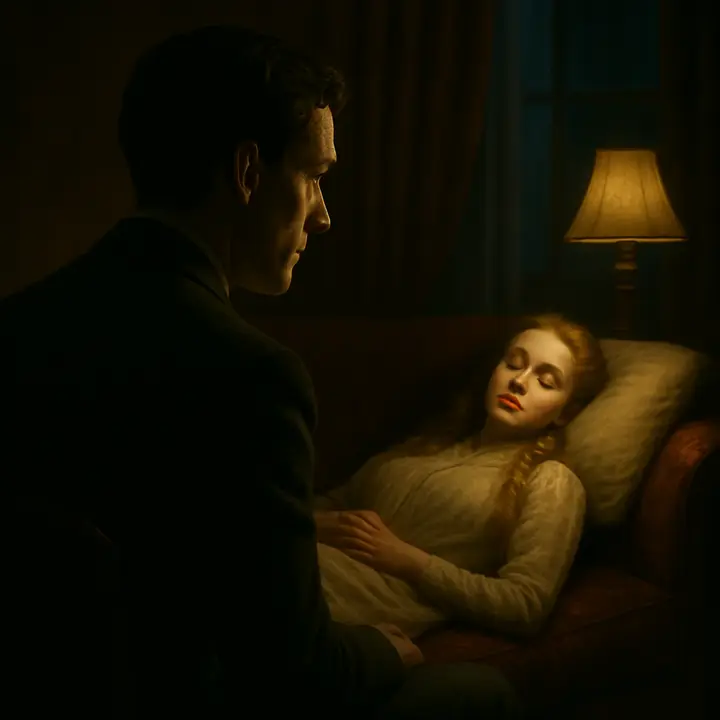
Lucy’s diary opens with gratitude for her friends and Dr. Van Helsing’s care: she notes that the flowers he prescribed bring her comfort and that she can sleep without dread. Dr. Seward records arriving at Hillingham with Van Helsing to find Lucy apparently improved; Mrs. Westenra reports removing some of the strong-smelling flowers from Lucy’s room, which throws Van Helsing into despair until he recovers and insists on renewed precautions and treatments, including another blood transfusion. Van Helsing takes over immediate night watch, leaving Seward relieved but puzzled by the intensity of the Professor’s reaction.
The chapter then shifts to a newspaper piece about an escaped wolf at the Zoological Gardens: keeper Thomas Bilder recounts Bersicker’s brief escape and return, describing a suspicious encounter with a strange man who stroked the wolf and a night of howling and broken glass. Back at Carfax, Seward recounts an alarming attack by his patient (Renfield), who stabs him and then laps up Seward’s blood while repeating a disturbing phrase. Seward is shaken and must leave for London on hearing that Van Helsing summons him urgently. The chapter closes with Lucy’s own memorandum of a night (17 September) in which she describes being awakened by flapping and a wolf’s head breaking through her window; she says her mother tore away the protective wreath and then collapses as if struck, the maids are drugged, lights burn blue and dim, and Lucy fears she and her mother will die—Lucy hides this paper in case she does not survive the night.
The chapter mixes personal, clinical, and public-document perspectives—diary, newspaper, medical record, and a dying memorandum—to advance both the plot and the sense of mounting menace around Lucy and the household.
Key events
- Lucy records comfort and sleep after Van Helsing’s prescribed flowers.
- Van Helsing breaks down when he learns Mrs. Westenra removed flowers from Lucy’s room; he insists on renewed treatment.
- Newspaper account: Bersicker the wolf escapes and returns after a strange encounter with a mysterious man.
- Renfield bursts into Seward’s study, wounds him, and licks his blood while repeating “The blood is the life!”
- Van Helsing telegram summons Seward to Hillingham; Seward leaves for London worried.
- Lucy’s memorandum describes a wolf’s head at her window, her mother’s collapse, drugged servants, and Lucy’s fear she will die.
Analysis
This chapter intensifies the novel’s mounting atmosphere of dread by layering multiple documentary forms—diary entries, a newspaper report, clinical diary, telegram, and a dying memorandum—to show various viewpoints on the same escalating crisis. Van Helsing’s emotional collapse and subsequent resolute action reveal his deep involvement and expertise while also signaling that ordinary remedies and social niceties cannot contend with whatever afflicts Lucy. The scenes underscore themes of science versus the uncanny: Seward’s clinical recording and transfusion work contrast with Van Helsing’s foreign, instinctive methods and ritual-like directions (flowers, garlic). The Zoological Gardens article supplies ironic distance and social texture—comedy and London gossip—yet its description of a strange man fondling a wolf and broken glass echoes the later, more sinister window intrusion at the Westenra house, foreshadowing violence crossing from public spectacle into private space. Renfield’s violent, blood-obsessed behavior concretely connects to the blood-transfusion motif and frames blood as both medical substance and dark life-force. Structurally, the chapter accelerates pacing by alternating calm recovery scenes with sudden, brutal intrusions, increasing reader anxiety and isolating Lucy despite the care surrounding her. Symbolically, broken glass, the wolf, and the blue-dim lights suggest boundary breaches—between outside and inside, life and death, rational care and predatory horror—while the multiple narrators remind readers that truth here is fragmentary and must be reconstructed from partial, sometimes unreliable, accounts.
Important quotes
“How good they all are to me. I quite love that dear Dr. Van Helsing.”
Lucy WestenraOpening diary line showing Lucy’s grateful state and trust in Van Helsing’s care.
““God! God! God!” he said. “What have we done, what has this poor thing done, that we are so sore beset?”
NarratorVan Helsing’s anguished cry to Seward after Mrs. Westenra reveals she removed the flowers, revealing the stakes of their situation.
““The blood is the life! The blood is the life!””
RenfieldRenfield repeats this while licking Seward’s blood after attacking him, linking obsession with blood to the novel’s medical and supernatural concerns.
Characters in Chapter 11
All chapter summaries ›Characters ›
Read Dracula illustrated
Every scene in these notes comes from the Book2Life reader, where the full public-domain text is illustrated as you read, with character portraits and narration. Free in your browser and on iPhone.
