
Renfield in Dracula
Minor character
A zoophagous asylum patient whose mania and violent episodes reveal Dracula’s influence and foreshadow danger to the protagonists.
Who is Renfield?
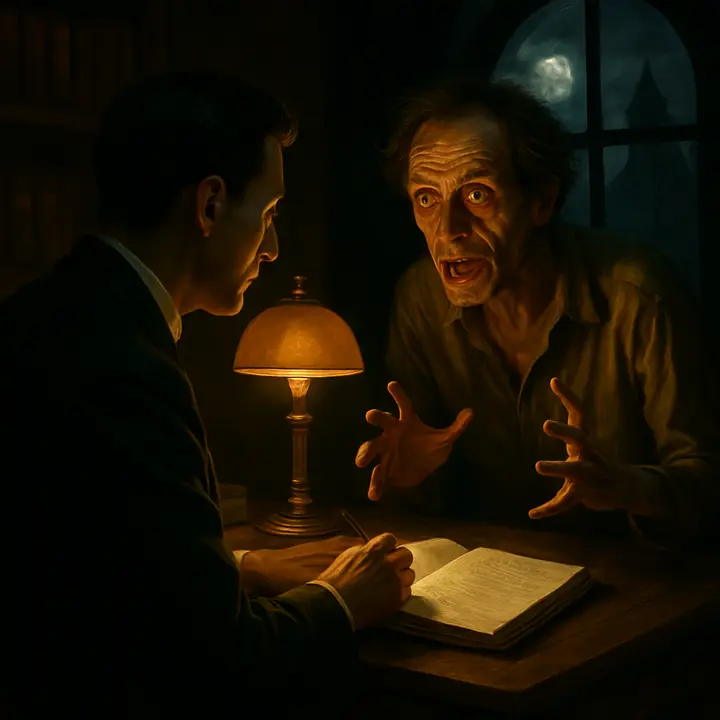
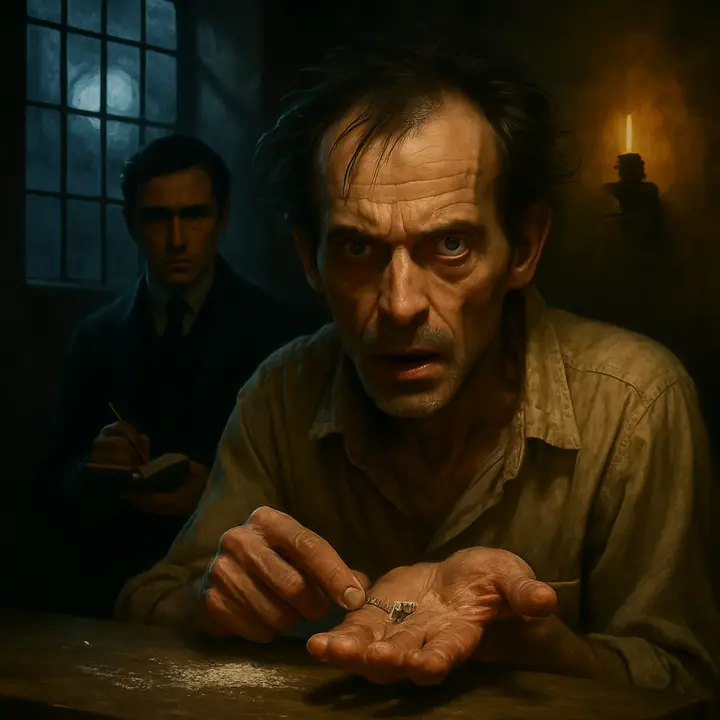
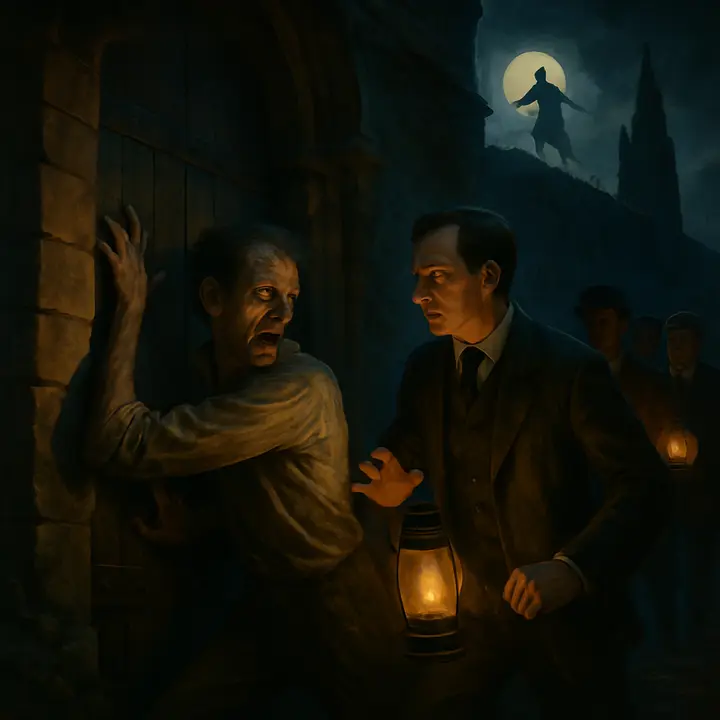
R. M. Renfield is a patient at Dr. Seward’s asylum driven by a zoophagous mania: he believes consuming life (flies, spiders, birds) transfers vitality to him. Seward studies and records Renfield’s escalating behaviour, noting phases of lucidity and violent frenzy that puzzle the doctors. Renfield’s seizures and outbursts correlate with remote events—he makes frantic escapes to Carfax grounds (Chapter 8), attacks Seward and laps up his blood (Chapter 11), and later is found brutally injured and delirious (Chapters 20–21). Under trephine operation delirium he describes Dracula’s appearance and admits the Count into his room (Chapter 21), giving the group direct evidence of an external vampiric force. Renfield repeatedly pleads to be released and speaks in lofty, sometimes courtly tones, alternated with childlike fear; his final collapse and death (found with broken neck bones after crying “God!” in Chapter 22) occur just as the hunting party prepares to act. Throughout, Renfield functions as a disturbed but crucial witness whose condition charts the proximity and violence of Dracula’s threat.
In the book: Renfield is a patient in Dr. Seward’s asylum whose “zoophagous” mania—his belief that consuming life passes vitality to him—makes him a disturbing foil to the novel’s themes of power and predation. His moods swing from meek lucidity to violent frenzy, and his behavior often serves as an eerie barometer of dark forces moving outside the asylum’s walls. Through his fixation on life-energy and his cryptic outbursts, he becomes a key figure whose actions and condition provide crucial hints that help the protagonists understand the nature of the threat they face.
Personality
- Obsessive
- Seward records Renfield’s steady escalation from catching flies to eating birds and his fixed idea that consuming life gives him vitality (Chapters 5 and 6).
- Mercurial
- Renfield alternates between polite, eloquent speech and sudden violent frenzy—Seward notes startlingly reasonable talk followed by attacks (Chapters 18 and 11).
- Suggestible
- During delirium after trephine surgery he narrates a vision in which Dracula appears and forces him to admit the Count into his room (Chapter 21).
- Being influenced
- Renfield’s violent outcries and physical collapses coincide with Dracula’s assaults on Mina and other nocturnal events, implying a direct link (Chapters 21–22).
- Prophetic
- His frantic escape to Carfax and demand to be released precede other sinister discoveries about the Count’s boxes and movements (Chapters 8 and 18).
Character arc
Renfield first appears as an object of clinical curiosity: Seward coins his condition "zoöphagous" and watches with professional interest (Chapter 5). Over time his behaviour escalates from insect-eating experiments to taming and consuming birds, prompting alarm and increasing intervention (Chapters 6–9). Periods of lucidity allow him to speak philosophically and even courtly, but these alternate with assaults—he stabs Seward and drinks his blood (Chapter 11)—showing his instability and dangerous potential. As the crisis mounts, Renfield exhibits extreme agitation: he begs to be freed and later is found brutally injured and delirious, requiring a trephine operation (Chapters 18–21). In delirium he provides eyewitness testimony of Dracula’s presence and his own subjugation to the Count (Chapter 21). Renfield’s arc ends in a tragic collapse and death—found with broken neck bones and having cried "God!"—just before the group fully confronts Dracula (Chapter 22). He moves from clinical curiosity to tragic, sacrificial informant whose ruin both foretells and helps precipitate the final assault.
Renfield in pictures
Relationships
- Dr. Seward Renfield is Seward’s patient; Seward studies, cares for, and records Renfield’s mania across many entries (Chapters 5, 11, 18, 21).
- Abraham Van Helsing Van Helsing observes Renfield’s behaviour, questions him, and interprets his delirious testimony as evidence of Dracula’s influence (Chapters 11, 21).
- Count Dracula Dracula exerts a controlling, violent influence over Renfield—Renfield describes the Count’s arrival and admits him into his room in delirium (Chapter 21).
- Mina Harker Renfield claims to have attempted to resist on Mina’s behalf and his final delirium relates directly to the attack on her (Chapter 21).
- Quincey Morris Quincey witnesses Renfield’s theatrical entreaties and later participates in the group actions that follow Renfield’s collapse (Chapter 18).
- Jonathan Harker Jonathan and the group consider Renfield’s reports and behaviour when planning their search for Dracula’s lairs and responding to attacks (Chapters 19–22).
Quotes by Renfield
“I don't want to talk to you: you don't count now; the Master is at hand.”
Chapter 8A sudden, ominous declaration signaling Renfield’s shift into religious mania and his fixation on an unseen ‘Master.’
“I am here to do Your bidding, Master. I am Your slave, and You will reward me, for I shall be faithful.”
Chapter 8Renfield addresses an unseen being in the Carfax chapel, intensifying the sense of a dangerous authority to which he submits.
“Now I can wait; now I can wait.”
Chapter 9Renfield murmurs this repeatedly during a spell of calm, prompting Seward to mark the odd periodicity of his behavior.
““The blood is the life! The blood is the life!””
Chapter 11Renfield repeats this while licking Seward’s blood after attacking him, linking obsession with blood to the novel’s medical and supernatural concerns.
“I don't want any souls!”
Chapter 20Renfield vehemently refuses the notion of possessing souls while professing a craving for 'life,' revealing his disturbed, paradoxical obsession.
“He came up to the window in the mist, as I had seen him often before; but he was solid then—not a ghost, and his eyes were fierce like a man's when angry.”
Chapter 21Renfield, after the operation, vividly describes Dracula entering by mist and the terrifying physical presence he believes he saw.
Why Renfield matters
Renfield embodies themes of predation, agency, and the porous boundary between victim and accomplice. His zoophagous compulsion literalises the novel’s metaphors of feeding and parasitism, and his alternating lucidity and frenzy dramatise how influence—psychic or supernatural—can erode reason and will. As a clinical case studied by Seward and Van Helsing, Renfield forces the rational characters to confront phenomena that exceed medical explanation, tightening the novel’s tension between scientific observation and folkloric horror. His eventual destruction underscores the human cost of Dracula’s predation and provides the protagonists with crucial, anguished testimony that propels their decisive actions.
Chapters with Renfield
More Dracula characters
 Jonathan HarkerProtagonist
 Mina HarkerMajor character
 Arthur HolmwoodMajor character
 Lucy WestenraMajor character
 Count DraculaAntagonist
 Abraham Van HelsingMajor character
 John SewardMajor character
 Quincey MorrisMajor character
All chapter summaries ›Characters ›
Read Dracula illustrated
Every scene in these notes comes from the Book2Life reader, where the full public-domain text is illustrated as you read, with character portraits and narration. Free in your browser and on iPhone.
