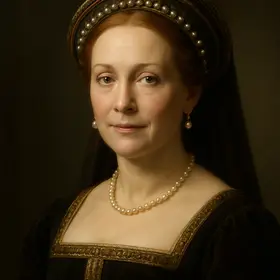
Gertrude in Hamlet
Major character
Queen of Denmark, Hamlet’s mother, recently married to Claudius and striving to maintain courtly stability.
Who is Gertrude?
Gertrude is the Queen of Denmark and Hamlet’s mother, newly married to Claudius after the former king’s death. She presents a warm, composed public face and urges Hamlet to abandon prolonged mourning and remain at court, trying to keep the household steady while courtiers watch her every move. Gertrude participates in court decisions—welcoming Rosencrantz and Guildenstern, hearing Polonius’s account of Hamlet’s madness, and attending the play—while privately enduring her son’s bitter reproaches. When Hamlet confronts her in her private chamber she is shocked by his violence and by Polonius’s death, and she reacts with genuine distress and vulnerability. In the final act she drinks from the poisoned cup meant for Hamlet and dies, unwittingly revealing the lethal stakes of the court’s plots. Throughout the play she acts to preserve appearances and the realm’s calm, even as she is caught between Claudius’s rulership and Hamlet’s escalating revolt.
In the book: We meet her as the Queen of Denmark and Hamlet’s mother, newly wed to King Claudius after the old king’s death. She’s warm and composed in public, urging Hamlet to put aside his mourning and stay close at court, trying to keep the household steady while everyone watches her every move.
Personality
- Diplomatic
- In Act 1 Scene 2 she balances public mourning and celebration while Claudius addresses diplomatic dispatches and domestic business.
- Composed
- She urges Hamlet to stay at court and put aside his mourning in Act 1 Scene 2, projecting steadiness before the court.
- Maternal
- She speaks with concern for Hamlet’s state and meets him privately in Act 3 Scene 4, showing worry and a desire to reconcile.
- Vulnerable
- She is visibly shocked and distraught when Hamlet stabs Polonius in her closet in Act 3 Scene 4.
- Unwittingly complicit
- Her hasty remarriage to Claudius—raised by Hamlet in his opening soliloquy in Act 1 Scene 2—places her at the center of his charge of corruption.
Character arc
Gertrude first appears as a public figure: composed, conciliatory, and intent on stabilizing the court after the old king’s death. Early she participates in counsel with Claudius and endorses measures to manage Hamlet’s behaviour, receiving reports from Polonius and welcoming Rosencrantz and Guildenstern in Act 2 Scene 2. As Hamlet’s actions escalate she continues to attempt calm—attending the play in Act 3 Scene 2 and responding with alarm when events turn dangerous. The closet scene (Act 3 Scene 4) marks a turning point: Hamlet violently confronts her, and Polonius’s murder in her chamber exposes her to personal crisis; she is shaken and grieving, forced to confront the immediate consequences of court intrigue. After reporting the murder to Claudius in Act 4 Scene 1 she aids the King’s attempts to manage the fallout and cares for Ophelia’s disturbed condition in Act 4 Scene 5, showing personal sorrow and royal duty. In the final scene she dies accidentally by drinking the poisoned cup meant for Hamlet, a tragic culmination that removes her from agency and underscores how her efforts to preserve the court fail to shield her from its fatal corruption.
Relationships
- Hamlet Her son, whose prolonged mourning and later violent confrontation deeply trouble her and expose familial conflict.
- Claudius Her new husband and the reigning king, whose rule she supports publicly though his guilt is the play’s hidden engine.
- Polonius A lord of the court who hides in her closet and is accidentally killed there during Hamlet’s confrontation with her.
- Ophelia A young courtier whom Gertrude observes with concern during Ophelia’s descent into disturbed behaviour.
- Rosencrantz One of the friends she helps summon with Claudius to watch Hamlet and report back on his condition.
- Horatio A trusted observer at court whom she encounters amid the play’s mounting crises and who later helps tell the story.
Quotes by Gertrude
“Mad as the sea and wind, when both contend Which is the mightier.”
Act 4, Scene 1Gertrude describes the extremity of Hamlet’s madness to Claudius, comparing it to violent natural forces.
“He weeps for what is done.”
Act 4, Scene 1Gertrude emphasizes Hamlet’s visible remorse after killing Polonius, complicating the picture of him as merely dangerous.
“The drink, the drink! O my dear Hamlet! The drink, the drink! I am poison’d.”
Act 5, Scene 2Gertrude suddenly declares she has been poisoned and dies, revealing the King’s treachery and accelerating the scene’s bloody revelations.
Why Gertrude matters
Gertrude embodies the tension between private family bonds and public duty. Her remarriage and attempts at courtly steadiness become focal points for Hamlet’s denunciations of corruption and inaction. She shows how personal choices—whether deliberate or pragmatic—have political consequences, and her vulnerability in the closet scene and accidental death reveal the tragic cost of a court riddled with secrecy and revenge. Gertrude’s presence highlights themes of appearance versus reality, the collapse of moral authority, and the tragic fallout when familial loyalty collides with political expedience.
Chapters with Gertrude
More Hamlet characters
 HamletProtagonist
 ClaudiusAntagonist
 PoloniusMajor character
 GuildensternMinor character
 HoratioMajor character
 RosencrantzMinor character
 LaertesMajor character
 OpheliaMajor character
All chapter summaries ›Characters ›
Read Hamlet illustrated
Every scene in these notes comes from the Book2Life reader, where the full public-domain text is illustrated as you read, with character portraits and narration. Free in your browser and on iPhone.
