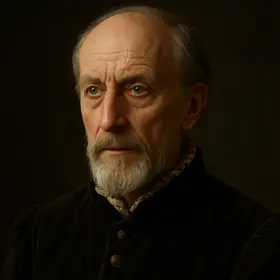
Polonius in Hamlet
Major character
Talkative chief counselor to King Claudius, meddling father who manages his children and court affairs with officious maxims.
Who is Polonius?
Polonius is the long-winded, politically minded chief counselor at Elsinore who prides himself on worldly wisdom and control. He wants to preserve order at court, protect his family’s reputation, and demonstrate his usefulness to the king. Polonius dispenses practical maxims to Laertes, orders Ophelia to cut off her intimacy with Hamlet, and conducts surveillance—sending Reynaldo to spy on Laertes and urging Ophelia to report Hamlet’s behavior. Convinced that Hamlet’s oddness stems from love for Ophelia, he reads Hamlet’s letters to Claudius and Gertrude and engineers an observed encounter to prove his theory. Polonius volunteers to hide in Gertrude’s room to eavesdrop on Hamlet’s private confrontation with the queen. His need to control events and prove his insight leads directly to his death when Hamlet, thinking a spy lies behind an arras, stabs and kills him. Throughout, Polonius behaves as a self-assured courtier whose talk and schemes bind family duty to statecraft.
In the book: When we first meet him at Elsinore, he’s the king’s talkative chief counselor—full of advice, maxims, and a habit of managing everyone around him. He dotes on his children, Laertes and Ophelia, laying down rules, sending messengers to keep tabs, and warning Ophelia to be careful with Prince Hamlet.
Personality
- Talkative
- Delivers a long set of maxims to Laertes in Act 1, Scene 3 and constantly explains his plans at court.
- Paternal
- Commands Ophelia to cut off contact with Hamlet and instructs Laertes on how to behave abroad in Act 1, Scene 3.
- Intrusive
- Sends Reynaldo to spread insinuations and pry into Laertes’s life in Act 2, Scene 1.
- Assuming
- Concludes Hamlet is mad from love after Ophelia describes Hamlet’s odd visit and reads Hamlet’s letters to the King in Act 2, Scene 2.
- Scheming
- Volunteers to hide behind the arras to overhear Hamlet’s talk with Gertrude in Act 3, Scene 3, hoping to gather proof for Claudius.
Character arc
Polonius appears initially as an authoritative, confident courtier who seeks to manage both family and state through counsel, surveillance and decisive commands. Early scenes show him doling out maxims to Laertes and giving strict orders to Ophelia, establishing his role as a controlling father and political fixer. As evidence accumulates—Ophelia’s report of Hamlet’s strange visit and the letters he reads—Polonius grows more certain of his diagnosis and more eager to validate it publicly, bringing his claims to Claudius and arranging staged encounters. His confidence culminates in a bold, personal act of eavesdropping: he hides in Gertrude’s chamber to catch Hamlet’s intentions. That choice, born of his need to prove and be useful, leads directly to his violent end when Hamlet kills the hidden figure. Polonius therefore moves from secure arbiter to a fatal casualty of the very intrigue he cultivates; his death exposes the limits and dangers of meddling and presumption at court.
Relationships
- Ophelia His daughter; he directs her relationships, forbids Hamlet’s visits, and uses her report to confirm his theory about Hamlet.
- Laertes His son; he gives Laertes extended practical advice and arranges spies to watch over him in France.
- Claudius King and political ally; Polonius advises Claudius, reads Hamlet’s letters to him, and helps devise schemes to manage Hamlet.
- Gertrude Queen and colleague at court; she consults with him about Hamlet and he hides in her closet to overhear Hamlet.
- Hamlet Prince whose behavior Polonius interprets as love-struck madness; Polonius’s schemes to expose Hamlet result in his own death.
- Rosencrantz Courtier who assists the king’s inquiries; Polonius works within the same network of surveillance that summons Rosencrantz to monitor Hamlet.
Quotes by Polonius
“Give thy thoughts no tongue, Nor any unproportion'd thought his act.”
Act 1, Scene 3Polonius’s opening rule to Laertes, urging restraint in speech and action as part of his list of practical precepts.
“This above all: to thine own self be true; And it must follow, as the night the day, Thou canst not then be false to any man.”
Act 1, Scene 3The pinnacle of Polonius’s advice to Laertes, presented as timeless wisdom about integrity and authenticity.
“Do not believe his vows; for they are brokers, Not of that dye which their investments show, But mere implorators of unholy suits, Breathing like sanctified and pious bawds, The better to beguile.”
Act 1, Scene 3Polonius warns Ophelia that Hamlet’s promises are deceptive tools aimed at entrapping her, framing love as a form of manipulation.
“Give him this money and these notes, Reynaldo.”
Act 2, Scene 1Polonius opens the scene by commissioning Reynaldo to carry funds and instructions to France; it sets up the episode of surveillance.
“This is the very ecstasy of love, Whose violent property fordoes itself,”
Act 2, Scene 1Polonius interprets Hamlet’s behaviour as romantic madness and uses Ophelia’s report to support his decision to inform the King.
“Therefore, since brevity is the soul of wit, And tediousness the limbs and outward flourishes, I will be brief. Your noble son is mad.”
Act 2, Scene 2Polonius announces his diagnosis of Hamlet’s madness while ironically indulging in long-windedness; the line highlights Polonius’s hypocrisy and the scene’s comic tension.
Why Polonius matters
Polonius embodies the play’s themes of appearance versus reality, surveillance, and the dangers of overreaching counsel. His reliance on maxims and secondhand information highlights how talk and interpretation can substitute for true understanding. By equating political usefulness with personal control—spying on his children and the prince—Polonius demonstrates how a court driven by rumor and manipulation dissolves into violence. His death is both comic and tragic: it punctures his self-importance and reveals how intrusive governance and familial coercion can produce ruin rather than protection.
Chapters with Polonius
More Hamlet characters
 HamletProtagonist
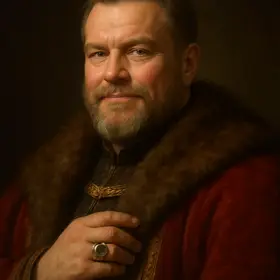 ClaudiusAntagonist
 GuildensternMinor character
 HoratioMajor character
 RosencrantzMinor character
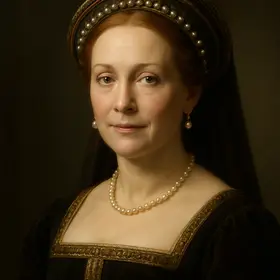 GertrudeMajor character
 LaertesMajor character
 OpheliaMajor character
All chapter summaries ›Characters ›
Read Hamlet illustrated
Every scene in these notes comes from the Book2Life reader, where the full public-domain text is illustrated as you read, with character portraits and narration. Free in your browser and on iPhone.
