
Gratiano in Othello
Minor character
A steady, well-born Venetian kinsman of Brabantio who appears as a measured presence and later as a witness to the play’s violence and judgment.
Who is Gratiano?
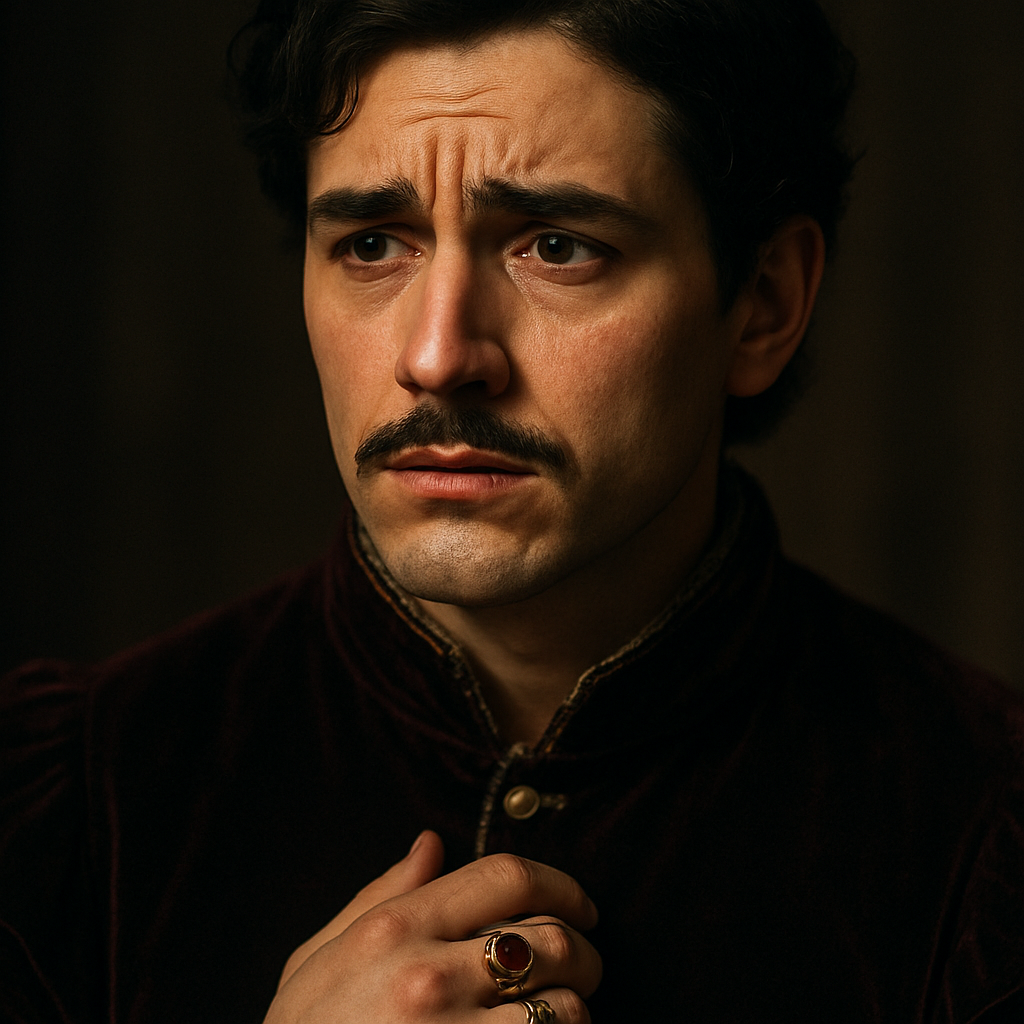
Gratiano is introduced as a sensible, composed relative of Brabantio and a member of Venice’s landed class. He arrives on official business and speaks with the calm confidence of someone used to council chambers. Throughout the recorded scenes he functions less as an instigator and more as an adult presence: he appears at the council when Othello’s marriage is heard, greets the party’s arrival in Cyprus, and returns in the island’s night to find a violent brawl. In the final act he is one of the men who come upon the murder scene in Desdemona’s bedchamber and stands with Lodovico to judge and report what has happened. Gratiano wants order and honest reporting; he acts as a practical, public-minded witness to events, lending credibility and social gravity when accusations, violence, and revelations occur around him.
In the book: We first meet Gratiano as a well-born Venetian who’s kin to Brabantio and arrives on official business, speaking with the calm confidence of someone used to council chambers. He’s the sensible, steady sort—more measured than hot-blooded—so when he steps in, it feels like an adult has entered the room.
Personality
- Measured
- In Act 1, Scene 1 he speaks with the calm confidence of someone used to council chambers, entering affairs like an adult authority.
- Steady
- He arrives on Cyprus after the brawl (Act 5, Scene 1) and remains a composed observer rather than a participant in the violence.
- Trustworthy witness
- He is present in Desdemona’s bedchamber (Act 5, Scene 2) among those who confront Iago and hear Emilia’s accusations, helping to corroborate events.
- Public-minded
- At the council (Act 1, Scene 3) his social standing and demeanor match the official business and concerns of the state.
Character arc
Gratiano’s role is largely stable: he begins as a sensible, well-born Venetian tied to Brabantio’s household and remains a composed, civic-minded presence through to the end. He does not undergo a profound personal transformation; rather, his trajectory is one of witness and social function. Early scenes establish him as the kind of adult who can be trusted in council and family matters; in Cyprus he appears with other officers and gentlemen, observing the garrison’s life and the consequences of disorder. When violence erupts in Act 5, Gratiano appears not as a catalyst but as part of the cleanup — arriving at the brawl’s aftermath and later at Desdemona’s bedchamber to hear Emilia’s revelations. By the final scene he stands with Lodovico as an official recorder and judge of what has occurred, moving from a background of civic steadiness to a public role in the tragic accounting of Othello’s crimes. His constancy highlights other characters’ moral collapse rather than changing himself.
Relationships
- Brabantio Kinsman; Gratiano is related to and arrives with Brabantio’s household authority in the opening scenes.
- Othello A respected military commander before whom Gratiano appears in council and whose actions Gratiano later helps to witness and judge.
- Lodovico Fellow Venetian officer and the man left with Gratiano to judge and report the tragic outcome in the final scene.
- Desdemona The woman whose death Gratiano witnesses; he is present when Emilia accuses Iago and when Othello confesses.
- Iago An antagonist whose machinations Gratiano observes indirectly and whose exposure Gratiano helps to witness at the end.
- Emilia A witness whose testimony Gratiano hears in Desdemona’s bedchamber, contributing to the unraveling of Iago’s plot.
Why Gratiano matters
Gratiano functions as a stabilizing, civic presence whose primary significance is to supply social credibility and witness. He contrasts with the manipulators (Iago) and the tragically unmoored (Othello) by embodying measured, public-minded authority. By appearing consistently in official or public moments — the council, the garrison, and the post-murder inquiry — he helps move the play from private jealousy to a public reckoning. His steady role underlines themes of reputation, judgment, and the need for communal testimony when private bonds break down.
Chapters with Gratiano
More Othello characters
 Othello
 Cassio
 Desdemona
 Iago
Iago Emilia
 Roderigo
 Lodovico
 Bianca
All chapter summaries ›Characters ›
Read Othello illustrated
Every scene in these notes comes from the Book2Life reader, where the full public-domain text is illustrated as you read, with character portraits and narration. Free in your browser and on iPhone.
